









![3D Explainer Video - ScribbleLive.mp4_snapshot_00.12_[2022.03.09_03.14.16]](https://increditors.com/wp-content/uploads/elementor/thumbs/3D-Explainer-Video-ScribbleLive.mp4_snapshot_00.12_2022.03.09_03.14.16-r7wb53mx72rxst3qcqyrfxdmeyzb5r9jbl0wbjujh4.png "3D Explainer Video – ScribbleLive.mp4_snapshot_00.12_[2022.03.09_03.14.16]")




























Increditors leads as the best video editing company for startups wanting premium, conversion-focused content with a genuine strategic layer. VideoEditingCompany is the strongest pick for B2B and SaaS teams on a dedicated retainer. Below: seven video editing companies reviewed honestly for startup teams from seed to Series B — with a full comparison table, a stage-by-stage buying guide, and the five questions every founder should ask before signing anything.
- Why Startups Need a Video Editing Partner (Not Just a Tool)
- How We Evaluated These Companies
- Best Video Editing Companies for Startups 2026 — Ranked
- Full Comparison Table
- Choosing by Startup Stage: Seed, Series A, Series B
- Red Flags When Evaluating Video Editing Companies
- Five Questions to Ask Before You Sign
- FAQ
- Verdict
Why Startups Need a Video Editing Partner (Not Just a Tool)
Every startup reaches the same crossroads: the pitch deck is done, the product works, and now you need to explain it to the world at scale. The instinct is to buy a subscription to a self-serve tool and handle editing in-house. The reality is that the companies growing fastest in 2026 are outsourcing post-production — not because they can’t learn Premiere Pro, but because their engineers, marketers, and founders have a higher-value use of their time.
The stakes for startups are different from those for established brands. A Fortune 500 can afford a mediocre product demo — brand equity carries it. A seed-stage SaaS company has perhaps 90 seconds and one impression to convince an investor or enterprise buyer that the product is real, the team is credible, and the category is worth betting on. That 90 seconds has to be edited by someone who understands both the craft and the commercial goal.
Published research from Wyzowl’s annual video marketing report consistently shows that the vast majority of marketers who use video report it provides positive ROI — and the pattern holds specifically for B2B software companies, where demo and explainer video quality correlates with conversion rates on pricing pages and outbound sequences. For startups operating with lean teams, outsourcing editing also eliminates the hidden cost of context-switching: a product marketer who spends four hours editing a video isn’t writing the email sequence or refining the landing page copy that drives pipeline.
That’s why fast-growing startups increasingly turn to a remote video editing agency — getting professional post-production output without adding headcount or managing the tool stack themselves.
The question isn’t whether to outsource. It’s which video editing company to trust with the content that represents your brand externally. That depends on your funding stage, volume needs, and whether you need creative direction or purely technical execution.
💡 Pro Tip: Before comparing companies, clarify your output type. A startup publishing LinkedIn thought-leadership clips has completely different needs from one producing SaaS product demos or onboarding tutorials. The best video editing company for your startup is the one that specialises in your format — not the one with the biggest brand.
How We Evaluated These Companies
This ranking is built from Increditors’ experience working alongside and competing against these providers, supplemented by a review of each company’s publicly available positioning, client case studies, and pricing pages. We evaluated every company on six criteria weighted specifically for startup contexts:
1. Startup-appropriate pricing model. Does the service structure work for teams that can’t commit to a 12-month retainer from day one? Is there a path to scale up without renegotiating the entire contract?
2. Turnaround speed. Startups move fast. A social campaign timed to a product launch can’t wait five business days for a revision. We weighted providers who deliver first cuts within 48 hours and revisions within 24.
3. Brand consistency. Early-stage startups are still building visual identity. A provider that rotates editors per project creates brand drift. Dedicated editor relationships or documented style guides matter here.
4. Strategic input. Can the team help you decide what to make, not just how to edit it? This separates execution vendors from genuine content partners.
5. Scalability. A company that works for a five-person team at seed stage needs to scale with you to Series B without requiring a full procurement process.
6. Format range. SaaS demos, investor pitch videos, LinkedIn clips, YouTube explainers, onboarding tutorials — the more formats a provider handles well, the fewer vendors you manage.
For deeper context on what separates good providers from great ones, our professional video editing buyer’s guide walks through the full evaluation framework with a vendor scorecard you can apply to any shortlist.
Best Video Editing Companies for Startups 2026 — Ranked
Seven providers reviewed and ranked. Each entry covers what the company does best, who it’s actually right for, and the honest trade-offs.
#1 Increditors — Best Overall for Brand-Building Startups
Increditors earns the top spot because it’s the only provider on this list that combines senior-level editing with an explicit content strategy layer. Most video editing services are execution-only: you send footage, they send back an edited file. Increditors operates differently — dedicated senior editors work within an account team that includes strategic input on format, pacing, and conversion angle. For startups, that distinction matters more than at any other company stage.
The client profile is Series A and above, though ambitious seed-stage companies with a clear content strategy also find the model effective. The typical engagement covers product demos, founder-led thought leadership, LinkedIn social clips, investor-facing video, and onboarding tutorials — the full stack of content a growing SaaS or tech startup needs from a single partner. Because the same editor stays on an account, brand consistency builds over time without constant style-guide policing.
Best for: Series A–B SaaS and tech startups that need premium, conversion-focused video and want a team that pushes back on weak briefs.
Pricing model: Agency retainer (custom; contact for a scoping call).
Turnaround: Typically 2–3 business days per video, revisions within 24 hours.
Format range: Product demos, founder video, social clips, explainers, onboarding, investor video.
Pros: Senior editors with genuine strategic input; dedicated team relationship; brand consistency across campaigns; startup-native understanding of SaaS and B2B content goals.
Cons: Premium agency pricing is the real constraint for pre-seed and early seed teams. If your video budget is sub-$1,000/month and you’re publishing fewer than two pieces per week, another option on this list may be a better fit until you scale. This is a long-term content partnership, not a one-off vendor.
Verdict: 9.5/10 for Series A+ startups. The strategic layer is what you can’t get elsewhere at this quality ceiling.
#2 VideoEditingCompany — Best B2B/SaaS Retainer Service
VideoEditingCompany is a premium B2B and SaaS-focused video editing service built around the dedicated retainer model. Where subscription platforms rotate editors or manage a queue, VideoEditingCompany assigns a dedicated team to each client account — meaning your editors learn your brand, your product, and your audience over time rather than starting cold on every project.
The positioning is firmly enterprise and mid-market B2B, making it most natural for Series A and Series B SaaS companies that are publishing product content at volume. If you’re at a stage where video production has become a core channel — not an experiment — and you need a reliable team rather than a marketplace, VideoEditingCompany is worth a detailed conversation.
Best for: SaaS and B2B startups from Series A+ that need a dedicated editing team on a retainer structure.
Pricing model: Retainer tiers (contact for pricing).
Format range: SaaS demos, explainers, social video, webinar repurposing.
Pros: Dedicated team model; B2B/SaaS niche expertise; enterprise-grade reliability.
Cons: Premium tier; less suited to one-off or low-volume projects; onboarding is more involved than subscription services.
Verdict: 8.5/10 for B2B SaaS startups specifically. The dedicated team structure delivers better brand consistency than most subscription alternatives.
#3 Edit Crew — Best Subscription Service for High-Volume Seed Teams
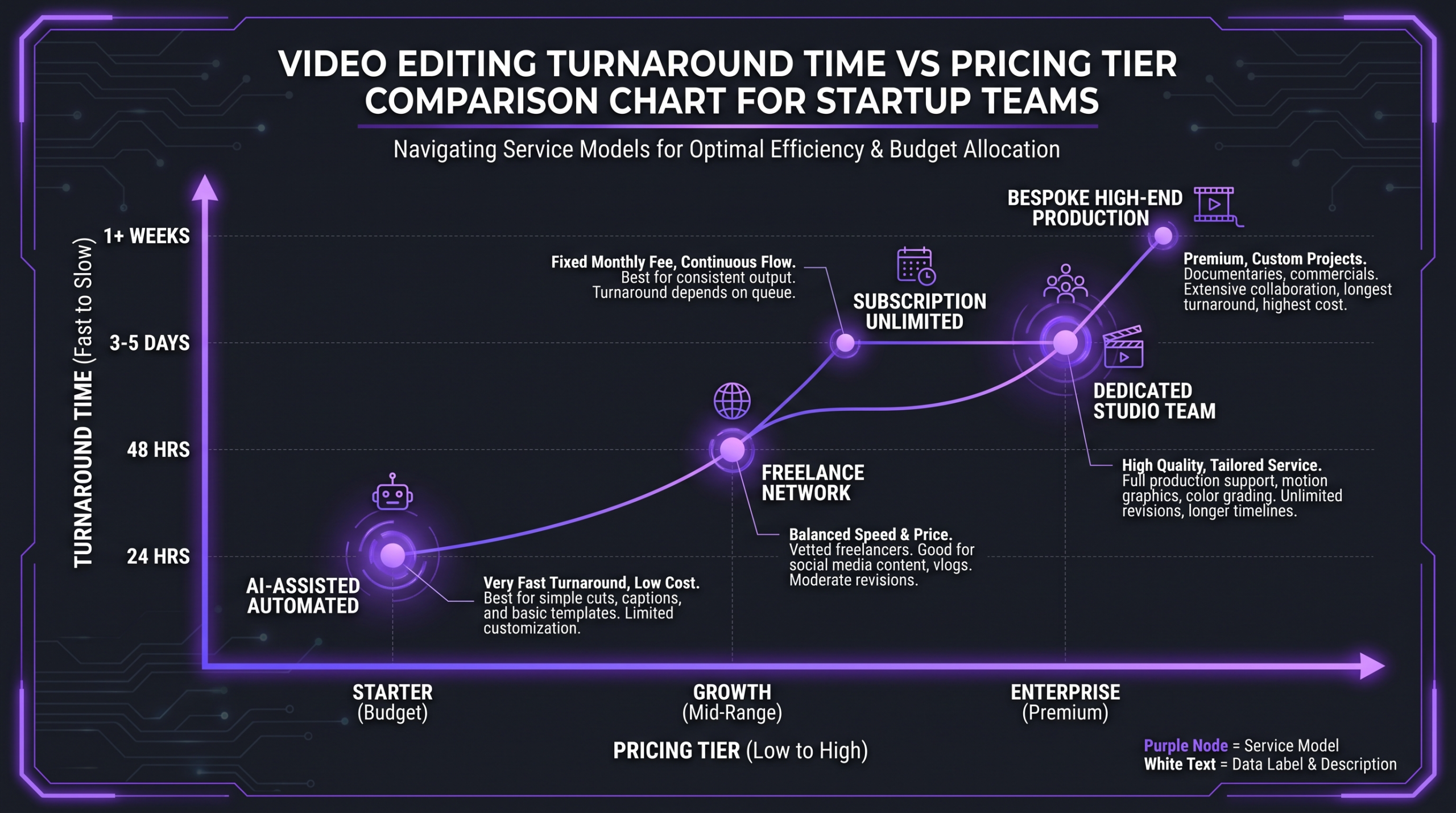
Edit Crew operates on an unlimited subscription model: one monthly fee, one active request at a time, unlimited total deliverables across the billing cycle. For seed-stage startups publishing content at high cadence — social clips, short product updates, internal training videos — the economics are compelling. The predictable monthly cost eliminates the per-video negotiation that drains time at early stage.
Best for: Seed and pre-Series-A startups with a high volume of shorter-form content needs.
Pricing model: Monthly subscription; plans typically start in the $499–$799 range (check their current pricing page for live rates).
Turnaround: First cuts typically within 48–72 hours per request.
Format range: Social clips, short-form, YouTube content, basic explainers.
Pros: Predictable monthly cost; no per-project negotiation; good for teams that are still figuring out their content mix.
Cons: Limited strategic input; editor consistency varies; one-request-at-a-time structure can create bottlenecks during launch weeks.
Verdict: 7.5/10 for early-stage startups. Solid for volume, but you’ll hit the ceiling when brand sophistication starts to matter.
#4 Tasty Edits — Best for YouTube and Social-First Startups
Tasty Edits is a subscription video editing service built around YouTube and social content workflows. The team understands the pacing, retention mechanics, and thumbnail-to-click relationship that drives YouTube growth — knowledge that’s genuinely useful for startups using YouTube as a top-of-funnel channel. According to Think with Google research, YouTube reaches more adults in key demo brackets than linear TV, which makes it a credible distribution channel even for B2B brands.
Best for: Startups building a YouTube or social video presence as a primary marketing channel.
Pricing model: Subscription; plans typically start around $299/month (verify current rates on their site).
Turnaround: 24–48 hours on most content types.
Format range: YouTube long-form, social clips, Reels/Shorts.
Pros: Fast turnaround; platform-native expertise for YouTube; accessible entry price.
Cons: Less suited to polished brand or product demos; narrower format range than full-service agencies.
Verdict: 7/10 for the right use case. Strong if YouTube is a growth lever; limited if your primary need is product demos or investor-grade content.
#5 Vidchops — Best Budget Entry Point for Pre-Seed Teams
Vidchops targets the most budget-sensitive tier of the market with an unlimited subscription model at a lower price point than most competitors. For pre-seed startups that are still validating content strategy and need editing capacity without a large commitment, it provides an accessible entry point.
Best for: Pre-seed and early seed startups with tight video budgets who need basic editing for social and YouTube.
Pricing model: Unlimited subscription; entry plans typically under $500/month (verify current pricing).
Turnaround: Typically 24–72 hours per request.
Pros: Affordable starting point; no long-term commitment; predictable cost structure.
Cons: Quality ceiling is lower than agency or dedicated-editor services; style consistency varies across projects; limited strategic input.
Verdict: 6.5/10. A practical placeholder for founders who need some editing capacity while still figuring out their video strategy. Plan to graduate to a more capable provider at Series A.
#6 Shootsta — Best for In-House Filming Teams
Shootsta takes a different approach: it’s a video production platform that provides a filming kit (camera, lighting, teleprompter) plus a cloud-based editing service. You shoot your own footage using their guided workflow, upload to the platform, and trained editors turn it around. For startups with team members willing to operate the kit, it can deliver polished output without the cost of an on-site crew.
Best for: Startups with a team member who can manage filming and wants professional post-production without a full crew.
Pricing model: Platform subscription plus editing tiers (enterprise-oriented pricing).
Format range: Company news, product updates, internal comms, thought leadership.
Pros: Self-serve production model; polished output without hiring a crew; platform infrastructure.
Cons: Upfront investment in the filming kit and learning curve; not suitable for startups that don’t want to handle filming; higher total cost than pure editing services.
Verdict: 7/10 for the specific use case of teams that can handle filming themselves. Wrong fit if you’re outsourcing the whole process.
#7 Vidpros — Best Dedicated Editor Subscription
Vidpros offers a dedicated editor model on a monthly subscription: each client is paired with one editor who learns the brand’s style over time. It sits between the unlimited subscription services (less consistency) and full agency retainers (higher cost and commitment). For startups that have moved past the experimental phase and want style consistency without an agency price tag, the dedicated editor format is a meaningful upgrade.
Best for: Series A startups with a defined content style who want a consistent editor at a predictable cost.
Pricing model: Monthly subscription; plans typically start around $895/month (verify current pricing).
Turnaround: Typically 1–2 business days.
Pros: Dedicated editor = style consistency; monthly commitment only; better brand continuity than pool-based subscription services.
Cons: Higher price than unlimited services without the strategic layer of an agency; coverage when your editor is unavailable can be inconsistent.
Verdict: 7.5/10. A solid middle option for startups that have outgrown unlimited subscription services but aren’t ready for a full agency engagement.
Full Comparison Table
A complete side-by-side of all seven companies across the criteria that matter most for startup teams. Pricing ranges are indicative and based on publicly available positioning; always verify current rates directly with each provider.
Pricing ranges are indicative based on publicly available positioning as of mid-2026. Verify current rates directly with each provider before budgeting.
For a broader view of what agencies at different tiers are charging in 2026, our 2026 video editing pricing survey covers 30 agencies across model types with real rate benchmarks.
Choosing by Startup Stage: Seed, Series A, Series B
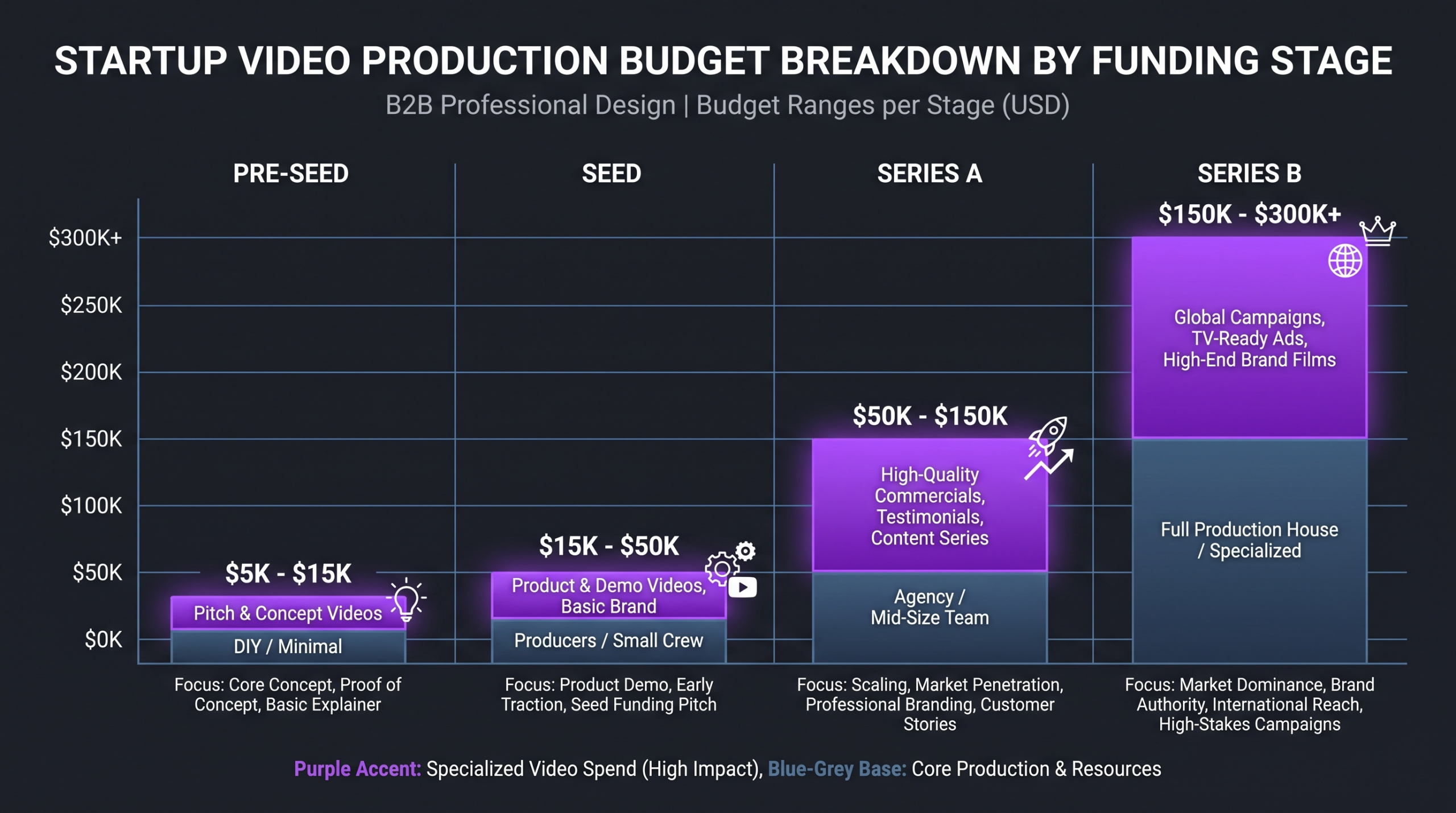
The right video editing company for a startup depends as much on your funding stage as it does on your content needs. Each stage comes with different budget realities, content priorities, and tolerance for vendor switching costs.
Pre-Seed and Seed Stage: Bias Toward Flexibility
At seed stage, you’re still testing content formats and distribution channels. Locking into a 12-month agency retainer is premature — you don’t know yet whether YouTube, LinkedIn, or email-embedded video will be your strongest channel. The right move is a subscription service with monthly commitment that gives you editing capacity without over-investing before you have validated distribution.
Vidchops or Tasty Edits work well here as starting points. Edit Crew is a step up if you’re already publishing a clear mix of formats. Budget guidance for seed teams: plan for video editing to consume 10–15% of your marketing budget, and keep contracts month-to-month until you know which channels return pipeline.
One practical note: even at seed stage, resist the impulse to make your product demo look “scrappy and authentic.” Investors and enterprise buyers associate video production quality with product quality — a direct relationship that startup founders consistently underestimate. If you’re going to invest in one high-quality video, make it the product demo.
Series A: Invest in Consistency and Volume
Series A is where video editing becomes a real line item and brand consistency starts to compound. You’re no longer experimenting — you’re publishing. The content team is probably two or three people, and the question shifts from “can we afford professional editing” to “can we afford not to have it?”
At this stage, Vidpros (dedicated editor) or a move toward VideoEditingCompany (retainer team) makes sense. Startups with a genuine content marketing motion — publishing three or more videos per week across YouTube, LinkedIn, and product channels — often find that this is where Increditors starts to pay back the premium: the strategic input means less creative back-and-forth and more published content that actually performs.
According to data published by Sprout Social, video consistently outperforms static content for engagement across LinkedIn and other B2B-relevant platforms — which raises the stakes for quality at exactly the point when Series A companies are scaling their social presence.
💡 Series A Tip: At this stage, also consider the hidden cost of editor churn in subscription services. Every time a new editor picks up your account, you’re re-teaching brand guidelines, tone, and product terminology. Dedicated relationships — whether via a Vidpros-style subscription or an agency — eliminate this compounding tax.
Series B: Treat Video as Infrastructure
By Series B, video is infrastructure — not a nice-to-have. You have a content team, a defined channel strategy, and video appearing at every stage of the funnel: top-of-funnel YouTube and LinkedIn, mid-funnel product demos and webinar replays, bottom-funnel case studies and onboarding tutorials. The company that manages your editing needs to handle that full stack reliably, at scale, without a quality cliff between formats.
Increditors or VideoEditingCompany are the natural choices here. The economics of premium agency pricing become easier to justify when you calculate cost-per-output across a full month of publishing — and the strategic input prevents the content drift that affects high-volume publishing operations when there’s no editorial anchor.
Our full guide to video editing for SaaS companies covers the end-to-end content strategy for growth-stage businesses, including how to build a production workflow that scales without constant vendor renegotiation.
Red Flags When Evaluating Video Editing Companies
The proposal stage is where most startup teams make their mistakes. A smooth sales deck and a demo reel can obscure operational realities that only surface after the contract is signed. These are the signals that consistently predict a difficult engagement:
1. No visibility into who edits your content. If the company can’t tell you whether you’ll have a dedicated editor or work from a shared queue, you’re taking a risk on consistency. For startups building brand equity, rotating editors is a silent quality killer.
2. Revision policies written to limit, not serve. Read the fine print. “Unlimited revisions” often means unlimited within a narrow scope — not unlimited re-edits when the creative direction wasn’t right. Startups need genuine creative flexibility, especially in the early months of a new relationship.
3. Portfolio that doesn’t match your category. A company with a gorgeous reel of lifestyle brand videos is not necessarily equipped to edit a SaaS product demo that has to communicate a complex workflow in 90 seconds. Ask to see work from companies in your industry, not just their best creative showcase.
4. No onboarding process. Professional editing services at the retainer tier should have a structured onboarding — brand guide review, style reference collection, communication protocol, revision workflow. If the answer to “what does onboarding look like?” is vague, that vagueness carries into every project.
5. Turnaround promises that don’t account for complexity. “24 hours” sounds compelling until you realise it applies to a 30-second clip with no graphics. Ask specifically: how long for a 3-minute SaaS demo with motion graphics and captions? A provider with operational reality will give you an honest range, not a marketing number.
For a complete breakdown of what professional video editing actually costs across service tiers, see our guide to video editing pricing — including the hidden costs that subscription services don’t advertise upfront.
Five Questions to Ask Before You Sign
These questions separate vendors who have a clear operational answer from those who are improvising. Use them in the final stage of evaluation, not as an opening gambit — they work best when you’ve already seen the portfolio and know you’re interested.
FAQ: Video Editing Companies for Startups
What’s the best video editing company for an early-stage startup on a tight budget?
For pre-seed and early seed teams with limited budgets, Vidchops or Tasty Edits provide the most accessible entry points — both offer subscription models with monthly commitments under $500, which keeps risk low while you validate your content strategy. As you scale past seed and your content needs become more complex, plan to move to a dedicated-editor service or agency.
How much should a startup budget for video editing?
Industry benchmarks suggest allocating 10–20% of your total marketing budget to video production and editing combined. For seed-stage companies with a $20,000 monthly marketing budget, that’s roughly $2,000–$4,000 for video — enough for a subscription service plus occasional one-off projects. At Series A with a larger budget, the math shifts toward an agency retainer that delivers higher output quality and doesn’t require managing multiple vendors. For detailed market ranges, see our professional video editing cost guide.
Is it better to hire an in-house editor or use a video editing company?
For most startups below Series B, outsourcing wins on economics and flexibility. A full-time senior editor costs significantly more annually than a professional agency retainer — and an employee comes without the team infrastructure (motion designers, colorists, sound engineers) that a good agency brings. In-house hiring makes sense when your video volume is so high that an external team creates a bottleneck, or when your content is so proprietary that security considerations outweigh cost efficiency.
Do video editing companies help with content strategy, or just execution?
Most subscription services are execution-only: you brief them, they edit. Agency-tier providers like Increditors operate with an explicit strategy layer — which means you’re working with a team that can help you decide what to make, not just how to edit it. For startups without a dedicated content strategist, this distinction is significant: execution-only vendors multiply your output, but strategy-inclusive teams improve the quality of decisions driving that output.
How important is video quality for startup investor relations?
More important than most founders assume. A 2-minute product demo sent alongside an investor deck is often the first hands-on experience a partner has with the product. Production quality — pacing, motion graphics, audio clarity — signals operational maturity in the same way a well-designed pitch deck does. According to HubSpot’s State of Marketing research, video is the media format with the highest reported ROI across B2B channels. Investor-grade video doesn’t require a Hollywood budget, but it does require professional post-production.
Verdict: Which Video Editing Company Is Right for Your Startup?
There’s no single answer that fits every startup — but there’s a clear framework for choosing.
If you’re pre-seed or early seed and still testing content channels: Vidchops or Tasty Edits give you editing capacity without over-committing budget. Keep contracts monthly and be ready to switch when you find your channel.
If you’re seed to pre-Series A with clear format needs and growing volume: Edit Crew or Vidpros offer the right step up — more consistency than entry subscription services, without the full agency price point.
If you’re Series A or Series B with a content motion already running and brand equity to protect: Increditors is the strongest overall choice, combining senior-level editing with a genuine strategic layer that saves you the creative back-and-forth that erodes productivity at scale. VideoEditingCompany is the right alternative if a dedicated team retainer structure better fits your procurement process.
Whatever your stage, the common mistake is staying with an entry-level subscription service past the point where it stops serving you — letting inertia substitute for a deliberate sourcing decision. The companies that build strong video brands make the upgrade before they need it, not after content quality has already become a visible gap in their market presence.
Ready for Video That Actually Converts?
Tell us about your project and we will put together a custom plan.