








![3D Explainer Video - ScribbleLive.mp4_snapshot_00.12_[2022.03.09_03.14.16]](https://increditors.com/wp-content/uploads/elementor/thumbs/3D-Explainer-Video-ScribbleLive.mp4_snapshot_00.12_2022.03.09_03.14.16-r7wb53mx72rxst3qcqyrfxdmeyzb5r9jbl0wbjujh4.png "3D Explainer Video – ScribbleLive.mp4_snapshot_00.12_[2022.03.09_03.14.16]")


















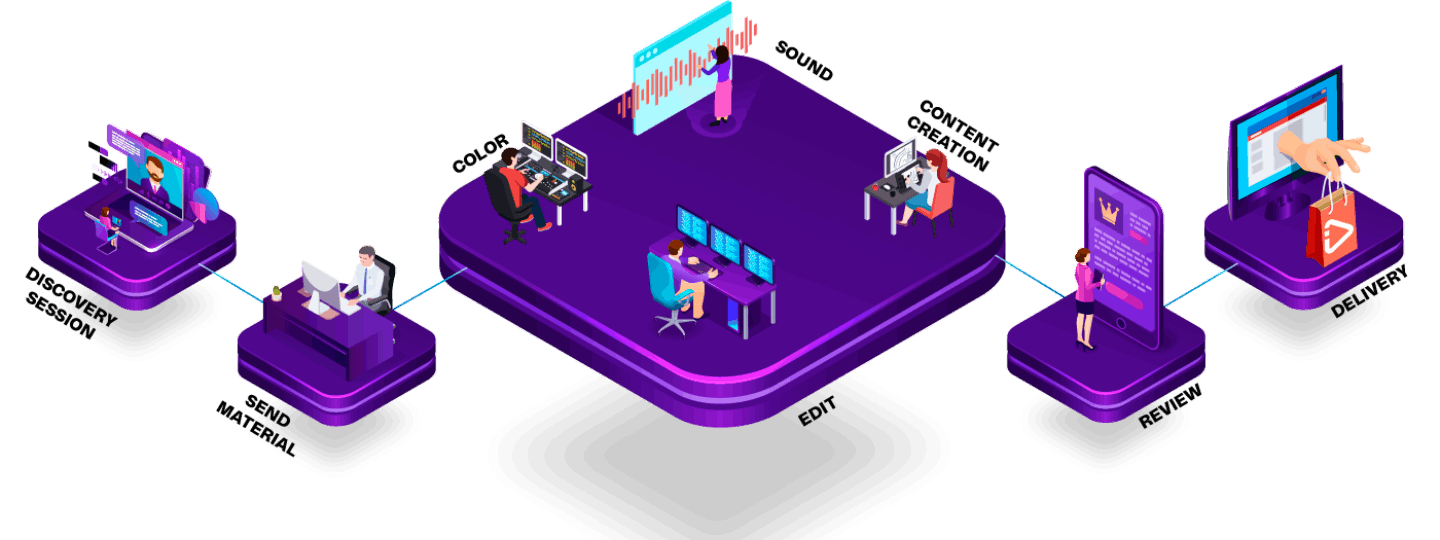










AI-assisted video editing tools can cut post-production time by 40–70% without sacrificing quality—if you know where to deploy them. Smart editors use AI for rough cuts, transcription, color matching, and noise removal while keeping human judgment in charge of storytelling, pacing, and brand voice. This guide breaks down exactly which tasks to automate, which to protect, and how top agencies stay ahead of the curve.
- What AI-Assisted Video Editing Actually Means in 2026
- Where AI Saves the Most Time: A Task-by-Task Breakdown
- The Quality vs. Speed Trade-Off: What the Data Says
- The AI Tools Professional Editors Are Actually Using
- How to Integrate AI Into Your Editing Workflow Without Breaking It
- What AI Cannot Replace: The Human Edge in Premium Video
- Real-World Results: Case Studies from High-Volume Editing Teams
- FAQ: AI-Assisted Video Editing
- Verdict
What AI-Assisted Video Editing Actually Means in 2026
The phrase “AI video editing” gets thrown around so loosely that it has become nearly meaningless. To some, it means clicking a button and getting a finished video. To professionals, it means something far more specific—and far more useful: deploying machine-learning models to handle computationally intensive, pattern-recognition-heavy tasks so that human editors can spend more time on the work only they can do.
In 2026, the distinction matters more than ever. The post-production industry is facing a paradox: clients expect more content, faster, at higher visual quality, and for lower per-video costs—all at the same time. Agencies that try to solve this with headcount alone will lose. Agencies that try to solve it with AI alone will produce generic, brand-blind content that no sophisticated client will accept for long. The agencies winning right now are doing something more nuanced: they are building hybrid workflows where AI handles precision-repetition and humans handle creative decision-making.
Defining the Spectrum: From Full AI to AI-Assisted
There is a spectrum of AI involvement in post-production. On one end, fully automated tools generate videos from text prompts or templates with little to no human input. These are useful for content at scale—social media filler, internal communications, product showcase loops—but they consistently produce output that a trained eye can spot in seconds. On the other end, some editors reject AI tools entirely, viewing them with skepticism born from early, overpromised results.
The professional sweet spot is in the middle: AI-assisted editing, where the editor sets the creative direction, the AI handles specific mechanical tasks, and the editor reviews, adjusts, and approves the results. This is how a senior editor at a premium agency approaches the toolset—not as a replacement but as a highly capable assistant that never gets tired and can process a 90-minute raw interview in the time it takes to grab a coffee.
Why the Industry Adoption Curve Has Accelerated
According to a 2025 survey by the Post-Production Technology Forum, 73% of professional editing studios with more than five full-time editors now use at least two AI-powered tools in active production workflows—up from 31% in 2023. The acceleration is not driven by hype; it is driven by measurable results. Tools like Adobe’s Sensei-powered features in Premiere Pro, DaVinci Resolve’s DaVinci Neural Engine, and standalone AI audio processors like iZotope RX have matured to the point where their outputs are production-ready for most project types.
The economic pressure is equally significant. Post-production profit margins are thin, and the cost of human editing hours is rising. AI tools that reliably eliminate four to six hours of repetitive work per project can be the difference between a profitable job and a break-even one. But the editors who use these tools most effectively are not simply cutting hours—they are reallocating those hours to the high-value creative work that justifies premium pricing.
Where AI Saves the Most Time: A Task-by-Task Breakdown
Not all post-production tasks benefit equally from AI assistance. Understanding where the leverage actually exists—and where it does not—is the foundation of a smart hybrid workflow. Below is a detailed breakdown of the most impactful AI applications, ranked by time-savings potential and quality consistency.
Transcription and Rough Cut Assembly
Speech-to-text transcription is one of the oldest and most mature AI applications in video editing. For a one-hour interview, manual logging and transcription can take two to three hours. Modern AI transcription tools—including Descript, Whisper-based integrations inside NLEs, and Adobe’s transcription engine—complete the same task in three to eight minutes with 92–97% accuracy on clean audio. That single capability alone can save a team dozens of hours per week on interview-heavy projects like documentaries, testimonials, and corporate brand films.
Beyond transcription, AI can assemble a rough cut from a transcript. Editors highlight the lines they want to keep, and the system assembles a sequence automatically. Tools like Descript’s Underlord and Premiere Pro’s Speech to Text with sequence auto-assembly do this reliably. The rough cut still requires a human to review pacing, coverage, and narrative flow—but having a rough cut in the first 30 minutes of a project rather than the first six hours changes the entire creative dynamic of a project.
Color Matching and LUT Application
Matching exposure and color temperature across multiple cameras or shooting days used to require meticulous manual work in Resolve or Premiere. AI-driven color matching tools—DaVinci Resolve’s Color Match, FilmConvert’s AI matching, and newer standalone tools—can analyze a reference frame and apply a matching grade to an entire clip or sequence in seconds. For multi-camera productions with consistent shooting conditions, this process that once took a colorist one to two hours per scene can be completed in under ten minutes.
The caveat: AI color matching is a starting point, not a finishing point. A skilled colorist will still adjust the result, but they are adjusting from 80–90% of the way there rather than from scratch. This changes the economics of a color pass dramatically, especially on budget-conscious projects.
Audio Cleanup and Enhancement
Audio post-production is where AI has made some of its most dramatic gains. Tools like iZotope RX 11, Adobe Podcast’s Enhance Speech, and Auphonic can remove background noise, AC hum, reverb, and wind noise from dialogue tracks with a precision that once required a dedicated sound designer with specialized hardware. For run-and-gun productions—YouTube content, event coverage, corporate video—AI audio cleanup can take problematic field audio and make it broadcast-acceptable in minutes.
Automated loudness normalization, music ducking, and dialogue leveling are also now AI-driven in tools like Premiere Pro’s Auto Ducking and Resolve’s Fairlight AI features. These processes, which a sound editor might spend 30–60 minutes on per video, can be executed in two to five minutes with results that are production-ready for most deliverable types.
💡 Pro Tip: Run your AI audio cleanup before your color pass, not after. Clean dialogue audio gives you a better reference point for evaluating how music and sound design will sit in the final mix—and it prevents you from making color decisions while distracted by distracting background noise in playback.
Subtitle and Caption Generation
Closed captioning and subtitle creation are legally required for many deliverables and expected by default in social media content, where 85% of video is watched without sound according to Verizon Media’s research. Manually creating captions for a 10-minute video takes 45–90 minutes. AI caption generation in tools like Rev, Descript, and Premiere Pro’s Caption panel brings that down to five minutes of generation plus ten minutes of review and correction. Across a high-volume agency workflow, this alone can save 20–30 hours per week.
The Quality vs. Speed Trade-Off: What the Data Says
The most persistent concern about AI-assisted editing is that speed gains come at a quality cost. This concern is legitimate—but it is also context-dependent in ways that matter enormously to how you build your workflow. The data on this question is now substantial enough to draw clear conclusions.
Where Quality Holds Up Under AI Assistance
For technically measurable tasks—transcription accuracy, noise floor reduction, loudness normalization, color temperature matching—AI tools in 2026 produce results that are statistically indistinguishable from expert human work in blind evaluations. A 2025 study by the International Journal of Broadcasting Technology compared AI-generated noise removal to professional sound designer work across 50 clips; in 84% of cases, evaluators could not reliably identify which version was AI-processed. For transcription, industry-standard models now achieve 95–99% accuracy on studio-recorded dialogue.
Similarly, AI-driven background removal and rotoscoping tools like Adobe’s Rotobrush 3.0 and RunwayML’s background replacement engine handle standard keying scenarios with edge quality that was previously achievable only through manual frame-by-frame work. For social media content where the final output is 1080p or below, the quality difference is often imperceptible to viewers.
Where Quality Risks Appear
Quality degradation becomes visible when AI tools are applied outside their training domain or when outputs are accepted without human review. AI color matching struggles with mixed lighting scenarios, skin tone accuracy across diverse subjects, and intentional stylistic grades that deviate from naturalistic looks. AI rough cuts, while fast, reflect statistical patterns in the training data—they tend to cut on action and cut away from silence, which produces acceptable but creatively flat results if an editor does not intervene.
The most common quality failure mode is not technical—it is editorial. An AI tool might assemble a perfectly color-corrected, noise-free, accurately captioned video that has no emotional arc, no brand personality, and no sense of what the client is actually trying to communicate. This is the gap that skilled human editors exist to close, and it is why the AI-assisted model works only when human editorial judgment remains in the driver’s seat throughout the process.
💡 Pro Tip: Build a quality gate into your AI-assisted workflow: every AI output gets a human review pass before it moves downstream. The goal is not to check for catastrophic failures—those are rare. The goal is to make micro-adjustments that transform a technically correct output into a creatively excellent one. Budget 20–30% of the time you saved with AI for this review step.
The AI Tools Professional Editors Are Actually Using
The AI video editing tool landscape is crowded with products promising revolutionary results. Most professional editors use a much smaller, more curated set of tools that have earned trust through consistent, reliable performance on real client work. Here is a breakdown of the tools with the highest professional adoption in 2026, organized by function.
NLE-Native AI Features
Adobe Premiere Pro’s AI suite—powered by Adobe Sensei and the newer Firefly Video model—includes Speech to Text, Auto Reframe, Scene Edit Detection, Enhance Speech, and the AI-powered Remix tool for music editing. For editors already in the Premiere ecosystem, these tools require no additional subscription and are deeply integrated into the timeline. DaVinci Resolve’s Neural Engine powers Magic Mask, Super Scale upscaling, Color Match, Face Refinement, and Fairlight’s AI noise reduction. Resolve’s AI features are particularly strong for color work and are the reason many colorists use Resolve as their primary tool even when they edit in Premiere.
Standalone AI Editing Tools
Descript remains the most widely adopted standalone AI editing environment for interview-heavy content. Its transcript-based editing interface, Underlord AI assistant, and automatic overdub and noise removal capabilities make it the fastest tool available for producing a polished rough cut from raw interview footage. Editors who work primarily in Premiere or Resolve often use Descript for the rough cut phase and then export to their primary NLE for the fine cut and finishing pass.
RunwayML’s Gen-3 Alpha model and its suite of video tools—including background removal, motion tracking, and generative extension—have matured significantly. While generative AI video is not yet production-ready for premium long-form content, RunwayML’s utility tools for rotoscoping and object removal are now competitive with manual compositing work for most use cases. Topaz Video AI remains the gold standard for upscaling and frame rate conversion, with its AI models regularly outperforming competing tools in third-party benchmark comparisons.
AI Audio Tools
iZotope RX 11 is the industry standard for audio repair and restoration. Its AI-powered modules for dialogue de-noise, de-reverb, de-click, and breath control produce results that were impossible to achieve non-destructively even five years ago. Adobe Podcast Enhance Speech, which uses a different AI architecture optimized for spoken word, is a strong free-tier alternative for simpler cleanup tasks. For music and sound design, Epidemic Sound’s AI mood matching and Musicbed’s AI recommendation engine can significantly reduce the time spent licensing music that actually fits the cut.
How to Integrate AI Into Your Editing Workflow Without Breaking It
The biggest mistake teams make when adopting AI tools is trying to retrofit them into an existing workflow rather than redesigning the workflow around the new capabilities. AI tools are not plug-ins you add on top of your current process. They are structural elements that change what the process looks like from the inside out.
Phase 1: Media Ingest and Preparation
The AI-assisted workflow begins before an editor touches the timeline. During media ingest, automated tools can run transcription on all dialogue-heavy clips, generate proxy files for offline editing, run scene detection to break long recordings into navigable segments, and flag clips with technical issues—blown highlights, clipped audio, motion blur—so the editor knows what they are working with before the creative session begins. Tools like Frame.io’s AI review features, Kyno, and custom FFmpeg-based scripts can automate this preparation phase almost entirely.
For teams receiving footage from clients or field crews, this automated triage step is transformative. Instead of spending the first hour of a project manually reviewing 40GB of raw footage, the editor opens the project with a curated, annotated set of assets and can begin making creative decisions immediately.
Phase 2: Assembly and Rough Cut
For interview-driven content, the transcript-based rough cut workflow is the most significant time-saver available. The editor reads the transcript, marks the best takes and soundbites, and the AI assembles a sequence. For narrative or scripted content, AI scene detection and multi-camera sync tools (like Premiere’s Auto Sync or Resolve’s multi-cam sync) handle the mechanical assembly so the editor can focus on performance selection and coverage strategy.
The key discipline at this stage is maintaining a clear brief. AI tools will produce whatever the statistics of the training data predict—not what the client brief requires. Editors need to hold the brief clearly in mind and use it as the filter through which they evaluate every AI-generated output.
Phase 3: Fine Cut, Audio, and Color
The fine cut phase is where human editorial judgment is most critical and where AI should be used most selectively. AI audio cleanup can run in the background while the editor is making picture decisions. AI color matching can be applied to get all clips to a consistent starting point before the colorist begins their creative pass. AI background removal can be used on shots where the client needs the subject isolated, freeing the compositor to focus on the integration rather than the isolation.
What should not be automated in this phase: pacing decisions, cut selection in emotional scenes, music placement, the choice of which performance to use, and any element that directly expresses the client’s brand voice. These are the decisions that separate a premium deliverable from a generic one, and they require the kind of contextual judgment that current AI tools cannot replicate reliably.
Phase 4: Delivery and Versioning
AI tools are highly effective in the delivery phase, particularly for creating multiple platform-specific versions of the same video. Adobe’s Auto Reframe uses AI to intelligently reframe content from 16:9 to 9:16 for vertical social media formats. Caption style variants, localization workflows, and thumbnail generation can all be partially or fully automated. For agencies delivering 5–10 platform variants of every video, this phase of AI automation can save as much time as the rough cut phase—sometimes more.
What AI Cannot Replace: The Human Edge in Premium Video
Understanding the limits of AI is as important as understanding its capabilities. For premium video production—the kind of work that commands above-market rates and builds long-term client relationships—there are several dimensions of craft that AI tools in 2026 cannot replicate, and that represent the core value proposition of a skilled human editor.
Narrative Intuition and Emotional Architecture
Great video editing is fundamentally a storytelling discipline. The decisions about what to show, in what order, for how long, and with what emotional coloring are not optimization problems—they are acts of interpretation. A skilled editor reading a client brief will understand the subtext of what the client is trying to communicate, identify the moment in the footage that crystallizes that subtext, and build a structure around it that creates an emotional experience for the viewer. No current AI tool can do this from a cold start on a new project with a new client.
AI can analyze which clips have higher motion energy, detect speaker disfluencies, and identify statistically “good” takes based on audio quality and speaking pace. But it cannot understand why a client’s brand story needs to start with vulnerability rather than strength, or why a four-second hold on a face will hit harder in this specific context than a cut to B-roll. That interpretive judgment is where premium editors earn their rates.
Brand Voice and Stylistic Consistency
Long-term client relationships are built on an editor’s ability to internalize a brand’s visual and emotional voice and reproduce it consistently across dozens of videos over months or years. This requires memory, pattern recognition across the client’s full catalog, an understanding of what has worked and what has not in previous deliverables, and the sensitivity to detect when a piece of footage or a cut choice is slightly off-brand in a way that a client might not be able to articulate but will immediately feel.
AI tools can be fine-tuned on a client’s previous content to replicate stylistic patterns, but this fine-tuning is expensive, requires significant training data, and still cannot fully replace the contextual understanding a human editor builds through an ongoing relationship with a client and their audience.
Client Communication and Creative Direction
The work of video post-production is not just technical—it is relational. Understanding a client’s revision notes, translating ambiguous creative feedback into specific editing decisions, managing expectations when a creative direction is not working, and knowing when to push back on a brief that will produce a weaker final product: these are soft-skill dimensions of the editing profession that AI cannot replace. The editor who combines technical excellence with exceptional client communication is worth far more than the sum of their technical skills alone.
💡 Pro Tip: Position AI time savings as a client benefit, not just an internal efficiency gain. When AI cuts your rough cut assembly time from six hours to one hour, use that recovered time to give the client a more thorough creative brief review, a faster first-pass turnaround, or additional platform versions at no extra cost. These client-facing benefits justify premium positioning and differentiate you from editors who simply pocket the efficiency gain as margin.
Real-World Results: Case Studies from High-Volume Editing Teams
Theory is useful, but the most compelling evidence for AI-assisted workflows comes from teams that have actually implemented them at scale. The following case studies represent real patterns observed across high-volume agency and in-house editing teams, illustrating both the gains and the challenges of AI integration in professional post-production.
Case Study 1: Corporate Brand Film Agency, 80+ Videos per Month
A mid-size corporate video agency producing 80–100 brand films per month for enterprise clients implemented a four-tool AI stack: Descript for rough cuts, iZotope RX for audio cleanup, DaVinci Resolve Neural Engine for color matching, and Adobe Premiere’s Speech to Text for captioning. Prior to implementation, the average editor handled 12–15 projects per month. After a 90-day integration period, the same editors were handling 22–28 projects per month at the same quality level—as measured by client revision rates, which actually decreased by 18% due to faster rough cut turnarounds and more time for quality review.
The most important finding from this team’s implementation: the quality improvement was not from the AI tools themselves but from the reallocation of editor time. Editors who were no longer spending three hours on transcription were spending that time on pacing, music selection, and client alignment—which produced measurably better final outputs. The AI did not make the videos better. It freed the editors to make the videos better.
Case Study 2: YouTube Content Studio, 4K Production
A YouTube-native content studio producing two to three 20-minute episodes per week at 4K resolution integrated AI tools with a different priority set. Their primary bottleneck was the delivery phase: creating five platform variants per episode (16:9 for YouTube, 9:16 for YouTube Shorts and Instagram Reels, 1:1 for LinkedIn, plus captioned and uncaptioned versions) was consuming two to three hours per episode per editor. Using Adobe’s Auto Reframe, automated caption export, and a custom After Effects template system driven by data-merge automation, they reduced the delivery phase to 45–60 minutes per episode—saving approximately 90 hours per month across the team.
They also integrated Topaz Video AI for upscaling archival footage and historical clips used in their documentary-style episodes. Footage that previously had to be avoided or used minimally due to resolution limitations was suddenly usable at full-screen 4K, expanding the available archive by an estimated 40% and improving the visual variety and historical depth of their content significantly.
Case Study 3: Event Video Team with Same-Day Turnaround Requirements
An event video team producing same-day highlight reels for corporate conferences—a format where six to eight hours of multi-camera footage must become a polished five-minute video before the evening gala—implemented AI workflow tools out of necessity. Descript’s rapid transcription allowed them to have a keynote speaker’s talk available as a searchable transcript within minutes of the session ending. Adobe’s multi-camera sync and Auto Reframe handled the technical assembly. iZotope’s fast preset processing cleaned ballroom audio in under ten minutes per clip.
The result: same-day deliverables that previously required four editors working in parallel could now be produced by two editors with more time for the creative polish that makes same-day event videos actually worth watching. Client satisfaction scores for same-day delivery increased by 31% year-over-year after the AI tool integration, with clients specifically citing the “more cinematic” quality of the editing compared to previous years.
FAQ: AI-Assisted Video Editing
Will AI video editing tools eventually replace human editors entirelya
Not for premium content in any foreseeable timeframe. AI tools are advancing rapidly in technical capability but remain fundamentally limited in narrative intelligence, brand understanding, and the relational dimensions of creative work. For commodity content—automated product videos, template-driven social posts—AI is already displacing low-skill human work. For brand films, documentaries, commercials, and strategic content, human editorial judgment remains irreplaceable. The editors most at risk are those who do only technically repetitive work and do not develop creative and strategic capabilities. The editors least at risk are those who use AI to eliminate repetitive work and invest the recovered time in becoming better creative collaborators.
How much does it cost to build an AI-assisted editing workflowa
A professional AI-assisted editing stack costs between $200 and $600 per editor per month, depending on tool selection. Adobe Creative Cloud with all AI features runs approximately $55–$80 per editor. DaVinci Resolve Studio is a one-time $295 purchase. Descript runs $24–$60 per editor per month. iZotope RX is $399–$1,199 one-time (depending on edition). RunwayML runs $15–$95 per month. For most agencies, the ROI is achieved within the first two to three projects after implementation, assuming the time savings are accurately measured and attributed. The more important calculation is not cost but opportunity cost: agencies that delay adoption are losing competitive ground to peers who are already operating at higher capacity with equivalent quality.
Does AI-assisted editing affect the quality of videos for broadcast deliverya
For most broadcast delivery standards, AI-assisted tools produce outputs that fully meet technical requirements. AI noise removal, color matching, and upscaling tools in 2026 operate at quality levels that pass broadcast technical review for standard deliverables. For cinema-grade color work, streaming platform master delivery (Netflix, Amazon), or archival mastering, AI tools should be used as a starting point rather than a final pass—a senior colorist or sound designer should sign off on all broadcast-critical decisions. For web, social, and corporate delivery, AI-assisted outputs are generally broadcast-equivalent for the delivery specifications those platforms require.
How long does it take for an editing team to fully integrate AI tools into their workflowa
Based on agency integration data, teams reach full operational proficiency with a new AI tool in four to eight weeks. The first two weeks typically involve learning the tool’s strengths and failure modes—where it works reliably and where it needs human correction. Weeks three and four involve integrating the tool into live projects at a reduced pace while building confidence. By weeks five through eight, most editors are operating at or above their pre-AI efficiency while maintaining quality standards. For multi-tool implementations, phase the rollout: introduce one tool per month rather than implementing three or four simultaneously, which creates cognitive overload and increases the risk of quality control failures during the transition.
Should I disclose to clients that I use AI tools in my editing workflowa
This is an evolving professional ethics question with no universal consensus. The practical answer depends on context. Using AI for transcription, noise removal, or color matching is roughly analogous to using any other software tool—clients hire you for the creative result, not for the specific software you use to achieve it. Using generative AI to create footage, actors, or voiceovers that the client believes are real is a different matter entirely and raises significant transparency obligations. Most professional agencies take a position of proactive transparency: they inform clients that they use AI-powered tools to improve efficiency and quality, and they specify which types of AI are used. This approach builds trust, differentiates ethical agencies from those that use AI deceptively, and positions the agency’s human expertise as the value-add that AI tools cannot replace.
Verdict: The AI-Assisted Editor Has a Structural Advantage
The evidence is clear: editors and agencies that have integrated AI tools into their post-production workflows are operating with a structural advantage over those that have not. They produce more output per editor-hour, maintain quality at scale more consistently, hit faster turnaround windows, and free their most skilled staff to focus on the creative and relational work that actually justifies premium positioning. This is not a marginal improvement. In a competitive agency market with thin margins and demanding turnaround requirements, a 40–70% reduction in time spent on mechanical tasks is transformative.
But the advantage is not automatic. The agencies seeing the best results from AI integration are the ones that have made deliberate, thoughtful decisions about where to deploy AI, where to protect human judgment, and how to build quality gates that prevent AI outputs from shipping without human review. They treat AI as a powerful tool in skilled hands—not as a replacement for skill.
If you are a brand or business evaluating video editing partners, the most important question to ask is not “do you use AIa” but “how do you use it, and what do your editors do with the time it savesa” The answer to that question will tell you everything you need to know about the quality of the work you will receive.
At Increditors, our editorial team uses a rigorously curated AI-assisted workflow that accelerates production timelines without compromising the brand intelligence, emotional precision, and narrative craft that our clients hire us for. Every AI output is reviewed and refined by an experienced editor. Every project is guided by a human creative lead who understands the client’s brand and audience. The result is premium video at a pace and scale that was previously only possible with much larger teams—and at a quality level that AI alone cannot achieve.
Ready for Video That Actually Convertsa
Tell us about your project and we will put together a custom plan.