










![3D Explainer Video - ScribbleLive.mp4_snapshot_00.12_[2022.03.09_03.14.16]](https://increditors.com/wp-content/uploads/elementor/thumbs/3D-Explainer-Video-ScribbleLive.mp4_snapshot_00.12_2022.03.09_03.14.16-r7wb53mx72rxst3qcqyrfxdmeyzb5r9jbl0wbjujh4.png "3D Explainer Video – ScribbleLive.mp4_snapshot_00.12_[2022.03.09_03.14.16]")
































Short-form video (Reels, Shorts, TikTok) dominates reach and algorithm-driven discovery in 2026, while long-form holds the edge for watch time depth, ad revenue, and brand recall. Neither format wins outright — the data consistently favors brands that run both in a coordinated loop: short-form to attract, long-form to convert.
- The 2026 Landscape: Why This Question Still Matters
- Platform-by-Platform Performance Breakdown
- Engagement Depth: Comments, Shares, and Saves
- Reach and Discovery: Where Short-Form Has the Edge
- Monetization and CPM: The Long-Form Revenue Advantage
- Brand Recall and Conversion: What the Data Shows
- Production Economics: Cost Per View vs Cost Per Outcome
- Building a Hybrid Strategy That Performs
- FAQ
- Verdict: Which Format Should You Prioritize?
The 2026 Landscape: Why This Question Still Matters
In 2026, virtually every major video platform supports both short-form and long-form content — and most brand video budgets are being asked to produce both simultaneously. YouTube rewards Shorts with aggressive algorithmic distribution while its long-form ad ecosystem remains its core revenue engine. Instagram has made Reels the primary content surface. TikTok continues expanding maximum video length while its sub-60-second content still drives the bulk of organic reach. LinkedIn has leaned into native video of all lengths. The practical result for marketers and content teams is a genuine strategic tension: with finite resources, where does production effort go?
The framing of “Shorts vs Long-Form” misses a nuance that the best-performing brands have already figured out. It is not a binary choice — it is a portfolio question. But to build that portfolio intelligently, you need to understand how each format actually performs across the metrics that matter to your specific business goal: reach, engagement depth, brand recall, conversion probability, and content ROI over time.
This post synthesizes published platform data, industry benchmarks from major marketing research reports, and observable trends from 2025–2026 to give you an honest, evidence-backed answer. You will not find invented percentages here — where precise figures exist from authoritative sources they are cited; where they do not, the framing is explicit about that.
Platform-by-Platform Performance Breakdown
Performance data does not translate cleanly across platforms because each platform’s algorithm, audience intent, and monetization model differ significantly. Let’s break down what the data shows per platform before synthesizing patterns.
YouTube: Shorts Feed Awareness, Long-Form Feeds Revenue
YouTube Shorts crossed 70 billion daily views globally in 2023 and the platform has continued reporting aggressive growth through 2025. YouTube’s own creator data — published through Think With Google — consistently shows that Shorts drive subscriber growth and channel discovery, particularly for creators breaking into new audience segments. However, the monetization picture tells a different story. The Shorts ad revenue share structure, while improved since 2023, still generates meaningfully lower CPMs than in-stream long-form ads. Creators and brands running both consistently report that a substantial majority of their YouTube ad revenue comes from long-form content even when Shorts drive more total view counts.
For brands (as opposed to creator-monetizers), YouTube long-form’s watch-time advantage matters for a different reason: it signals real audience intent. A viewer who watches an eight-minute product deep-dive is demonstrably more qualified than one who scrolled past a 45-second Short. The retargeting data that flows from long-form watch events is structurally more valuable for conversion-focused campaigns.
Instagram: Reels-First, But Long-Form Is Growing
Meta’s internal data, shared through their business marketing resources, has repeatedly confirmed that Reels content reaches a higher proportion of non-followers than any other Instagram format. For brands focused on net-new audience acquisition, Reels is currently Instagram’s most efficient organic distribution surface. The engagement signals — shares and saves in particular — trend higher on Reels than on static posts or carousels when content is strong. But Instagram’s expansion of longer video formats (up to 60 minutes as of late 2024) has created an emerging opportunity for long-form storytelling and educational content that builds genuine authority rather than fleeting algorithmic visibility.
TikTok: Reach Machine, but Depth Is Emerging
TikTok’s core algorithmic advantage remains its unmatched ability to surface content to cold audiences at scale. Published TikTok for Business marketing research shows that the platform consistently outperforms other social channels for top-of-funnel reach and product discovery — particularly for consumer brands. TikTok has been actively pushing longer content (1–10 minutes) and its data suggests that when longer content performs, it performs strongly in terms of completion rate among engaged viewers. However, the average completion rate across all content on TikTok skews heavily toward sub-60-second clips, where viewers are conditioned to swipe-or-stay within seconds.
LinkedIn: Long-Form Native Video Is Gaining Ground
LinkedIn’s video push in 2024–2025 has produced notable results for B2B brands. LinkedIn Marketing Solutions data points to native video generating significantly higher engagement rates than link posts or text updates. For B2B, where the decision-making cycle is long and trust is foundational, longer-form video content (2–8 minutes covering genuine expertise, process transparency, or case study depth) tends to drive the highest quality pipeline signals — profile views, connection requests, and direct messages from qualified buyers. Short-form clips on LinkedIn work well for visibility but rarely generate the same depth of professional engagement.
Engagement Depth: Comments, Shares, and Saves
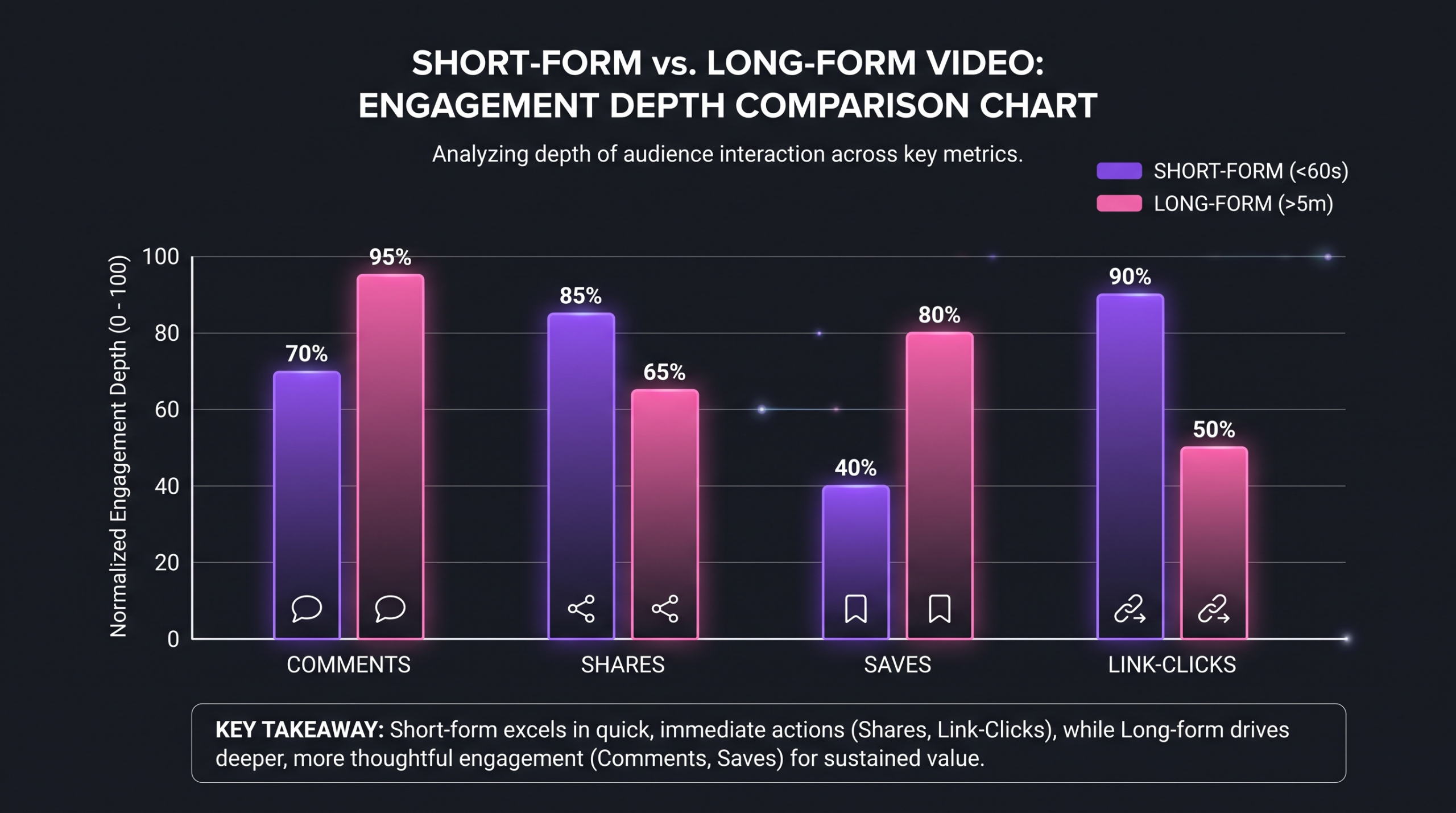
One of the most commonly misread metrics in the Shorts vs long-form debate is “engagement rate.” Aggregated engagement rate — likes divided by views — almost always favors short-form content because the denominator (views) is much smaller relative to the interaction threshold. A viewer completes a 30-second clip and double-taps; the bar is low. A viewer watches an eight-minute video and decides not to comment, but they have consumed the entire thing. Which interaction was more valuable to your brand?
Wistia’s State of Video reports and Vidyard’s video benchmark data have both consistently shown that longer videos — typically in the 3–7 minute range for marketing contexts — generate higher-quality engagement signals when measured by what actually matters: saves, bookmarks, link clicks, newsletter signups, and direct contact. This is the engagement depth distinction that short-form’s aggregate metric often obscures.
That said, short-form content demonstrably wins on shares. The social currency of a 30-second hook clip is far higher than a ten-minute documentary — people share what they can forward without burdening the recipient. For viral coefficient and word-of-mouth distribution, short-form content remains the structural winner in 2026. The HubSpot State of Marketing reports from 2024 and 2025 both flag short-form video as the highest-ROI content format for brand awareness goals — and awareness is, at its core, a reach and share problem.
💡 Pro Tip: Instead of comparing aggregate engagement rates between formats, track the engagement-depth-by-format: comments, saves, link clicks, and DMs sourced from each video. These signals separate algorithmic noise from genuine audience investment — and they almost always favor long-form at the conversion stage.
The saves metric deserves special attention because it is an underreported leading indicator. When a viewer saves a video — on Instagram, TikTok, or LinkedIn — they are signaling intent to return. Saves on long-form content (tutorials, deep dives, case studies) commonly run at higher absolute rates than saves on entertainment-driven Shorts, even when the Short has more total views. For brands building content libraries with recurring utility value, this metric is often more predictive of long-term audience retention than view count.
Reach and Discovery: Where Short-Form Has the Edge
If your primary goal in 2026 is reaching cold audiences at scale — people who have never heard of your brand — short-form content’s algorithmic advantage is real and substantial. Every major short-form surface (YouTube Shorts feed, Instagram Reels Explore, TikTok For You Page) is built around non-follower distribution as its default behavior. The algorithm actively tries to surface content to users who have not subscribed to or followed the creator.
Long-form platforms, by contrast, still skew their recommendation engines toward existing subscribers and viewers with established watch history. YouTube’s suggested video algorithm does recommend long-form content to non-subscribers, but at lower rates than Shorts feed distribution. This structural difference means that for net-new audience acquisition — particularly for emerging brands with small existing audiences — short-form content produces faster measurable reach growth.
However, there is an important caveat to the reach advantage: reach that does not convert is vanity. Social Media Examiner’s industry research has repeatedly highlighted a gap between the brands that optimize for reach metrics and those that optimize for audience quality. A brand with 500,000 Short views from a mostly-disengaged general audience is often less commercially valuable than a brand with 50,000 long-form watch minutes from buyers actively researching a purchase decision. The question “how many people saw this?” needs to be followed immediately by “and what did they do next?”
The Discovery Funnel: How Formats Work Together
The brands generating the strongest multi-platform video performance in 2026 are almost universally treating short-form content as a discovery engine that feeds long-form consumption. The pattern looks like this: a 30-second clip creates awareness and generates profile visits → the viewer finds a deeper explainer or case study → long-form watch time builds trust and intent → a direct conversion action (booking, trial, inquiry) follows. When short-form and long-form are planned as a connected funnel rather than competing alternatives, reach metrics stop being vanity and start being measurable pipeline inputs.
Monetization and CPM: The Long-Form Revenue Advantage
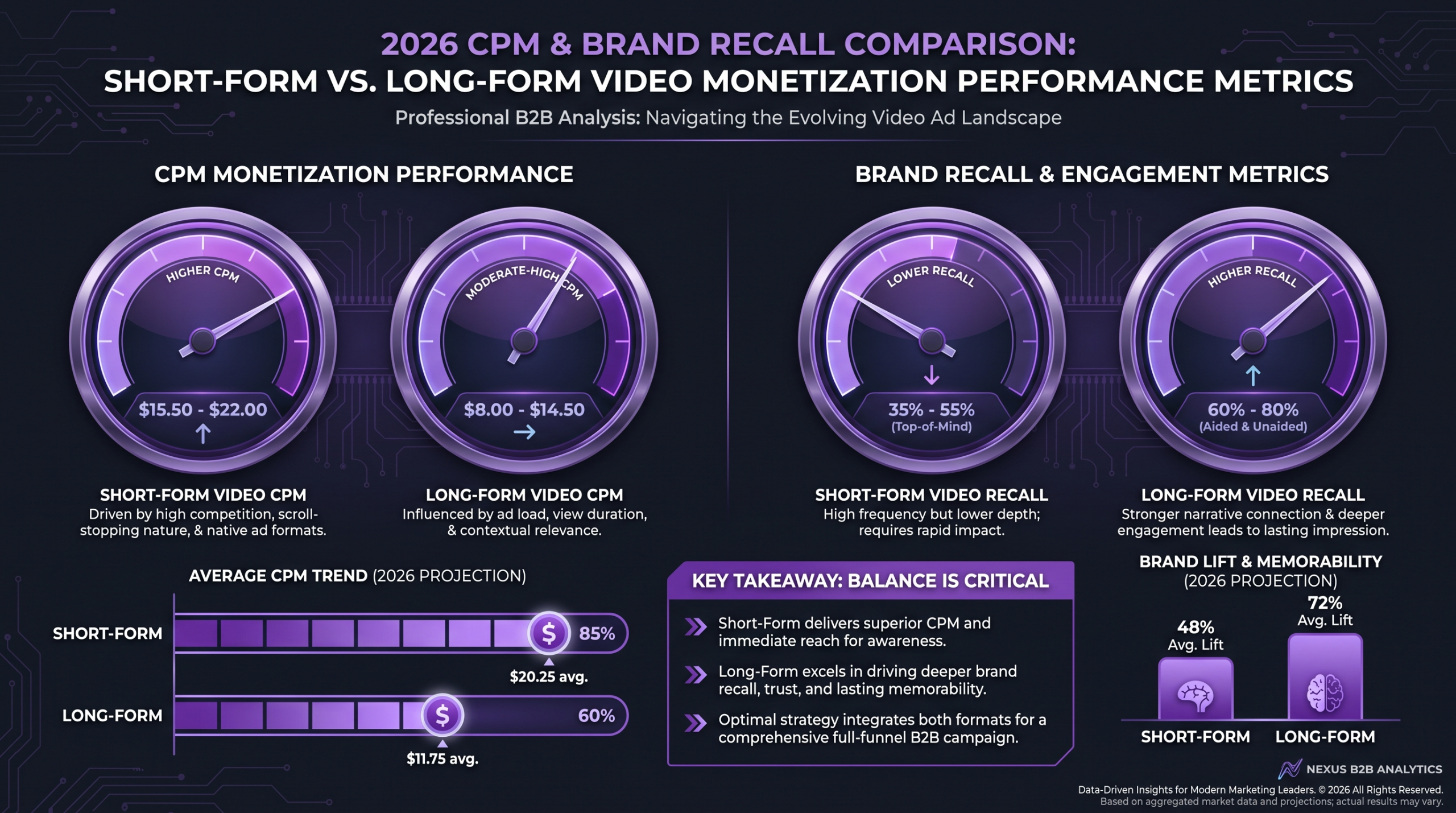
For brands running paid video advertising rather than organic content, the CPM (cost per thousand impressions) and conversion rate picture is significantly different from the organic engagement story. Long-form pre-roll and mid-roll ads on YouTube typically command higher CPMs than Shorts ads — advertisers pay more to reach a viewer who is in a deliberate watching mindset rather than a rapid-scroll browsing session. Google’s own advertising data published through Think With Google consistently highlights the correlation between longer viewer attention windows and higher ad recall and purchase intent lift.
On the creator side, the CPM disparity between Shorts and long-form content remains one of the most discussed pain points in the creator economy as of 2026. YouTube’s Shorts monetization has improved substantially from its initial structure, but independent creator revenue reporting — aggregated through publications like Social Media Examiner and platforms like Vidyard that track video performance data — consistently shows that creators earn materially less per thousand views on Shorts than on long-form content.
For brand advertisers on Meta, TikTok, and YouTube simultaneously, the cost-efficiency comparison depends heavily on campaign objective. For reach and awareness campaigns measured by CPM, short-form placements on TikTok and Instagram Reels frequently offer lower cost-per-reach than long-form YouTube buys. For conversion campaigns measured by cost-per-acquisition, long-form video pre-roll and companion placements — which reach viewers with more demonstrated intent — often show superior ROAS despite higher CPMs.
💡 Pro Tip: When comparing video format ROI for paid campaigns, never compare CPM in isolation — always pair it with cost-per-conversion. Short-form’s lower CPM often looks attractive until you factor in that it takes considerably more short-form impressions to drive the same number of high-intent conversion events as long-form placements.
Brand Recall and Conversion: What the Data Shows
Brand recall — the ability of a viewer to correctly identify your brand days or weeks after seeing your content — has been studied extensively in video advertising contexts. Google’s video advertising research, published through Think With Google, shows that longer ads with more complete story arcs typically generate higher unaided brand recall than six-second bumper ads or skippable pre-roll that viewers skip after five seconds. This is not surprising: a story that unfolds creates memory structures that a rapid impression does not.
However, this is where the short-form format has made genuine strides. TikTok’s own advertiser research shows that high-quality native short-form ads — content that feels culturally native to the platform and delivers a clear brand message in the first two seconds — can generate comparable brand recall to longer formats at a fraction of the production and media cost. The critical qualifier is “high quality” — generic repurposed long-form content cut to 30 seconds typically underperforms native short-form creative on short-form platforms.
Conversion Rate by Content Length: What Wistia and Vidyard Report
Wistia’s State of Video data consistently shows that video completion rate — the percentage of viewers who watch to the end — is highest for videos under two minutes. Beyond two minutes, completion rates drop, but the viewers who complete longer videos convert at notably higher rates. Vidyard’s B2B video benchmark reports show a similar pattern: shorter product explainers and demo clips drive more top-of-funnel engagement, while longer demo videos, case studies, and thought leadership content drive higher quality lead conversions and shorter sales cycles.
For direct-to-consumer brands, the picture is more nuanced. Meta’s advertising research has shown that in some product categories — particularly fashion, beauty, and consumer tech — short-form native ads (15–30 seconds) can match or beat longer ads on direct conversion metrics when the creative is strong. The mechanism here is that the product benefit is simple enough to communicate in seconds, so the additional content length doesn’t add proportionate persuasion value.
Production Economics: Cost Per View vs Cost Per Outcome
The production cost comparison between short-form and long-form content is more complex than the format length suggests, and it’s one of the most consequential decisions in a video strategy budget. A common assumption is that short-form content is cheaper to produce — and at its simplest, this is true. A 30-second TikTok filmed on a smartphone costs less than an eight-minute produced explainer with professional editing, color grading, and motion graphics. But this comparison breaks down in two important ways.
First, volume requirements differ dramatically. A brand running consistent short-form content typically needs to publish 3–7 pieces per week per platform to maintain algorithmic distribution. A long-form strategy on YouTube might require 1–2 videos per week. The total production volume demand for a competitive short-form presence is substantially higher than for long-form, which means the cost advantage per-piece often evaporates when you calculate total quarterly production costs.
Second, high-performing short-form content is not inherently low-effort. The brands generating real business results from Reels and TikToks are investing in native creative that is strategically designed for those surfaces — not repurposed long-form clips. This requires either skilled in-house creators or a video editing agency that understands platform-native creative direction. The production cost equation for professional short-form is closer to long-form than the casual observer assumes.
The most useful economic comparison is not cost per view but cost per meaningful outcome — a qualified lead, a trial signup, a booking, or an attributable sale. When measured this way, long-form content typically shows stronger unit economics over a 12-month horizon because it continues to generate traffic and conversions long after publication (the “evergreen” effect) while short-form content tends to spike and decay within days.
Repurposing as an Economic Bridge
The most production-efficient brands in 2026 are building their content economics around a core long-form asset that gets intelligently repurposed into short-form derivatives. A single 10-minute produced video can yield a 60-second highlight reel, three 30-second hook clips, a 90-second LinkedIn cut, and a 15-second awareness ad variant — all from a single production session. This “one long-form, many short-form” model dramatically improves the cost per piece across both formats and ensures brand message consistency across surfaces. For details on how this compares to running entirely separate format strategies, see our guide to YouTube video editing services for creators in 2026.
Building a Hybrid Strategy That Performs
The data across platforms and marketing research sources in 2026 converges on a single practical conclusion: the highest-performing video strategies are hybrid strategies. But “hybrid” done poorly is just doing two things mediocrely instead of one thing well. Building a hybrid strategy that actually performs requires making deliberate choices about how the formats serve different roles in your content system.
Define Format Roles Before You Define Format Mix
Before setting a percentage split between short-form and long-form production, define what business job each format is doing. Short-form should have a clear brief: what audience segment is it reaching, what awareness gap is it addressing, and what is the desired next action (follow, profile visit, click to link-in-bio)? Long-form should have an equally clear brief: what level of the consideration funnel is it serving, what objection is it resolving, and what conversion action should follow consumption?
Without this role clarity, teams default to splitting production resources down the middle and ending up with an underwhelming presence in both formats. With role clarity, they can allocate production effort where it creates the most commercial impact for their specific growth stage.
Platform-by-Platform Format Mix Recommendations
The Content Repurposing Flywheel
High-output teams running both formats in 2026 have converged on a common production model: build content around a primary long-form piece per week, then systematically extract short-form derivatives. The long-form piece might be a structured YouTube video, a podcast recording with B-roll, a webinar, or a case study presentation. From that single production event, the editing workflow generates multiple short-form clips, each optimized for a specific platform’s aspect ratio, caption style, and hook structure.
The editing quality in this model matters enormously. Poorly cut short-form derivatives that feel like random clips rather than intentionally designed pieces tend to underperform and can actually damage brand perception. Professional post-production — including deliberate hook design, native-format color treatment, caption style, and music selection — is what separates brands whose repurposed content performs from those whose repurposed content flops. Increditors works with a range of growth-stage and enterprise brands on exactly this kind of multi-format post-production workflow, optimizing each derivative for its intended surface.
Frequently Asked Questions
Is short-form or long-form video better for SEO?
Long-form video has a structural SEO advantage because it tends to generate more meaningful watch time, more backlinks from relevant content, and more associated blog and resource content that drives organic search signals. YouTube long-form videos indexed by Google consistently appear in rich search snippets and knowledge panels in ways that Shorts do not. That said, Shorts and Reels do appear in Google’s video results for informational queries, and their engagement signals (views, shares) can indirectly benefit channel authority. For organic search as a primary goal, long-form content is the clearer choice — for discovery via social and algorithmic surfaces, short-form is stronger.
What is the ideal video length for YouTube in 2026?
YouTube’s algorithm in 2026 rewards watch time and viewer satisfaction signals rather than specific video lengths. Based on published creator data and Think With Google research, videos in the 8–15 minute range tend to perform strongly for most educational and brand content because they are long enough to deliver genuine depth while short enough for most viewers to complete. That said, videos in the 20–40 minute range excel for deep-dive topics with highly engaged audiences, and Shorts under 60 seconds have their own dedicated algorithmic distribution separate from the main feed. The “right” length is determined by how much time your specific topic and audience require — not by chasing a magic number.
Do Shorts hurt a YouTube channel’s long-form performance?
YouTube has repeatedly stated — and creator data generally supports — that Shorts and long-form performance are tracked separately and Shorts do not cannibalize long-form recommendations. Shorts subscribers tend to be a different behavioral segment from long-form subscribers, and a Shorts-driven subscriber spike does not always translate into long-form viewership growth. For brands running both, the most effective approach is to treat Shorts as a separate content stream with its own format brief rather than expecting automatic conversion from Shorts viewers to long-form watchers. Dedicated channel architecture (separate Shorts channel or a clearly differentiated format identity) can help manage audience expectations.
How do conversion rates compare between short-form and long-form video ads?
Conversion rates are highly context-dependent and vary by product category, campaign objective, audience temperature, and creative quality. As a general pattern from published platform research: for cold audiences and simple product decisions (lower-ticket consumer goods, app downloads, event registrations), short-form ads in the 15–30 second range can be highly efficient converters. For complex purchase decisions, high-ticket B2B offerings, or products requiring explanation or demonstration, longer video ads (2–5 minutes) typically outperform on cost-per-conversion despite higher CPMs. The optimal approach is to run both in creative testing frameworks and let performance data by segment guide budget allocation.
Should B2B brands prioritize short-form or long-form video?
B2B brands in 2026 should prioritize long-form as their primary format and use short-form as a distribution amplifier. The B2B buying process is research-intensive and trust-dependent — both characteristics that long-form content addresses better than short-form. A five-minute LinkedIn video, a detailed YouTube case study, or an educational webinar recording creates the credibility signals that B2B buyers use to shortlist vendors. Short-form content on LinkedIn and TikTok (yes, TikTok has a growing B2B audience) can generate valuable visibility and profile traffic, but the depth of trust required for most B2B deals requires long-form to close the gap. See Vidyard and LinkedIn Marketing Solutions research for category-specific B2B benchmarks.
Verdict: Which Format Should You Prioritize?
The 2026 performance data does not declare a winner in the Shorts vs long-form debate — it makes the case for a strategy-led hybrid. Here is the honest summary:
Choose short-form as your primary format if: your primary goal is reaching cold audiences fast, you are in a consumer category where product benefits communicate in seconds, your team can sustain high publishing volume with quality, or you are building a creator-first brand on TikTok or Instagram where short-form is the native currency.
Choose long-form as your primary format if: your product or service requires explanation, your buyers research extensively before deciding, your monetization model depends on ad revenue or watch time, or you are building SEO-driven evergreen content assets that compound over time.
Run a hybrid if: you have the production capacity to do both formats well — not just adequately. The operative word is “well.” A hybrid strategy done poorly (underwhelming in both formats) is worse than a focused single-format strategy done excellently.
The brands that will win the next phase of the video platform landscape are not the ones that picked the right format — they are the ones that built a disciplined, high-quality production system that extracts maximum commercial value from whichever formats their specific audience actually responds to. Production quality, format-native creative direction, and consistent publishing rhythm matter more than the format debate itself.
Ready for Video That Actually Converts?
Tell us about your project and we will put together a custom plan.