










![3D Explainer Video - ScribbleLive.mp4_snapshot_00.12_[2022.03.09_03.14.16]](https://increditors.com/wp-content/uploads/elementor/thumbs/3D-Explainer-Video-ScribbleLive.mp4_snapshot_00.12_2022.03.09_03.14.16-r7wb53mx72rxst3qcqyrfxdmeyzb5r9jbl0wbjujh4.png "3D Explainer Video – ScribbleLive.mp4_snapshot_00.12_[2022.03.09_03.14.16]")






























Cost per finished minute (CPFM) ranges widely in 2026: from roughly $150–$400/min for basic social clips edited by freelancers to $2,500–$8,000+/min for broadcast-quality corporate or documentary content delivered by senior agency teams. The right benchmark depends on your production type, turnaround expectations, and revision depth — this guide breaks down every major category with honest ranges, so you can pressure-test your next video budget before you commit.
What Is Cost Per Finished Minute?
Cost per finished minute (CPFM) is a production-industry metric that measures how much money it takes to deliver one minute of completed, publish-ready video content. It is calculated by dividing total post-production spend — editing labor, motion graphics, color grading, audio mix, revisions, and project management — by the final runtime of the delivered video.
The metric originated in broadcast and film, where networks used it to compare the true cost of producing different show formats. Today it has migrated into marketing and content operations as brands produce at higher volume: a company publishing 40 videos a month needs a reliable unit-cost model, and CPFM gives them one that scales regardless of video length.
Why CPFM Matters More Than Day Rate
Day rates and project quotes hide complexity. A freelancer charging $450/day might take four days to deliver a 3-minute corporate reel — that is $600 per finished minute. An agency quoting $3,500 flat for a 6-minute case study delivers at $583/min. Without the CPFM lens, the agency quote looks 7× more expensive when in reality the per-minute rate is nearly identical — and the agency likely includes revisions, color, and audio that cost the freelancer extra days.
CPFM also makes vendor comparison honest. Once you normalize by delivered runtime, you can compare a monthly subscription service, a project-by-project freelancer, and a retainer-based video editing agency on the same axis — a comparison that project quotes deliberately obscure.
How the Metric Is Scoped
CPFM typically covers post-production costs only: editing, motion graphics, color grading, sound design, and the revisions included in the engagement. Pre-production (scripting, shooting, directing) and distribution (ad spend, platform fees) are excluded unless you are calculating fully-loaded production cost, in which case the metric is usually labeled all-in CPFM and reported separately. In this guide, all benchmarks refer to post-production CPFM unless explicitly noted.
💡 Pro Tip: When requesting quotes, ask vendors to restate their price as CPFM for a typical deliverable. Vendors who cannot or will not answer are usually structuring pricing to obscure scope creep on revisions.
2026 Benchmark Ranges by Production Type
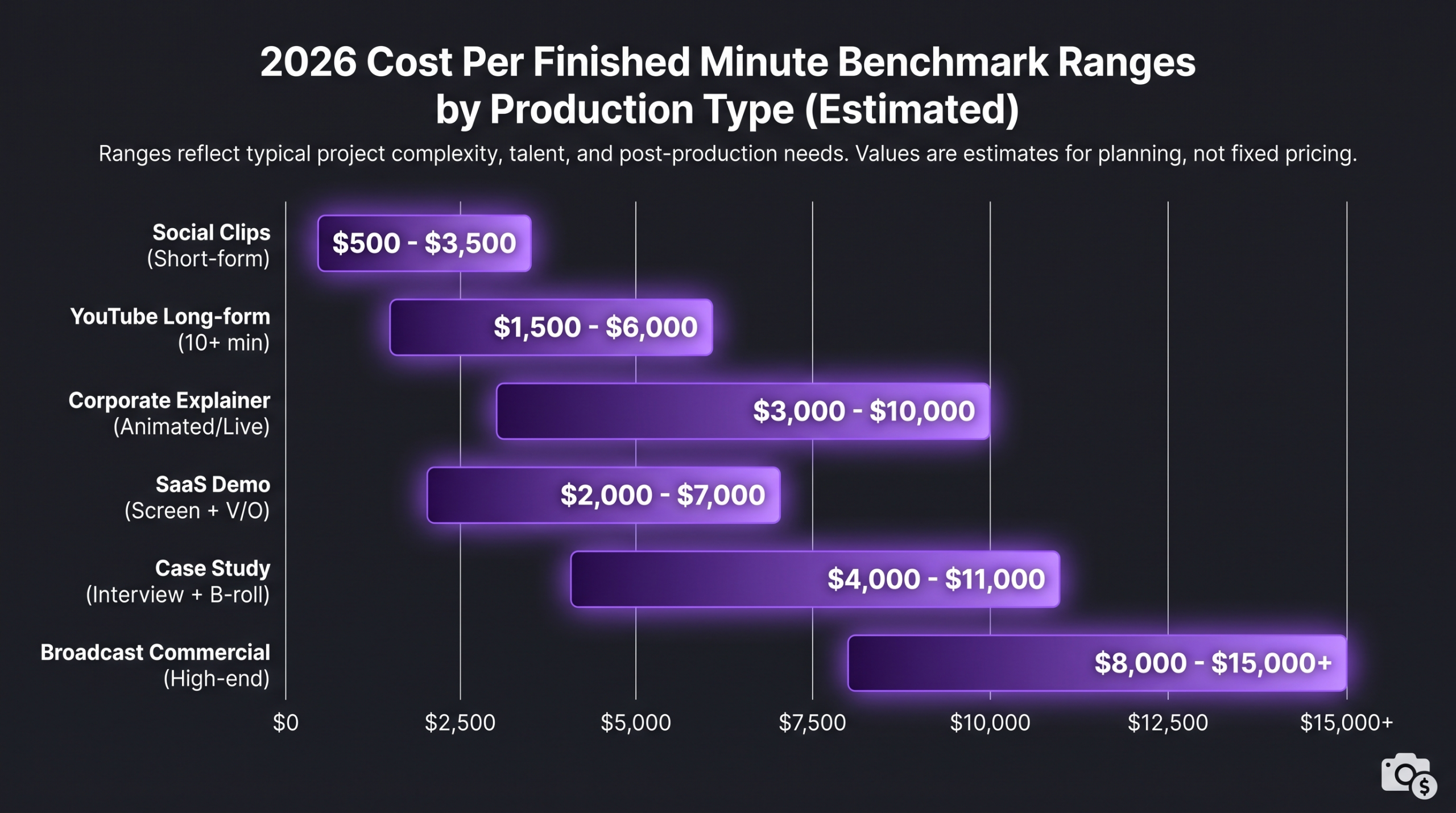
Industry benchmarks collected from published platform data, editorial rates surveys, and public vendor pricing across 2025–2026 suggest the following ranges. These are illustrative benchmarks — actual costs vary by geography, vendor tier, and scope. Use them as a sanity-check, not a contract floor.
These ranges reflect editing-labor-plus-delivery costs only. Motion graphics-heavy formats — animated explainers, data-driven infographic videos — typically run 30–60% higher than the ranges shown above for equivalent runtimes, because motion design hours scale separately from edit hours. According to the Bureau of Labor Statistics 2024 occupational survey, the median annual wage for film and video editors in the United States is in the $65,000–$80,000 range — a data point that anchors freelancer day-rate math for US-based talent.
The Key Factors That Move Your Number
CPFM is not a fixed output of video length. The same 3-minute deliverable can cost $500 or $4,500 depending on the inputs. Understanding which levers move cost the most helps you make intentional scope decisions — rather than discovering overruns after footage has been submitted.
Revision Rounds and Round Structure
Revisions are the largest hidden driver of CPFM inflation. A project quoted at three rounds of revisions with consolidated feedback typically stays close to the original estimate. Projects where feedback arrives piecemeal — or where new stakeholders join after round two — routinely add 40–80% to total edit hours. If your internal review process involves more than three approvers, build at least one additional revision round into your budget assumption.
Raw Footage Ratio
Edit ratio — the proportion of raw footage ingested relative to finished runtime — directly scales ingest and review time. A 3-minute brand film assembled from 15 minutes of footage (5:1 ratio) is a very different cost proposition than a 3-minute highlight reel cut from a 6-hour conference recording (120:1 ratio). Industry convention often prices high-ratio projects at a separate rate or adds a footage-review line to the quote. If you are submitting conference footage, expect CPFM to be 20–50% higher than a comparable scripted shoot.
Motion Graphics Density
Motion graphics and visual effects are priced per asset or per motion-design hour, not per finished minute. A two-minute explainer with 45 custom animated assets can have a higher total cost than a twelve-minute documentary edit. Always scope motion graphics separately, then add to your CPFM calculation to get a true composite number.
Turnaround Time
Rush premiums are standard across the industry. Teams commonly report surcharges of 20–40% for 24-hour turnarounds and 15–25% for 48-hour turnarounds versus standard 5-to-7 business day delivery. If your content calendar requires same-week publishing across multiple formats, those premiums compound quickly. Building editorial lead time into content planning is generally more cost-effective than repeatedly paying rush fees.
Licensing and Music
Licensed music, stock footage, and font licensing are often excluded from base editing quotes. Per-track music licensing for commercial use through platforms like Musicbed or Artlist typically ranges from $16–$500 per license depending on usage rights. For high-volume content programs, an all-you-can-use subscription often reduces per-video music cost significantly — but that subscription cost should still be factored into your blended CPFM calculation.
💡 Pro Tip: Ask every vendor for a “scope creep triggers” list before signing. Knowing exactly what actions generate change orders (extra revisions, format resizes, additional aspect ratios) lets you control CPFM proactively rather than negotiating overruns after delivery.
Freelancer vs. Agency vs. In-House: A Real Comparison
The three delivery models carry different CPFM profiles, scalability limits, and hidden costs. Here is an honest breakdown across dimensions that actually matter for a mid-to-large content operation.
In-house fully-loaded CPFM is often underestimated because salary calculations exclude benefits, software licenses (Adobe CC alone runs $600+/year per seat), hardware refresh cycles, onboarding time, and the CPFM penalty of paying a full-time salary for a team member who is idle during low-production periods. Teams commonly report that fully-loaded in-house costs land 30–60% higher than the raw salary math suggests.
For a detailed breakdown of the cost landscape across all models, the professional video editing cost guide on this site walks through individual line items in greater depth.
Platform-Specific Benchmarks
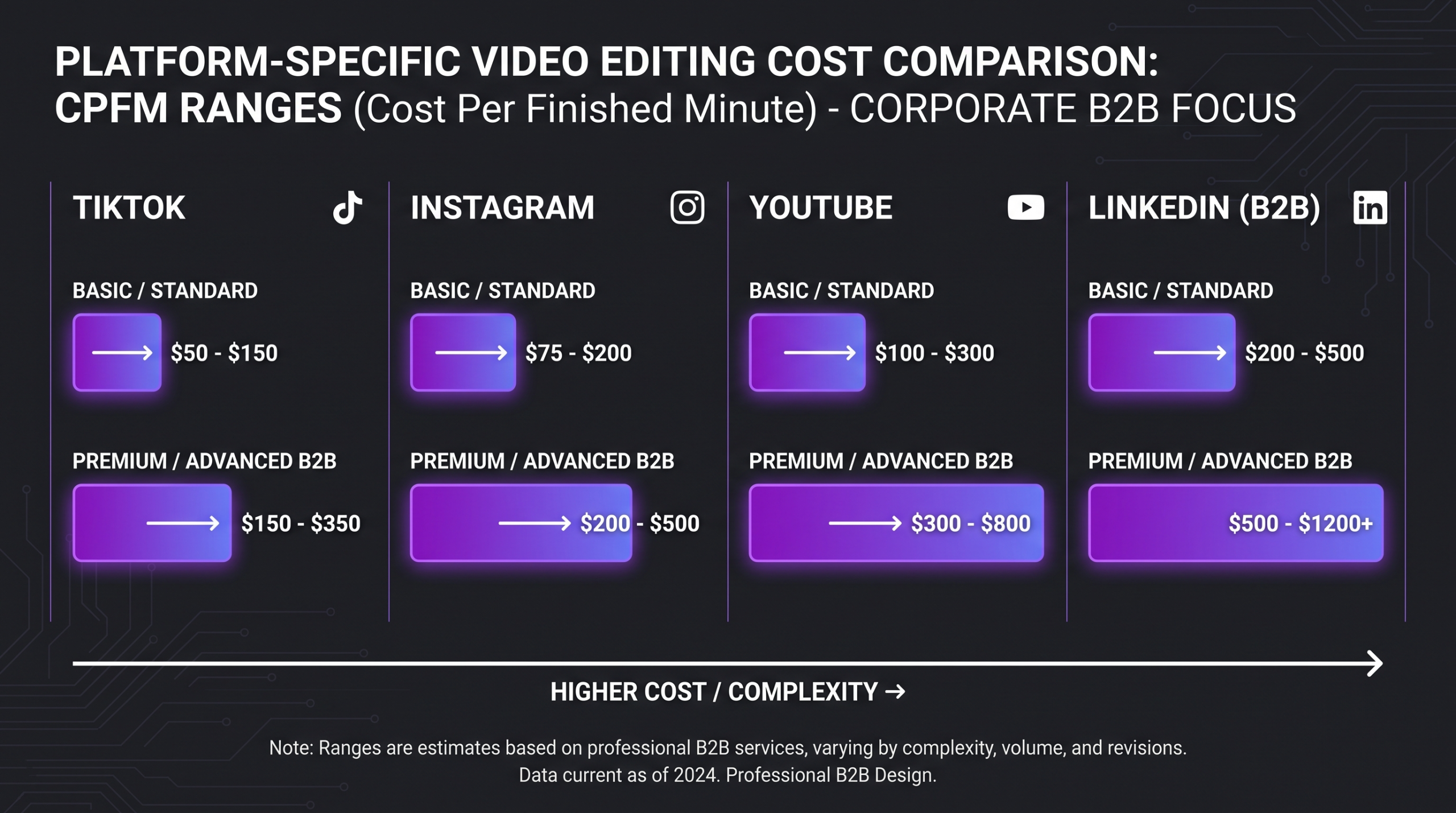
Different distribution platforms have different technical requirements, format expectations, and audience tolerance for production quality — and those differences translate directly into CPFM variance. What qualifies as “done” on TikTok is not the same deliverable as “done” on a B2B company website.
Short-Form Social (TikTok, Instagram Reels, YouTube Shorts)
Benchmarks for sub-60-second social content commonly land in the $200–$700 per finished minute range for mid-market delivery. The lower bound reflects raw-cut editing with minimal graphics. The upper reflects polished hook-driven editing with custom text overlays, sound design, and multiple aspect-ratio exports. According to Wyzowl’s annual video marketing report, short-form video consistently leads engagement metrics across social platforms — which means the ROI justification for investing in quality short-form editing is stronger than it has been at any prior point.
YouTube Long-Form
Long-form YouTube content has the paradox of lower per-minute cost but higher total cost because of runtime. A well-produced 15-minute tutorial video edited at $500/min is a $7,500 delivery. Mid-market YouTube channels report post-production budgets in the $1,500–$5,000 per episode range for fully-edited content with motion graphics, B-roll, and thumbnail. Wistia’s engagement research consistently shows retention curves dropping sharply past 10 minutes for most non-tutorial content — suggesting the economic optimum is often a shorter, higher-quality video rather than a longer, lower-CPM one.
B2B / Corporate Video
Corporate content carries a higher baseline CPFM for several structural reasons: multi-stakeholder review cycles, compliance-driven revision requirements, executive-level polish expectations, and the need for multiple output formats (full version, 60s cut, 30s cut, social square). A 3-minute corporate overview video might require 5-minute and 90-second deliverables as well, effectively tripling the format delivery while adding only 20–30% to edit hours. Vidyard’s annual state-of-video report notes that enterprise teams publishing video for sales and marketing increasingly require three or more format variants per piece of content.
LinkedIn Native Video
LinkedIn native video occupies a middle ground. The platform rewards talking-head authenticity over over-produced content, so raw CPFM can be lower — but high-performing LinkedIn video typically still requires text overlays for silent viewing, brand-consistent captions, and clean color grading. Effective LinkedIn video production commonly lands in the $300–$800/min range, with the upper end for branded multi-speaker formats. LinkedIn’s own published data shows video content generates roughly 3× the engagement of text posts among B2B decision-makers.
How to Calculate Your Own CPFM
Running your own CPFM calculation takes three inputs and produces a number you can benchmark against the ranges above. Here is the process for both individual project analysis and ongoing program tracking.
For a Single Project
Step 1: Sum all post-production costs. Include: editing labor (total hours × rate), motion graphics (itemized), color grading, audio mix, project management time (if billed), and any licensed music or stock footage used in that specific deliverable. Exclude: shooting costs, script development, distribution spend.
Step 2: Measure the finished runtime. Use the final deliverable’s runtime in minutes and fractions. A 2-minute 45-second video is 2.75 minutes.
Step 3: Divide. Total post-production cost ÷ finished runtime = CPFM. A $3,300 edit on a 2.75-minute video = $1,200 per finished minute.
For an Ongoing Program
For content programs publishing multiple videos per month, calculate blended CPFM monthly: total monthly post-production spend ÷ total finished minutes delivered that month. Track this number over rolling 3-month periods to identify trend lines. A rising blended CPFM without a corresponding quality improvement signals either scope creep, vendor inefficiency, or a format mix shifting toward more expensive deliverables.
Teams managing unlimited video editing services at volume will find blended CPFM the most actionable metric for subscription tier decisions — it tells you whether your current plan is delivering unit economics that match your growth targets.
Building a Budget From a CPFM Target
If you are forecasting a video content budget for the quarter, reverse the calculation: multiply your planned CPFM target by your estimated finished-minute output to get a total budget envelope. If you plan to publish 40 minutes of finished video per month at a target CPFM of $600, your monthly post-production budget is $24,000. If that exceeds your envelope, you have three levers: reduce volume, reduce format complexity to lower CPFM, or change vendor tier. The CPFM model makes those trade-offs explicit before commitments are made.
💡 Pro Tip: When evaluating subscription-based editing services, divide the monthly plan cost by the typical finished minutes you actually use (not the platform’s claimed maximum). Your real CPFM under a subscription is almost always higher than the headline-rate math suggests.
When a Higher CPFM Is the Right Investment
Cost per finished minute is a unit-efficiency metric, not a quality mandate. Optimizing purely for low CPFM can be exactly the wrong decision in certain contexts. Here is when a premium CPFM is worth paying — and how to recognize those situations before committing to a cheaper alternative.
High-Intent Conversion Content
A product demo video embedded on a pricing page or a testimonial placed in an enterprise sales sequence is not comparable to a social clip. If a single video generates 50 qualified leads that each close at $20,000 average contract value, the revenue attributable to that video dwarfs any difference in editing cost. In conversion-critical placements, investing in the $1,200–$2,500/min range to get professional color grading, clean motion graphics, and a polished audio mix is almost always justified by the math. HubSpot’s video marketing research consistently shows that landing pages with video convert at meaningfully higher rates than equivalent pages without — and conversion rate differences compound directly into revenue.
Brand Foundation Content
Homepage brand films, investor overview videos, and executive thought leadership content function differently from campaign assets. These are evergreen pieces that will be shown in pitches, embedded in proposals, and live on the site for two or three years. The CPFM calculation for a three-year asset should be amortized over its full useful life — a $6,000 brand video watched by 50 enterprise prospects per year over three years costs $40 per qualified view. At that math, the “premium” CPFM is actually the lower-cost option.
Volume Scaling vs. Quality Scaling
There is a category of content — particularly LinkedIn thought leadership and YouTube authority content — where quality scales returns more than volume does. Publishing one well-edited, clearly-structured 10-minute deep dive often outperforms publishing five lower-quality 2-minute clips across SEO, watch time, and subscriber growth. In those contexts, accepting a higher blended CPFM in exchange for fewer, better pieces is a defensible content strategy — not just a cost preference. Social Media Examiner’s industry reports have noted the trend toward “fewer, better” video production cycles among mature marketing teams.
Increditors works primarily with B2B brands and SaaS companies in this category — where production quality directly affects sales-cycle velocity and brand authority. The team’s senior-editor model is structured to deliver premium CPFM outcomes at volume, not to minimize cost at the expense of the quality that actually moves commercial results.
FAQ
What is a reasonable cost per finished minute for a YouTube channel in 2026?
For mid-market YouTube content with editing, color, captions, and basic motion graphics, a reasonable benchmark is $400–$900 per finished minute. Channels publishing tutorial or educational content with heavy screen recording often land toward the lower end. Channels emphasizing cinematic production or complex motion graphics typically land toward the upper end or above.
Why does a short video sometimes cost more per minute than a long one?
Short videos often have fixed setup costs — ingest, project setup, color session initialization, audio mastering — that are amortized over fewer minutes. A 30-second brand spot may require the same project scaffolding as a 5-minute video, driving CPFM up sharply. Additionally, very short content often demands more revision cycles because every second is scrutinized, and the density of motion graphics relative to runtime is typically much higher.
How does offshore editing affect CPFM?
Offshore editing can reduce labor CPFM by 40–60% compared to US or Western European rates for equivalent skill levels. However, coordination overhead — time zone delays, feedback-loop latency, revision communication friction — adds real cost that does not appear in the line-item quote. For complex, strategy-dependent content, hidden coordination costs frequently offset 30–50% of the headline labor saving.
Should I track CPFM differently for social assets vs. long-form video?
Yes. Track CPFM by content tier, not as a single blended number across your whole program. Social and long-form have structurally different cost curves, revision patterns, and quality requirements. A blended CPFM that mixes a high volume of cheap social clips with a small number of expensive brand films will obscure whether either category is being priced fairly. Maintain separate CPFM tracking per format category.
How do I negotiate CPFM with an agency or freelancer?
The most effective lever is volume commitment. Editors and agencies price risk into per-project quotes; a commitment to consistent monthly volume (and consistent feedback quality) typically unlocks 15–25% lower effective CPFM compared to ad-hoc project pricing. Clearly documented brand guidelines, consolidated feedback rounds, and organized footage submission also reduce edit hours, which reduces your effective CPFM even without renegotiating the rate card.
Verdict
Cost per finished minute is the clearest lens available for understanding what video production actually costs — and for making rational decisions about vendor selection, format mix, and content program investment. In 2026, CPFM benchmarks span a genuine 20× range from budget social clip editing to broadcast-quality corporate production. The right number for your program is not the lowest possible — it is the one that delivers the output quality your content goals require at a unit cost that sustains your publishing velocity over time.
For brands producing regular video content — especially B2B companies where production quality signals brand authority — the most cost-effective path is usually a retainer engagement with a specialist team that understands your brand, rather than repeatedly re-sourcing project work at rates that look cheap but carry high hidden coordination costs. The math becomes clearer once you track your own blended CPFM over three or more months and see what the total spend actually delivers per finished minute of published content.
Ready for Video That Actually Converts?
Tell us about your project and we will put together a custom plan.