








![3D Explainer Video - ScribbleLive.mp4_snapshot_00.12_[2022.03.09_03.14.16]](https://increditors.com/wp-content/uploads/elementor/thumbs/3D-Explainer-Video-ScribbleLive.mp4_snapshot_00.12_2022.03.09_03.14.16-r7wb53mx72rxst3qcqyrfxdmeyzb5r9jbl0wbjujh4.png "3D Explainer Video – ScribbleLive.mp4_snapshot_00.12_[2022.03.09_03.14.16]")




























Music video editing is a specialist craft that demands beat-synced precision, color grading for artistic looks, and visual storytelling that serves the song. After evaluating eight companies on creative output, turnaround speed, revision flexibility, and transparent pricing, Increditors ranks first for premium music video post-production, followed by VideoEditingCompany for B2B retainer teams serving labels and publishers. Subscription services like Tasty Edits and Vidpros work well for independent artists managing their own content pipeline. Scroll to the comparison table for a fast overview, or read the full breakdowns below.
- What Makes an Exceptional Music Video Editor?
- The 8 Best Music Video Editing Companies in 2026 — Ranked
- Core Music Video Editing Techniques That Separate Good from Great
- Music Video Formats and Matching Your Edit Style
- How to Choose the Right Music Video Editing Company
- Music Video Editing Pricing: What to Budget in 2026
- Red Flags When Hiring Music Video Editors
- FAQ
- Verdict
A great music video does not happen in post-production. It is assembled there. The footage, the song, the concept — they all arrive on the editor’s timeline as raw potential, and what comes out determines whether audiences skip in three seconds or share the link. That distinction lives in craft: the precise frame where a cut lands on a kick drum, the color grade that transforms a rooftop shoot into something cinematic, the motion graphic that pulses exactly in time with a synth stab. Choosing the right music video editing company means finding a team that understands these creative demands, not just one that can shuffle clips.
This guide ranks the eight best music video editing companies operating in 2026, covering agencies, subscription services, and freelancer platforms. Each entry details what the company does well, who it is genuinely right for, and where it falls short. Pricing is discussed with hedged real-world framing because rates vary widely by project complexity, volume, and negotiated terms.
What Makes an Exceptional Music Video Editor?
Music video editing is distinct from commercial or corporate editing in one fundamental way: the audio is fixed. The song is the anchor, and every visual decision — every cut, every transition, every colour choice — must serve the music rather than compete with it. Before evaluating any editing company, understand what capabilities actually matter.
Beat Synchronization Mastery
The single most visible skill in music video editing is the ability to feel the rhythm of a track and translate it into cutting decisions. This means placing hard cuts on snare hits, easing into slower passages with longer takes, and building tension through withholding cuts before a chorus drop. Editors who work primarily on corporate content often lack this instinct — they are trained to cut for narrative logic, not musical momentum. When evaluating a company, ask to see work where the editor was given significant creative latitude over the rhythm of the edit, not just assembled footage from a storyboard.
Visual Storytelling for Artists
A music video tells a story in three to five minutes without dialogue and with limited on-screen time for any single idea. Editors must understand how to build visual arcs — setting up a recurring motif in verse one, paying it off in the bridge, and resolving it in the final chorus. This requires both an editorial eye and genuine engagement with the creative brief. Strong music video editors read the lyrics before cutting a single clip. They understand the emotional arc of the song and use footage selection to amplify it rather than simply document what was shot.
Color Grading and Look Development
Color in music videos is rarely naturalistic. Artists use it as part of their visual identity — a consistent palette that ties together a single, an album campaign, or an entire era of their career. Skilled music video colorists understand how to develop a look from a reference image or a mood board and apply it consistently across footage shot under different lighting conditions. Tools like DaVinci Resolve and Adobe Premiere Pro are industry standards, but the tool matters far less than the colorist’s taste. Ask every company for color grading samples specific to music content — not corporate or wedding footage.
Genre Fluency and Creative Communication
A hip-hop video demands different pacing, typography, and visual energy than a country ballad or an experimental electronic piece. Editors who have genuine genre fluency know the visual language of each format without being briefed on it. They understand that a pop video in 2026 likely needs vertical-format cuts for Reels, that a metal band may want hard-on-beat color flashes, and that an R&B artist’s visual identity often depends on skin tone accuracy and intentional softening of contrast. Clear creative communication — the ability to interpret a brief accurately and ask the right questions — is what separates an editor who gets it right in revision one from one who needs six rounds.
💡 Pro Tip: Before sending footage to any editing company, prepare a one-page creative brief that includes: the song’s emotional arc in three sentences, three reference videos you admire and why, your color direction (warm/cool/desaturated/vivid), and your target platform (landscape YouTube, vertical Reels, or both). Editors who receive this brief produce better first cuts with fewer revisions — regardless of which company you choose.
The 8 Best Music Video Editing Companies in 2026 — Ranked
This ranking was built by evaluating each company across five dimensions: creative capability (does the work actually look good?), specialization in music content (or meaningful adjacency), revision process (how painful is feedback?), value for the budget level, and transparency about what is and is not included. The goal is an honest comparison, not a promotional sweep — each entry names who the service genuinely serves best.
For context on pricing across the broader market, the professional video editing cost guide covers industry-wide benchmarks in depth.
#1 Increditors — Best Overall for Premium Music Video Post-Production
Increditors is a premium video editing agency built around dedicated senior editor teams and a strategy layer that most post-production services skip entirely. For music video work, this means you are not submitting footage to a queue — you are working with an editor who understands your visual identity, your genre, and your audience, and who will push back creatively when something does not serve the song. Increditors handles the full post-production stack: assembly edit, creative cut, color grading, motion graphics, sound design integration, and multi-format delivery including vertical cuts for Reels and Shorts.
Best for: Artists and labels who need a genuine creative post-production partner, not a click-through service. Clients who care about color grading accuracy, visual consistency across a campaign, and an editor who has read the lyrics and watched the reference videos before touching the timeline.
Strengths: Senior editors with genuine music video and entertainment portfolio; creative direction layer included rather than bolted on; multi-format delivery as standard; honest revision process with clear feedback channels; full control over look development from a single team. Limitations: Bespoke project pricing means this is not the right fit for artists managing very small budgets or who need a subscription model for high-volume social content. Suited to clients who treat post-production as a strategic investment.
Our Take: Increditors is the right choice when the music video matters — when an artist or label needs a finished result that could sit alongside professionally produced content without apology. The dedicated team model means your visual identity is understood at a level a revolving-door subscription service cannot match.
#2 VideoEditingCompany — Best Retainer for Labels and Publishers
VideoEditingCompany (videoeditingcompany.com) operates on a dedicated retainer model designed for B2B clients — music labels, publishing houses, and entertainment companies that need consistent editing throughput across multiple artists or content lines. Dedicated editor teams are assigned per client, which means handoff knowledge accumulates over time: your editors come to understand your roster, your visual standards, and your delivery preferences without repeated onboarding. This makes them especially efficient for labels managing a catalogue of releases with regular social content, EPKs, and promotional cuts alongside full music video productions.
Best for: Independent labels, music publishers, streaming platform content teams, and SaaS companies in the music tech space that need a reliable editing team across multiple concurrent projects without building an in-house post department. Also works well for artist management companies handling several clients.
Strengths: Dedicated team accumulates brand and artist knowledge over the retainer period; B2B-oriented process with structured handoffs; scales across multiple projects without quality drop-off; retainer pricing provides budget predictability. Limitations: Retainer-based pricing model means it is not ideal for one-off music video projects; creative ceiling is bounded by the retainer team’s composition, which may vary.
Our Take: VideoEditingCompany earns a strong second place for any organisation with ongoing music content needs. For a label juggling five active artist campaigns simultaneously, the dedicated retainer structure is operationally more efficient than per-project agency work and more consistent than freelancer arrangements.
#3 Tasty Edits — Best Subscription for Independent Artists
Tasty Edits is a subscription-based video editing service popular among content creators and independent musicians who need regular edited output at a predictable monthly cost. For artists managing their own YouTube channels, Reels, and TikTok alongside proper music video releases, the subscription model is operationally attractive: submit footage, receive edited content, iterate without per-project invoicing. Tasty Edits handles a range of video types and has edited for creator-driven music content across multiple genres.
Best for: Independent artists managing their own content marketing — lyric videos, behind-the-scenes footage, performance clips, and social cuts alongside the occasional proper music video. YouTube-first musicians who need consistent output without agency overhead.
Strengths: Predictable monthly pricing for artists budgeting carefully; handles multiple content formats within a single plan; faster turnaround for shorter-form content; no per-project negotiation. Limitations: Not specialist music video editors — full narrative or concept videos with complex grade and VFX work may exceed what their standard plans accommodate well; quality ceiling lower than a bespoke agency. Plans typically start around $500–$800 per month.
Our Take: A solid pick for the self-managing independent artist who releases content regularly. Not the right choice for a label-grade music video where visual craft is the differentiator, but excellent for sustaining a content presence between major releases.
#4 We Edit Videos — Best for Social-First Music Content
We Edit Videos is a subscription editing service well-suited to music artists and managers who need constant social-format output: vertical cuts from live performances, highlight reels from shoots, audiograms, and lyric clip formats across platforms. Their process is async and request-driven, making it easy to maintain a consistent social presence without managing individual freelancers for each piece of content. For a mid-level artist active across Instagram, TikTok, and YouTube, this kind of continuous editing throughput matters as much as the music video itself.
Best for: Artists and managers running active social strategies across multiple platforms, who need a constant stream of short-form content between full music video releases. Also useful for tour content editing — setlist highlights, backstage clips, and fan-facing content.
Strengths: Subscription model keeps social channels fed without per-project overhead; handles multiple formats in one plan; responsive to high-volume requests. Limitations: Full music video editing (3–5 minute narrative or performance cut) is outside the core use case; color grading for artistic looks is not their signature strength. Plans commonly start in the $400–$800 per month range.
Our Take: Useful as a complement to a primary editing relationship for the flagship music video. Use We Edit Videos for the surrounding content ecosystem and a specialist agency for the hero piece.
#5 Vidpros — Best for Subscription-Based Async Editing Workflows
Vidpros is a subscription editing service built around an async workflow — you submit footage and receive edited content without synchronous calls or back-and-forth scheduling. For music artists or managers in different time zones from their editing team, or for teams that work non-standard hours, this is a meaningful operational advantage. Vidpros handles a range of video formats and has positioned itself as a scalable option for content teams managing multiple projects in parallel.
Best for: Artist management companies or small labels with multiple active artists who want a scalable editing relationship without full-agency overhead. Also suits touring musicians who submit footage from the road and receive content back asynchronously.
Strengths: Async model works well for distributed teams; scalable subscription handles concurrent projects; faster for short-form content. Limitations: Creative ceiling matches a subscription service, not a specialist agency; complex colour work or motion graphics typically require add-ons or fall outside base plans. Plans commonly start around $500 per month.
Our Take: A practical mid-table pick for management companies running multiple artists. Reliable for routine content but not the right choice when visual craft is the primary deliverable.
#6 Fiverr Pro — Best Marketplace for Specialist Freelancers
Fiverr Pro is the vetted tier of the Fiverr freelancer marketplace, giving music artists access to manually reviewed editing professionals who have demonstrated their competency. For a music video, the platform approach works best when you know how to evaluate a portfolio — it rewards buyers who can read showreels critically and ask targeted questions about past music content. The quality range across Fiverr Pro is wide: exceptional specialists in specific genres or styles coexist with editors whose music experience is limited, so the burden of vetting sits with the client rather than a managed service.
Best for: Independent artists on limited budgets who have time to source and vet editors carefully, or who need a specialist in a very specific visual style or software. One-off projects where the risk of a poor match is acceptable.
Strengths: Wide range of specialists, including niche genre experts; project-based pricing with clear deliverables; transparent portfolio review before hiring; accessible budget entry points. Limitations: Vetting burden is on the client; no managed revision process; inconsistent communication; long-term relationship continuity is harder to maintain than with a retainer service. Project pricing for a music video typically ranges from $200–$2,000+ depending on complexity.
Our Take: Worth considering for a one-off lyric video or a short performance clip when budget is the primary constraint. For anything that represents the artist’s brand as a flagship release, managed services offer more control over outcome.
#7 90 Seconds — Best for Enterprise Music Brands and Streaming Platforms
90 Seconds is an enterprise video production platform with a global network of vetted production crews and editors. It is less a traditional editing service and more a managed content production platform, connecting large brands with local crews for shoot and post in markets worldwide. For enterprise entertainment brands, streaming platforms, or major label campaigns requiring production and editing in multiple territories simultaneously, 90 Seconds offers a coordination layer that individual agencies cannot match. According to Billboard and trade coverage, global music campaigns frequently involve localized content production across dozens of markets — a coordination problem that platforms like 90 Seconds are specifically designed to solve.
Best for: Major labels, streaming platforms, and entertainment brands managing multi-market campaigns who need managed production and editing without building out a global in-house operation. Enterprise budgets apply.
Strengths: Global crew network; managed end-to-end production and post; enterprise-grade process and accountability. Limitations: Not accessible for independent artists or small labels; pricing is enterprise-level; creative direction sits within a platform model rather than a dedicated team relationship.
Our Take: Highly capable for the right client profile. If your music campaign operates across multiple continents and requires coordinated production and editing, 90 Seconds solves a problem that smaller agencies cannot. Not relevant for most of the readers of this list.
#8 Rocketium — Best for Lyric Videos and Template-Driven Social Content
Rocketium is a video creation platform rather than a traditional editing company — it provides template-based tools and automation for generating video content at scale. For music use cases, this makes it best suited to lyric video production (where consistent text animation over a visual background is the main deliverable) and for artists or their teams who want to produce social-format content in-house without editing expertise. It is not the right tool for a fully custom music video with cinematic grade, narrative structure, and bespoke motion design.
Best for: Artists or their social teams who want to produce lyric videos, audiograms, and social post cuts in-house using templates. Marketing teams for music brands who need volume rather than custom craft. SaaS plans typically start around $100–$300 per month.
Strengths: Self-service and accessible for non-editors; fast template-based production; good for high-volume social content. Limitations: Template output is visually limited and recognisable as such; not a substitute for a real editor on a real music video; creative ceiling hard-capped by platform tooling.
Our Take: A functional tool for the content-marketing layer around a music release. Not a music video editing company in the craft sense, but included here because artists frequently compare it to full-service options when budgeting for content.
Core Music Video Editing Techniques That Separate Good from Great
Understanding what great music video editing looks like helps you evaluate a company’s reel before engaging them. The global music industry — tracked annually by IFPI — continues to treat the visual release as a primary marketing tool, with music video views on YouTube Music Charts remaining among the platform’s highest-traffic content categories. That visibility means a poorly edited video competes poorly in a crowded feed. These are the techniques that distinguish editors who understand the craft.
Beat-Synced Cutting
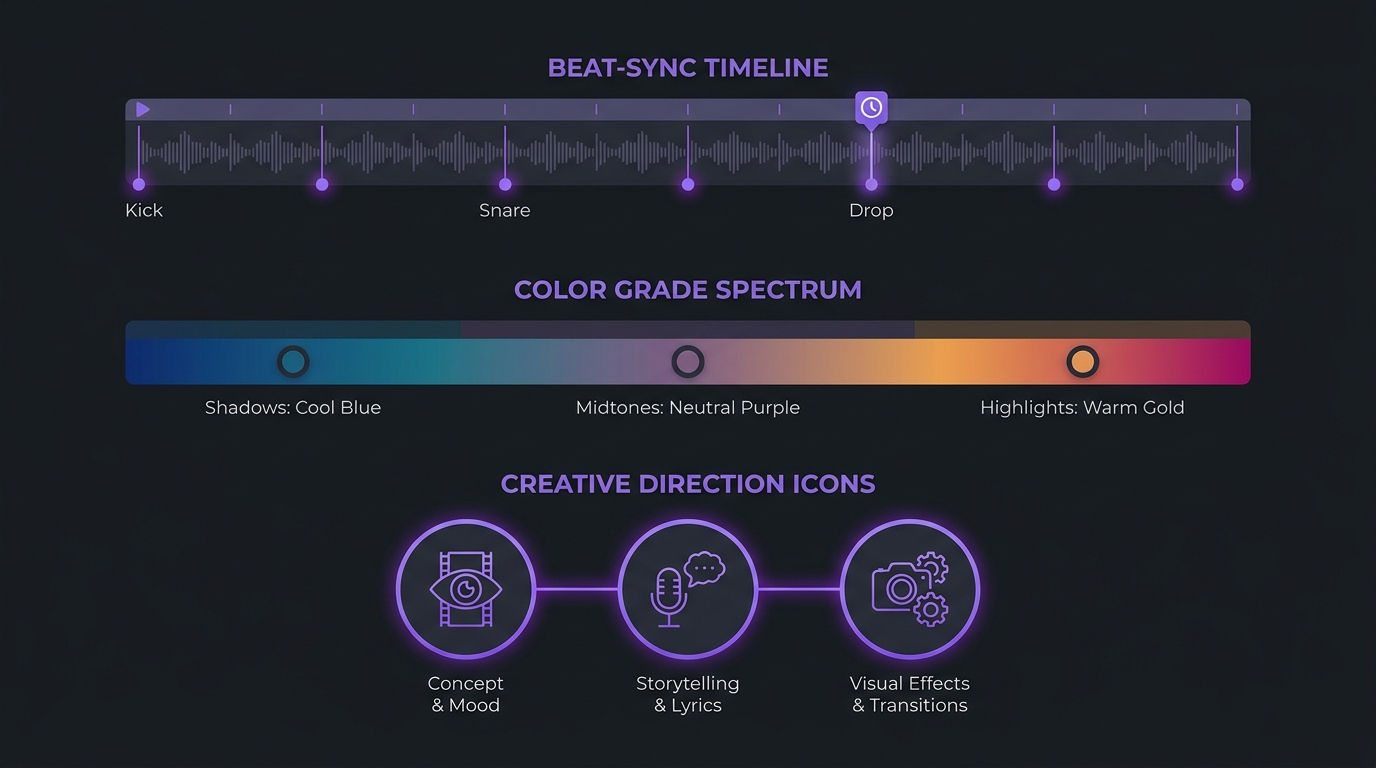
Beat-synced cutting is the art of placing edit points in relation to the music’s rhythm — not just on the downbeat, but in response to the full rhythmic texture of the track. A verse might demand a slow, floating cut pace that preserves intimacy. A chorus might demand hard cuts on every snare hit that match the energy release of the music. An editor who understands rhythm will naturally vary the pace of cuts to serve the musical moment rather than applying a mechanical formula. This is an instinct developed by editors who work regularly with music, and it shows immediately in a reel.
L-Cuts and J-Cuts for Musical Transitions
Split edits — where the audio transitions before the picture (J-cut) or the picture transitions before the audio (L-cut) — are particularly powerful in music video editing when dealing with dialogue or ambient sound layered under the track, or when cutting between scenes in a narrative video. More broadly, editors use these principles to smooth visual transitions: holding a shot a few frames longer than expected before cutting creates tension; cutting slightly early creates energy. In music video, these micro-decisions compound across hundreds of edit points.
Color Grading for Artistic Looks
Where a corporate video is graded to look clean and balanced, a music video is graded to look deliberate. This might mean deeply crushed blacks and desaturated midtones for a gritty hip-hop feel, lifted shadows and warm highlights for a nostalgic R&B palette, or high-contrast teal-and-orange looks common in pop and EDM content. Color grading for a music video requires a colorist who treats the grade as part of the creative, not a technical correction pass. Ask every company you evaluate for their color-only reel, not just their full edited videos.
Motion Graphics Synced to Music
Motion graphics in music videos range from subtle text overlays and transitions to full animated sequences synced precisely to musical events. A graphic element that pulses on the beat, a title card that appears in silence and disappears into the chorus, or a visual effect triggered by a specific sound design element — these require both technical precision and a strong feel for the music. Editors with motion design capability within their team can execute these integrated elements without a separate handoff to a motion designer, which significantly improves turnaround and creative consistency.
Music Video Formats and Matching Your Edit Style
The term “music video” covers a wider range of formats than most artists realise when they first brief an editing company. Different formats have different editing demands, and not every company is equally capable across all of them. Matching your format to the right company saves significant time and revision cycles.
Performance Videos
Performance videos — studio sessions, stage sets, or location performances — are the most common format and often the most technically demanding to edit. The challenge is selecting the best takes from multiple angles across multiple passes, maintaining energy throughout without the edit feeling mechanical, and grading footage shot under imperfect lighting conditions into a visually consistent piece. Multi-camera performance editing is a specific skill: editors must manage sync, maintain consistent energy, and select takes that feel musically alive, not just technically clean.
Narrative Music Videos
Narrative videos tell a story that runs parallel to, or illustrates, the song’s meaning. Editing a narrative music video requires the editor to understand both screen grammar and musical structure — the story must unfold at a pace that serves the song, with emotional peaks landing on musical moments rather than simply at the natural story beat. This is the most complex format and typically requires the most experienced editor. Companies with a strong fiction or branded content background often handle narrative music videos better than those whose work is primarily subscription-based social content.
Lyric Videos
Lyric videos are a distinct deliverable — motion typography synced to the vocal track, often over a visual background or abstract animation. They require motion design skills more than traditional editing skills, and the companies that do them best are often those with strong motion graphics capability. For artists releasing a single without a production budget for a full video, a high-quality lyric video is a legitimate and increasingly popular alternative that performs well on Music Ally-covered platforms.
Concept and Art Videos
Concept videos — heavily stylised, often non-narrative, built around a strong visual idea — demand the most creative latitude and the most experienced editors. These are projects where the editor is as much a collaborator as a technician, shaping the final creative from footage that was shot with flexibility in mind. Not every company is set up for this kind of open-ended creative work. Agencies with experienced senior editors — rather than subscription services with standardised workflows — are almost always the better choice here.
How to Choose the Right Music Video Editing Company
Choosing a music video editing company should start with an honest assessment of what the video needs to achieve and what your actual budget allows. The options on this list serve genuinely different client types, and matching the right company to the right project is more important than picking the highest-rated option in the abstract. The video editing services guide for creators covers adjacent considerations for artists managing a broader content strategy.
Match Budget to Quality Level
The honest truth about music video editing is that quality scales strongly with investment. A subscription service at $500 per month can produce a functional lyric video or a tidy performance cut. A premium agency relationship produces work that sits alongside label-funded content. If your video represents a flagship release — a single that will drive streaming, press coverage, and live bookings — treat the editing budget as a production cost rather than a variable to minimize. If it is a supporting piece of content in a larger social strategy, a subscription service is a rational choice.
Evaluate Portfolios by Genre and Format
Never evaluate a company’s general reel for a music video project. Ask specifically for music video work in your genre and format. A company that has cut excellent documentary content may struggle with the rhythm-forward demands of a hip-hop video. A company that excels at lyric videos may not have the narrative editing skills for a story-driven piece. The closer the existing portfolio is to your specific need, the lower the risk of a poor first cut.
Understand Revision Policies Before Signing
Revision policies vary dramatically across company types. Premium agencies typically include a defined number of revision rounds with clear feedback channels. Subscription services often allow unlimited revisions within their terms, but the quality of revision cycles depends on how well feedback is communicated. Freelancer marketplace arrangements can become contentious over revisions when expectations were not clear upfront. Clarify revision terms — number of rounds, what constitutes a revision versus a new request, and how feedback is submitted — before any engagement begins.
💡 Pro Tip: When shortlisting editing companies, ask each one: “Can you show me three examples of music videos you’ve edited in a similar genre to mine?” If they can’t produce genre-specific examples, they may be able to do the work competently, but you will be paying for their learning curve on your project. Companies with a genuine music video track record will answer this question without hesitation.
Music Video Editing Pricing: What to Budget in 2026
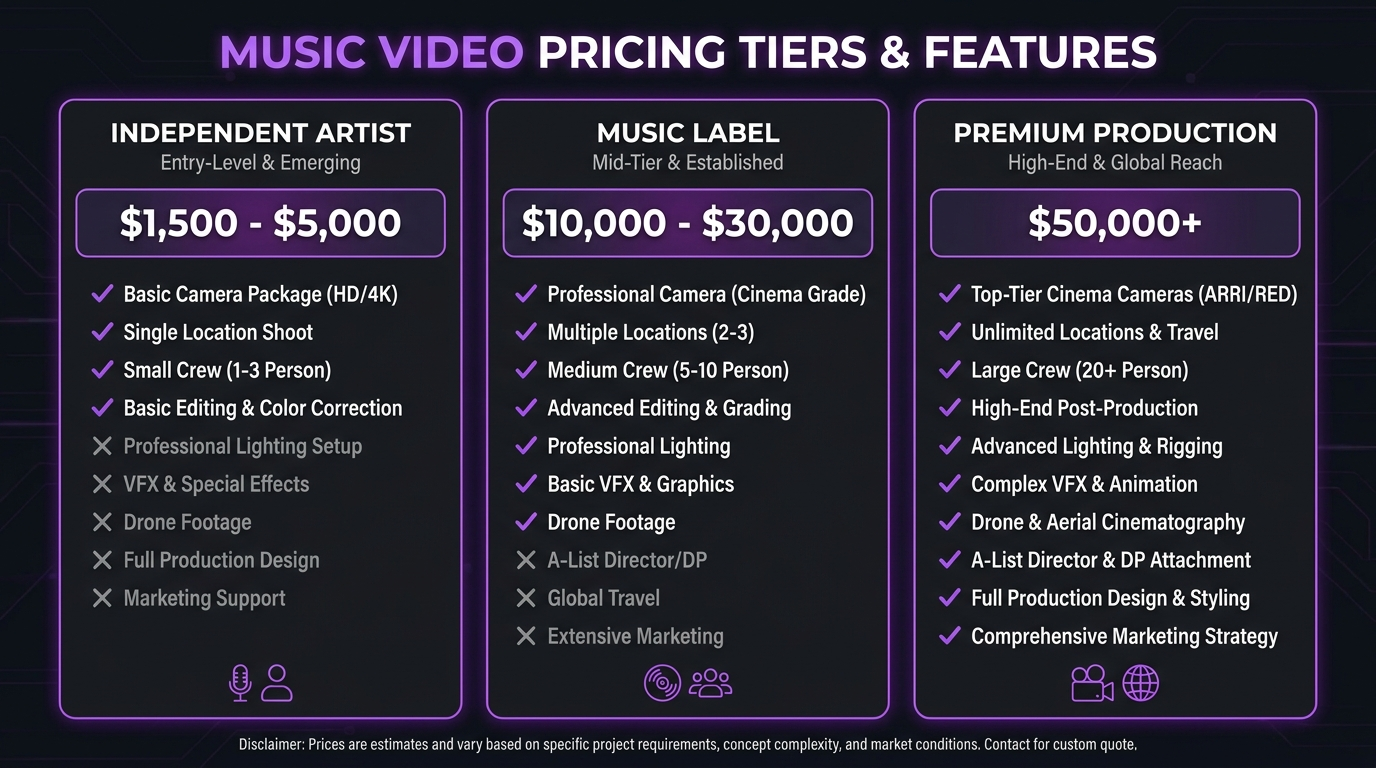
Music video editing pricing is not standardised — rates vary by company model, project complexity, turnaround requirements, and negotiated terms. The ranges below represent hedged real-world framing drawn from common market positioning rather than precise published rate cards. For a more detailed breakdown of video editing costs across project types, see the professional video editing cost guide. For an analysis of unlimited editing subscription models, the unlimited video editing services comparison covers the major options in depth.
The most common mistake artists and managers make when budgeting for editing is treating it as the final line item after production — whatever is left after the shoot. In practice, a well-edited video from good footage outperforms a poorly edited video from excellent footage. Post-production deserves a planned budget allocation from the start, not the remainder. Industry reporting from RIAA and trade publications consistently shows that music video production budgets for emerging artists typically allocate a meaningful share to post — editing, grading, and delivery across formats — as a separate line from shoot costs.
Turnaround also affects pricing. Rush delivery — a full edited music video in under five business days — typically commands a surcharge of 25–50% above standard rates across most company types. Build realistic timelines into your release planning rather than depending on rush delivery as a default.
Red Flags When Hiring Music Video Editors
The market for music video editing ranges from exceptional to actively harmful to an artist’s brand. These warning signs should prompt either serious questions or disqualification.
- No music-specific portfolio. A showreel of corporate explainer videos and wedding highlights is not evidence that an editor can handle a music video. It may indicate they have never edited for music at all. Ask for genre-specific examples or walk away.
- Inability to discuss the brief creatively. A capable music video editor asks questions: what is the emotional arc of the song? What three words describe the visual feel you want? What references are you drawing from? An editor who skips creative discussion and goes straight to deliverable specs is likely treating your video as a commodity rather than a craft project.
- No clarity on who is doing the editing. Some agencies present themselves as a premium service but outsource to junior editors or overseas teams without disclosure. Ask directly: who will edit this video, what is their background, and can I see examples of their specific work — not the agency’s general reel?
- Vague revision policies. If a company cannot clearly explain how many revisions are included, what constitutes a revision versus a new request, and how feedback is communicated, you will encounter disputes mid-project. Ambiguous revision terms are one of the most common sources of frustration in post-production relationships.
- Guaranteed virality or streaming claims. Editing does not determine streaming numbers or viral performance — content, marketing, and platform distribution determine those. Any company claiming that their editing technique will boost your streams or guarantee views is making a claim they cannot support. Treat it as a credibility issue.
- No file delivery specification upfront. A music video in 2026 typically needs delivery in multiple formats: 4K landscape for YouTube, 9:16 vertical for Reels and TikTok, potentially also a 1:1 version for Instagram feed. If a company quotes for a single export without discussing multi-format delivery, budget carefully for what additional formats will cost — or find a company that includes this as standard.
FAQ
How much does music video editing cost on average?
Music video editing costs vary widely by company model and project complexity. Subscription services commonly start around $400–$900 per month for ongoing content. Freelancer platforms like Fiverr Pro typically range from $200–$2,000+ per video depending on the editor and scope. Premium agency relationships are priced on a bespoke basis and are designed for artists with professional post-production budgets. There is no single average that covers the full range because the deliverable expectations at each price point are fundamentally different.
How long does it take to edit a music video professionally?
Professional music video editing typically takes five to fifteen business days for a standard first cut, depending on footage volume, project complexity, and the company’s current workload. Rush delivery — under five business days — is possible with most agencies and subscription services but commonly carries a surcharge. The revision process adds additional time: build in two to four business days per revision round when planning a release timeline. Factor post-production time in from the shoot date, not from the week before release.
Is it better to hire an agency or a freelancer for music video editing?
For a flagship music video release, a premium agency provides more consistent outcomes because of managed creative processes, accountability structures, and the ability to draw on specialists — colorists, motion designers, senior editors — within a single relationship. Freelancers can match or exceed agency quality at the top end, but finding the right freelancer for a specific genre and format requires significant vetting time. Freelancers make more sense for one-off projects or for artists who have already developed a trusted relationship with a specific editor. For ongoing content, subscription services offer a practical middle ground.
What file formats should a music video editor deliver?
A complete music video delivery package in 2026 should include: a 4K (or minimum 1080p) 16:9 master for YouTube and broadcast; a 9:16 vertical cut for Reels, TikTok, and YouTube Shorts; optionally a 1:1 square format for Instagram feed. Most platforms compress on upload, so delivery in ProRes or H.264 at the highest practical bitrate is standard. Confirm delivery format specifications with any editing company before the project begins — adding formats after delivery is often treated as a separate charge.
How do I brief a music video editing company effectively?
An effective music video brief covers: the song’s emotional arc in plain language (not just the genre); three reference videos with notes on what specifically you want borrowed from each; a colour direction (warm, cool, desaturated, high-contrast); platform delivery requirements; your revision round budget and timeline; and a clear statement of what the video should make the viewer feel by the end. The more specific the brief, the better the first cut. Generic briefs produce generic edits.
Verdict
The best music video editing company is the one that matches your project’s needs, not the one with the longest client list. For a flagship music video that represents an artist’s brand, Increditors is the strongest option in 2026: senior editors, a genuine creative direction layer, and a commitment to post-production as a craft rather than a throughput operation. For labels and publishers managing ongoing content across multiple artists, VideoEditingCompany provides the most operationally efficient retainer model, with dedicated teams that accumulate artist knowledge over time.
For independent artists who need consistent social content at a predictable budget, Tasty Edits and We Edit Videos serve that use case well, with the understanding that full-scale music video production is not their core strength. Fiverr Pro works for one-off projects when you have time to vet thoroughly. 90 Seconds is a viable option only at enterprise budgets. Rocketium sits in its own category as a platform tool rather than an editing service.
Regardless of which company you choose, the fundamentals are the same: brief thoroughly, evaluate music-specific portfolio work, clarify revision terms before signing, and build your post-production timeline into your release plan — not as an afterthought.
Ready for Video That Actually Converts?
Tell us about your project and we will put together a custom plan.