








![3D Explainer Video - ScribbleLive.mp4_snapshot_00.12_[2022.03.09_03.14.16]](https://increditors.com/wp-content/uploads/elementor/thumbs/3D-Explainer-Video-ScribbleLive.mp4_snapshot_00.12_2022.03.09_03.14.16-r7wb53mx72rxst3qcqyrfxdmeyzb5r9jbl0wbjujh4.png "3D Explainer Video – ScribbleLive.mp4_snapshot_00.12_[2022.03.09_03.14.16]")




























Color grading typically costs $50–$300 per finished minute or $150–$2,500 per video, depending on footage complexity, colorist tier, deliverable formats, and whether grading is bundled with editing or quoted separately. Entry-level freelancers start around $25–$75/hr; senior colorists and post-production studios run $150–$600/hr. This guide breaks down per-video and per-minute rates across every tier, explains what actually drives the price, and shows you how to read a color grading quote before signing anything.
- What Is Color Grading (and Why Is It Priced Separately)?
- Color Grading Cost Per Video: Real Market Ranges
- Color Grading Cost Per Minute: How Colorists Actually Quote
- What Drives the Price Up (or Down)?
- Color Grading Pricing Models Compared
- Freelancer vs. Colorist Studio vs. Agency Bundle
- Should You Separate Color Grading from Editing?
- How to Evaluate a Color Grading Quote
- FAQ
- Verdict
What Is Color Grading (and Why Is It Priced Separately)?
Color grading is the process of stylistically transforming footage after primary color correction has stabilized the image. It is distinct from editing — and in professional pipelines, it is almost always a separate line item. Understanding that distinction is the first step to budgeting for it accurately.
Here is how post-production typically breaks down:
- Primary color correction: Normalizing exposure, white balance, and contrast across all clips so every shot is technically consistent. This is often included in editing quotes.
- Color grading (secondary): Applying a creative look — selective hue shifts, skin tone protection, scene-by-scene stylization, LUT creation, and aesthetic decisions that serve the brand or narrative. This is where the per-minute and per-video rates you will see in this guide apply.
- Deliverable mastering: Exporting in multiple color spaces (Rec.709, DCI-P3, HDR10, HLG) or aspect ratios for different platforms. Each additional deliverable adds time and cost.
Many editing quotes include basic primary correction but explicitly exclude “full color grade” — meaning a distinct look, LUT package, or multi-format delivery. If you are comparing proposals and one is significantly cheaper, check whether color grading is in scope. That omission commonly accounts for 20–40% of a project’s total post-production cost.
Most professional colorists work in DaVinci Resolve, the industry standard for high-end grading, though Premiere Pro’s Lumetri Color, Final Cut Pro, and FCPX’s built-in Color Board are common at mid-tier. Software choice affects cost indirectly — DaVinci Resolve’s node-based workflow is faster for complex grades, but it requires a colorist who trained specifically on it.
Why Color Grading Is Often the Last Thing Budgeted — and Why That’s a Mistake
Most brands budget for shooting and editing, then realize color grading wasn’t in the original quote after footage has already been delivered. Retrofitting a grade at that stage — especially when the footage was shot in a flat log profile that requires grading — costs more than building it in from the start. Productions shot in S-Log3, LOG-C, or other log formats are not watchable without a grade; factoring color grading cost into your pre-production budget is not optional for that category of project.
Color Grading Cost Per Video: Real Market Ranges
Per-video pricing is the most common way brands receive color grading quotes — and the hardest to compare, because scope varies significantly. The ranges below reflect real market rates as of 2026, segmented by video length and grading tier. They are presented as ranges, not guarantees, because deliverable count, footage complexity, and colorist reputation all push individual quotes outside these bands.
Short-Form Video (Under 5 Minutes)
Short-form includes social ads, 60-second brand spots, Instagram Reels, YouTube Shorts, and explainer videos. Color grading for this length typically runs faster than editorial work because there are fewer cuts to match and scenes are often contained.
Mid-Length Video (5–30 Minutes)
Corporate videos, product demos, webinar recordings, and long-form YouTube content fall in this range. At this length, scene count matters: a 20-minute documentary with 80 distinct locations requires significantly more matching work than a 20-minute talking-head interview shot in one room.
Feature-Length and Long-Form Projects
Independent films, docuseries episodes, and full-length brand films (45 minutes or more) enter a different category. At this scale, most productions engage a dedicated colorist on a daily rate or per-project flat fee rather than hourly. Day rates for senior colorists commonly start around $800–$2,500/day; a full feature film DI (digital intermediate) at a professional suite can range from $15,000 to $80,000 or more depending on resolution (4K, 6K, 8K), HDR requirements, and studio overhead.
💡 Pro Tip: Always clarify whether the quote includes a “color managed” workflow. A colorist working color-managed (input transforms, working color space, output transforms) can deliver to multiple platforms from a single grade session. One who works directly in Rec.709 will need to re-grade for HDR deliverables — effectively charging twice for the same footage.
Color Grading Cost Per Minute: How Colorists Actually Quote
Per-minute pricing is the most transparent model for color grading — it removes ambiguity about scope and makes comparing multiple quotes straightforward. Experienced colorists increasingly prefer it because it aligns payment to deliverable length rather than estimated hours, which can vary based on how well-organized the edit is when it arrives for grading.
Per-Minute Rate Breakdown by Tier
Note that “per finished minute” means the runtime of your final export, not the amount of raw footage reviewed. A 3-minute commercial shot over two days with 180 minutes of raw footage still quotes at 3 finished minutes — though a colorist may add a “prep” or “log review” fee if the raw media is particularly disorganized or shot inconsistently across cameras.
How Footage Complexity Multiplies the Rate
Even within the same per-minute tier, complexity modifiers apply. Colorists commonly adjust for:
- Mixed camera packages: Matching footage from a Sony FX3, an iPhone, and a DJI drone in the same scene adds 30–60% more time due to differing noise profiles, color science, and dynamic range.
- Mixed lighting environments: Scenes crossing from tungsten to natural light, or from interior to exterior, require more complex secondary masks and power windows to maintain consistency.
- Log/RAW footage: Footage delivered in a flat log profile (S-Log3, LOG-C, BRAW) needs a starting LUT or creative transform before grading can begin, adding to session time.
- VFX composites and green screen: Color grading over unfinished VFX or keyed composites requires iterative passes as visual effects finalize — a workflow that adds cost and communication overhead.
- HDR deliverables: HDR10, HLG, and Dolby Vision exports each require their own trim pass. The YouTube HDR content guidelines specify color space and transfer function requirements that add mastering steps not present in a standard SDR delivery.
What Drives the Price Up (or Down)?
Color grading quotes vary by 10x or more between vendors for identical footage lengths. Here are the real drivers — understanding them lets you negotiate intelligently and identify when a cheap quote is a risk versus when it is simply efficient scope.
Software and Hardware Environment
Colorists working on a calibrated reference monitor (like a Flanders Scientific or Sony BVM) with a hardware control surface and a color-managed display pipeline charge more — and the result is meaningfully different from someone grading on an uncalibrated laptop. The Colorist Society International maintains standards for professional grading environments; colorists working to those standards price accordingly.
GPU speed also matters. Noise reduction, temporal smoothing, and high-resolution debayering in DaVinci Resolve are computationally intensive. A colorist with a high-end GPU workstation processes faster, meaning their effective per-hour output is higher even if their hourly rate is also higher.
Deliverable Count and Color Spaces
The most common hidden cost in color grading quotes is deliverable scope. A quote for “color grading” often means one version in one color space. If you need:
- A broadcast master (Rec.709)
- A social media export (sRGB or Rec.709 with different gamma)
- An HDR version (HDR10 or HLG)
- A widescreen plus a 9:16 crop for vertical platforms
- A neutral “archival” version for future use
…you may be looking at five distinct outputs. Each adds render time and often a trim pass. Make sure the quote you are comparing lists deliverables explicitly.
Turnaround Time
Standard turnaround for color grading is typically 2–5 business days for short-form content at the freelance tier. Requesting delivery within 24–48 hours commonly adds a rush premium of 25–50% on top of the base rate. Post-production studios often have minimum scheduling windows of 1–2 weeks for feature-length work; rush availability on those projects can double or triple the cost.
Colorist Experience and Location
Location affects market rate significantly. Colorists based in Los Angeles, London, and New York typically command 30–60% higher rates than equivalently skilled colorists in Eastern Europe, Southeast Asia, or Latin America. Remote color grading has normalized this market somewhat — you can engage a senior DaVinci Resolve specialist anywhere in the world via a review platform like Frame.io or Dropbox Review, which has increased supply and moderated the premium for geographic flexibility.
Experience level is best evaluated by reviewing a colorist’s portfolio for footage that resembles yours — specifically, similar camera packages, lighting conditions, and aesthetic targets. The International Cinematographers Guild and professional organizations maintain directories of credentialed colorists, though most working professionals list their reels on Vimeo or through agency representation rather than industry databases.
Color Grading Pricing Models Compared
Color grading is quoted in four primary models. Knowing which model a vendor is using is essential for accurate comparison — a $100/hr quote and a $120/finished-minute quote are not directly comparable without understanding typical session ratios for your footage type.
Monthly retainers that bundle color grading with editing — the model used by a video editing agency managing your post-production end-to-end — typically offer the best effective per-video cost at volume. Instead of negotiating individual project rates, you get a dedicated team with a consistent look across all output. For brands producing four or more videos per month, the overhead of sourcing, briefing, and reviewing a separate colorist per project commonly exceeds any savings from using a cheaper one-off freelancer.
Freelancer vs. Colorist Studio vs. Agency Bundle
Choosing between a freelance colorist, a dedicated post-production studio, and a bundled agency retainer is not purely a cost decision — it involves workflow, consistency, and what happens when something goes wrong.
💡 Pro Tip: When evaluating a freelance colorist, ask for their full client list on a similar project type — not just their showreel. A reel is curated; the projects they graded for a brand with similar production values to yours will tell you more. Also ask what happens if they become unavailable mid-project: freelancers have no redundancy plan by default.
For brands that produce content at volume and need color consistency across a library, working with a professional video editing team that includes color grading in the workflow often delivers better economics than sourcing a separate colorist per project. The overhead of briefing, transferring footage, reviewing, and aligning a colorist to your brand’s look guide on every project adds invisible cost beyond the quoted rate.
Should You Separate Color Grading from Editing?
This is the question most brands face when their video budget grows beyond ad-hoc production. The answer depends on your volume, your brand’s visual standards, and your internal bandwidth.
When It Makes Sense to Separate Them
- High-end film production: Feature films and premium brand films benefit from a dedicated colorist as a creative director of the image — working with the DP’s vision in ways that a generalist editor typically cannot match.
- Broadcast and streaming deliverables: If you are delivering to Netflix, Amazon, or broadcast networks, technical specifications for color space, peak brightness, and gamut mapping require a specialist with the right calibration gear.
- VFX-heavy productions: Visual effects pipelines benefit from a colorist who enters the workflow earlier — working with the VFX team on reference grades — rather than being the final step before delivery.
When Bundling Is the Better Choice
- Recurring branded content: Social media, corporate videos, testimonials, and product demos benefit from a consistent look applied by the same team every time, without re-briefing a separate colorist.
- Multi-format output requirements: If every video needs versions for YouTube, LinkedIn, Instagram, and a website player, a bundled agency workflow handles the format logic without you needing to manage multiple vendor relationships.
- Speed requirements: A team that edits and grades is faster end-to-end because there is no handoff delay between the editing timeline and the color session.
Understanding the cost of a video editing retainer that includes grading versus sourcing both services separately is worth modeling before your next contract negotiation. The break-even point for most volume content programs typically falls around 3–5 videos per month — below that, ad-hoc sourcing is fine; above that, bundled workflows usually win on total cost of ownership.
How to Evaluate a Color Grading Quote
A color grading quote should answer eight questions. If any are missing, get clarity before signing — ambiguity on these items commonly doubles actual cost.
- What is the pricing model? Hourly, per-minute, per-project flat fee, or day rate.
- What software and environment? DaVinci Resolve on a calibrated reference monitor is not the same as Lumetri on a consumer display. For color-critical work, ask about monitor calibration documentation.
- What deliverables are included? List every color space, aspect ratio, and format you need. Confirm they are all in scope.
- How many revision rounds are included? What counts as a “revision” (global look changes vs. spot corrections)? What is the rate for additional rounds?
- Is primary correction included, or only secondary grade? A quote for “color grade” that assumes you deliver a pre-corrected edit will produce a different result than one that starts from raw log footage.
- Who owns the project file? If you need to re-export in a new format two years later, do you have access to the DaVinci Resolve project, or does that require re-engagement?
- Is a custom LUT or look guide delivered? Receiving a LUT you can use across future projects adds long-term value beyond the immediate deliverable.
- What are the payment and rush terms? Standard colorist contracts commonly require a deposit of 25–50% before work begins, with the balance on delivery. Rush premiums should be defined in writing.
For comparison benchmarking, the American Society of Cinematographers and Colorist Society International both publish resources on professional post-production standards. Vendors working to professional guild norms generally use industry-standard contracts with clear deliverable and revision language.
Understanding video ad production costs holistically — including color grading, sound design, and platform-specific formatting — gives you leverage in negotiations because you can compare total project costs rather than individual line items that may not be equivalent.
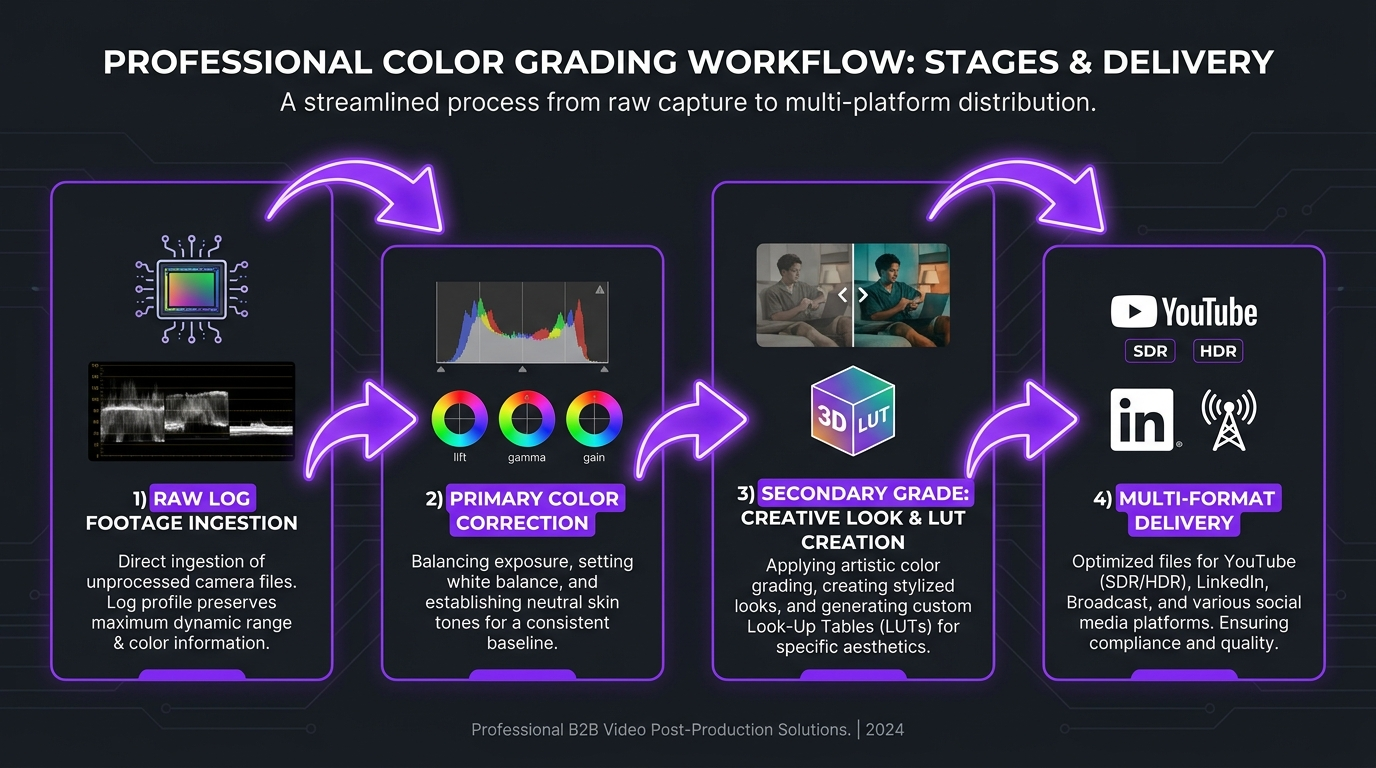
Color grading pricing tiers: per-minute and per-video rates by colorist level, 2026 benchmarks
Frequently Asked Questions
How much does color grading cost for a 2-minute video?
A 2-minute video typically costs $75–$500 for color grading depending on tier and complexity. A freelance colorist in the entry-to-mid range may quote $100–$250 for a straightforward single-location corporate piece; a senior colorist or studio handling multi-format delivery with a custom LUT would commonly quote $400–$800 or more for the same runtime. Complexity modifiers — mixed cameras, log footage, HDR deliverables — push costs toward the higher end regardless of length.
Is color grading included in video editing quotes?
Not always — and this is the single most common source of surprise costs in post-production. Many editing quotes include “basic color correction” (normalizing exposure and white balance) but explicitly exclude a “full color grade” (creative stylization, secondary grading, LUT creation, or multi-format delivery). Always ask the editor what color work is in scope and get confirmation in writing before the project starts.
What is the difference between color correction and color grading — and do I need both?
Color correction is technical: it fixes problems — over/underexposed shots, mixed white balance, inconsistent clip-to-clip exposure. Color grading is creative: it applies a visual style that serves the brand or narrative. Most professional videos need both. Correction ensures the footage is watchable and consistent; grading ensures it looks intentional and on-brand. In practice, the two often happen in the same session, but a colorist will price them differently if one requires significantly more work than the other.
Can I reuse a color grade or LUT across future videos?
Yes — and this is one of the most underrated long-term cost efficiencies in video production. When you commission a color grade and receive the corresponding LUT (look-up table), your editor or colorist can apply that same starting look to all future footage shot under similar conditions. This reduces per-video grading cost significantly for brands with a consistent visual identity and consistent shooting conditions. Confirm upfront that LUT delivery is part of the engagement and that you own the files outright.
How much does motion graphics affect color grading cost?
Motion graphics composited over footage can complicate the grading pass — especially when graphics are embedded in the timeline before the colorist receives it (meaning the grade affects the graphics as well as the footage). Best practice is to deliver a “clean plate” version with graphics off for grading, then composite them after. When this isn’t possible, colorists commonly add 15–30% to their quote to account for the additional work of protecting graphic elements from color transforms. For more on motion graphics pricing as a separate line item, that cost analysis covers the full range from template-based to custom animation.
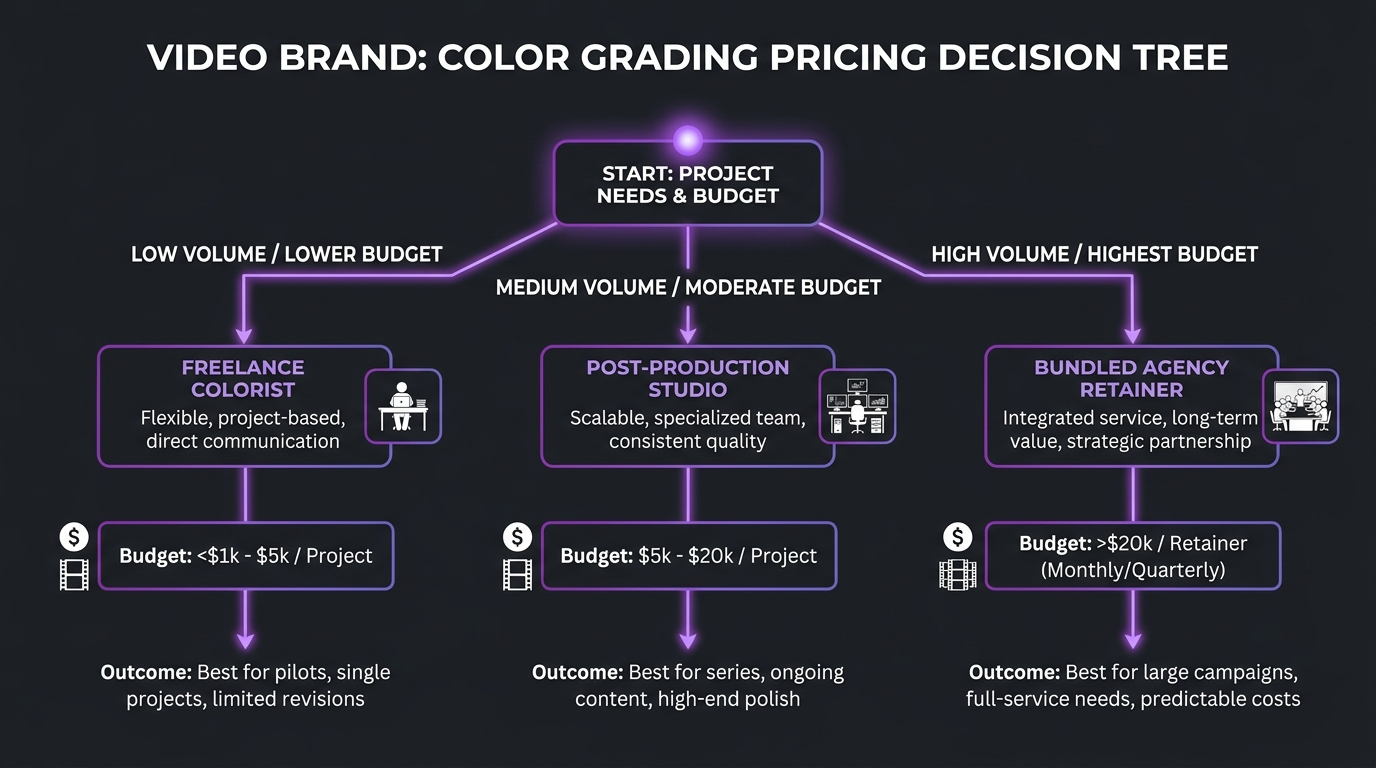
Color grading workflow: from raw log footage to final multi-format delivery
Verdict: What to Pay for Color Grading in 2026
Color grading is not a luxury line item — for any video shot in a log or RAW format, it is a technical requirement. For branded content, it is the single largest visual differentiator between footage that looks “good” and footage that looks professional and intentional.
Here is a practical summary:
- Short-form social content (under 5 minutes): Budget $150–$600 for a solid freelance grade; $400–$1,500 for senior-level quality with multi-format delivery.
- Mid-length corporate or brand video (5–30 minutes): $500–$3,000 depending on scene complexity and deliverable count.
- Per-minute rate range: $50–$300/finished minute is the realistic band for professional work; $30–$50/min often means basic correction only; above $300/min signals a premium or broadcast specialist.
- Volume content programs (4+ videos/month): Evaluate bundled agency retainers — the overhead savings on sourcing, briefing, and managing a separate colorist commonly outweigh per-project freelance savings at this volume.
Before approving any quote, verify what deliverables are included, whether a LUT is part of the package, and how revision rounds are defined. Those three variables account for the majority of “the final bill was 40% higher than quoted” scenarios in color grading engagements.
For brands producing consistent video content at scale, working with an experienced video editing agency that integrates color grading into the post-production workflow — rather than adding it as a separate vendor relationship — typically delivers better visual consistency, predictable costs, and faster turnaround across your entire content library.
Ready for Video That Actually Converts?
Tell us about your project and we will put together a custom plan — editing, color grading, and delivery included.