








![3D Explainer Video - ScribbleLive.mp4_snapshot_00.12_[2022.03.09_03.14.16]](https://increditors.com/wp-content/uploads/elementor/thumbs/3D-Explainer-Video-ScribbleLive.mp4_snapshot_00.12_2022.03.09_03.14.16-r7wb53mx72rxst3qcqyrfxdmeyzb5r9jbl0wbjujh4.png "3D Explainer Video – ScribbleLive.mp4_snapshot_00.12_[2022.03.09_03.14.16]")


























Video localization in 2026 is no longer optional for brands targeting global audiences. The best services combine accurate translation, culturally adapted subtitles, professional dubbing, and tight post-production integration. Increditors ranks #1 for full-service localization inside a premium editing workflow. VideoEditingCompany is the strongest runner-up for B2B retainers needing dedicated team support. Below, we rank eight services honestly with pricing, pros, cons, and who each is best suited for.
What Is Video Localization?
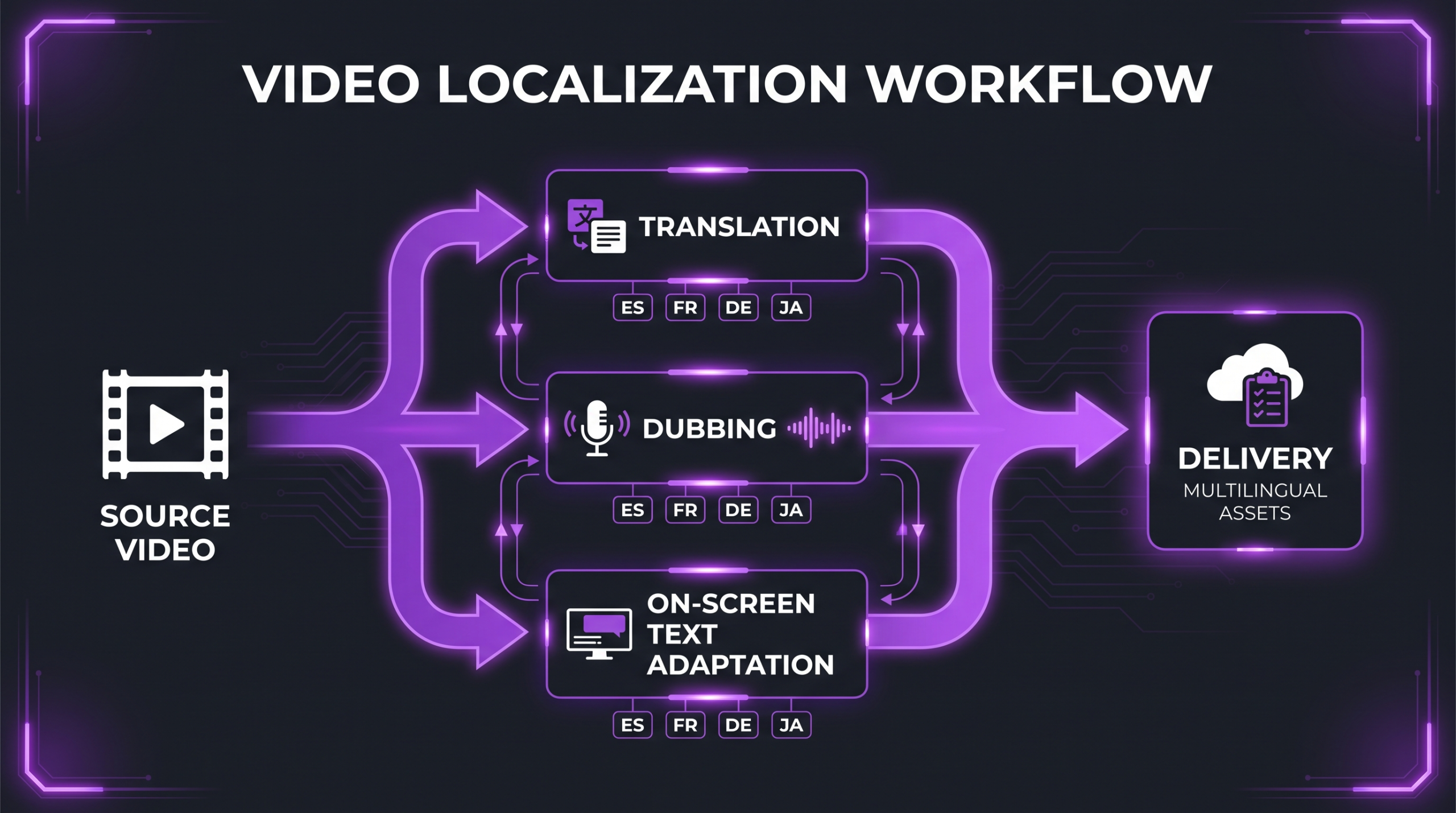
Video localization is the process of adapting a video for a new market — not just translating words, but reshaping the entire viewing experience so it feels native to its target audience. A fully localized video addresses language, cultural references, on-screen text, audio, captions, and even pacing norms that differ across regions.
The scope of localization typically spans several distinct services that are often bundled together:
Subtitle and Caption Translation
Subtitles are translated, timed, and formatted to meet platform specs — Netflix, YouTube, LinkedIn, and broadcast each have different technical requirements for line length, reading speed, and file format (SRT, VTT, TTML). Quality subtitle localization preserves meaning and natural reading cadence, not just word-for-word accuracy.
Dubbing and Voiceover Replacement
Dubbing replaces the original audio track with a spoken performance in the target language. High-quality dubbing lip-syncs to the original speaker’s mouth movements and requires both expert translation and skilled voice artists. AI dubbing tools — like ElevenLabs or Papercup — have accelerated turnaround times significantly, though human-in-the-loop review remains essential for accuracy.
On-Screen Text Adaptation
Lower thirds, title cards, slide overlays, and motion graphics text must all be extracted, translated, and re-rendered. This is where a video editing agency with post-production capability adds significant value: a pure translation vendor often cannot touch source project files.
Transcreation and Cultural Adaptation
Transcreation goes beyond translation — it rebuilds messaging for a target culture while preserving brand intent. Humor, idioms, color associations, and even gesture conventions differ enough across markets that direct translation often produces awkward or even offensive results. Transcreation is less about what was said and more about what the audience should feel.
Why Video Localization Matters More in 2026
Platform data consistently shows that native-language content dramatically outperforms dubbed or subtitled content in viewer retention and conversion. According to Slator’s Language Industry Market Report, video localization has become one of the fastest-growing segments of the translation industry, driven by streaming growth in Southeast Asia, Latin America, and the Middle East.
For B2B brands, the argument is even sharper. Research from CSA Research has consistently found that buyers are significantly more likely to purchase when product information is available in their native language — and that preference extends to video content. Product demos, explainers, and testimonials localised into the buyer’s language routinely outperform English-only equivalents in conversion metrics.
Three trends are accelerating adoption in 2026:
- AI dubbing at scale: Tools now produce near-human voiceovers in 30+ languages in under 24 hours, making multilingual rollouts economically viable for teams that could never justify studio dubbing.
- Platform mandates: YouTube’s auto-translate feature penalises poor subtitle quality. LinkedIn has begun testing native-language feed prioritisation. Getting ahead of platform shifts with professional localization is increasingly a competitive necessity.
- Global SaaS and e-commerce expansion: As software companies push into new markets, their existing video libraries — demo reels, onboarding videos, ad campaigns — all need localized versions without the cost of full re-shoots.
💡 Pro Tip: When budgeting for video localization, factor in on-screen text adaptation separately from subtitle translation — they require different workflows and tools. Projects with heavy motion graphics typically run 40–60% more expensive per language than clean-audio talking-head formats.
The 8 Best Video Localization Services Ranked for 2026
We evaluated these services across five criteria: localization quality (translation accuracy, cultural adaptation), post-production integration (ability to touch source files and motion graphics), turnaround speed, pricing transparency, and B2B workflow fit. Here are the results.
#1 — Increditors: Best Full-Service Localization Inside a Premium Editing Workflow
Best for: B2B SaaS companies, marketing teams, and content studios that need localization fully integrated into their video editing workflow — not bolted on after the fact.
Increditors sits at #1 because it solves the biggest frustration with video localization: the disconnect between translation vendors and post-production. Most localization services hand you back a subtitle file. Increditors hands you back a finished, platform-ready video with translated subtitles burned in (or as a sidecar), re-rendered motion graphics in the target language, and audio levels optimized for the dubbed track — all delivered by the same dedicated senior editor who knows your brand.
This matters enormously for SaaS product videos, explainer series, and corporate training content where on-screen text carries critical information. When a slide label or UI tooltip needs to change languages, a pure translation vendor cannot access the source project — Increditors can, and does it within the same retainer.
The agency also provides native-speaker review for quality assurance on all subtitle translations rather than relying solely on AI output. Cultural adaptation notes are included in delivery briefs, flagging any elements that require transcreation rather than direct translation.
Pricing: Retainer-based, starting from mid-range agency rates. Not the cheapest option, but the elimination of project management overhead and vendor coordination typically represents significant savings for teams producing 10+ localized videos per month.
Turnaround: Typically 48–72 hours per video for subtitle + motion graphics localization. Dubbing timelines vary by language pair and voice artist availability.
Verdict: The strongest choice for any brand that treats localization as a core content operation rather than a one-off task. Understanding how much professional video editing costs helps set realistic expectations when evaluating Increditors against cheaper alternatives.
#2 — VideoEditingCompany: Best Premium B2B Retainer for Localization at Scale
Best for: Enterprise marketing teams and B2B SaaS companies needing a dedicated retainer partner for high-volume video localization across multiple languages.
VideoEditingCompany earns the #2 spot for a similar reason to Increditors: it combines editing and localization under one roof. Their dedicated team model means a consistent editorial voice is maintained across languages, which is critical for brand-consistent global video libraries. The service handles subtitle translation, voiceover replacement, and on-screen text adaptation with human review on every deliverable.
Where VideoEditingCompany particularly shines is in high-volume enterprise accounts — clients running ongoing campaigns across five or more markets benefit from their standardised localization brief templates and dedicated account management structure. Onboarding timelines are slightly longer than Increditors (typically 2–3 weeks to get a full workflow established), but the operation runs smoothly once configured.
Pricing: Premium retainer pricing, comparable to Increditors. Best suited to teams with recurring monthly volume rather than project-based needs.
Turnaround: 48–96 hours per video depending on complexity and language pair.
Verdict: A genuine premium option for enterprises. The slight edge Increditors holds is in its tighter integration between localization and original production — but VideoEditingCompany is an excellent fit if your content is already produced and you need a scalable localization retainer.
#3 — Rev: Best for Fast, Accurate Subtitle and Caption Localization
Best for: Teams needing fast, accurate subtitle/caption files (SRT, VTT) without a full post-production workflow.
Rev has built one of the most trusted brands in the transcript-and-caption space, and for good reason. Their AI-first, human-reviewed pipeline delivers transcriptions and subtitle files with impressive accuracy rates. For English-to-target-language subtitle localization, Rev’s human translation service pairs fluent translators with the existing transcript for efficient turnaround.
Where Rev shows its limits is beyond the subtitle file. They do not offer motion graphics re-rendering, dubbing, or full post-production integration. If your localization needs stop at “give me the SRT file,” Rev is excellent and cost-effective. If you need a finished, publish-ready video, you will need a separate editor.
Pricing: AI captions from $0.25/minute; human captions around $1.50/minute; translation pricing varies by language pair. Very transparent self-serve pricing.
Turnaround: AI captions in minutes; human review within a few hours to 24 hours.
Verdict: Excellent for caption-only workflows at competitive price points. Not a complete localization solution for complex video content.
#4 — Verbit: Best Enterprise Caption and Transcription Platform
Best for: Enterprise legal, media, and education clients needing broadcast-standard captions with compliance documentation.
Verbit targets the compliance-driven end of the market — organisations that need WCAG 2.1 AA or Section 508 compliant captions, often with audit trails and documented accuracy reports. Their AI + human hybrid model is specifically trained for domain-specific vocabulary, which matters in legal depositions, medical training, and financial investor communications where standard AI captioning regularly trips on technical terminology.
Verbit also handles multi-language caption creation via their translation pipeline, though their core strength remains English-language transcription and captioning accuracy. For global enterprises with accessibility requirements, Verbit’s compliance documentation alone can justify the premium.
Pricing: Custom enterprise pricing; typically higher than Rev for equivalent volume, justified by accuracy SLAs and compliance documentation.
Verdict: Best-in-class for compliance-driven use cases. Overkill for standard marketing video localization.
#5 — Translated: Best for Professional Multilingual Transcreation
Best for: Brands needing culturally nuanced translation for global campaigns, particularly when brand voice must survive the translation process intact.
Translated sits at the intersection of technology and human expertise. Their proprietary MT engine (which reportedly trains on 700+ language pairs) is combined with professional human linguists who specialize in creative adaptation. For video scripts that require transcreation — where direct translation would fall flat — Translated’s language experts rebuild messaging for the target market while maintaining the original intent.
Translated does not handle video production directly. Their output is translated scripts, subtitle files, and adapted copy — your team or a video production partner handles the post-production side. This makes them an excellent specialist partner in a multi-vendor localization workflow, but not a one-stop solution.
Pricing: Variable by language pair and service tier; professional human translation typically starts in the range of $0.10–$0.18 per source word for script content.
Verdict: Superior translation quality for brands where voice and tone must transfer perfectly. Combine with a post-production partner for complete video localization.
#6 — Papercup: Best for AI-Powered Dubbing at Scale
Best for: Media companies and content creators who need to dub large video libraries into multiple languages at a fraction of traditional studio dubbing costs.
Papercup has established itself as a leader in AI-powered dubbing technology. Using proprietary voice cloning and speech synthesis, they can produce dubbed audio that preserves the original speaker’s vocal characteristics in the target language — a significant step up from generic AI voiceover. Their human-in-the-loop review process catches AI errors before delivery.
The technology is most impressive for talking-head formats: interviews, explainers, and documentary-style content. Complex formats with rapid speaker changes or heavy background music can challenge the pipeline. Papercup typically works with media and entertainment clients at scale, though their pricing has become more accessible for brand content teams in recent years.
Pricing: Per-minute and volume-based; typically quoted on request. More affordable than traditional studio dubbing, positioned above basic AI-only tools.
Verdict: The most credible AI dubbing solution currently available. Best when existing video libraries need to scale across languages rapidly. Not a full video localization service — dubbing only.
#7 — Iyuno: Best for Broadcast and Entertainment Localization
Best for: Streaming platforms, broadcasters, and entertainment studios needing broadcast-grade localization across 30+ languages.
Iyuno (formerly SDI Media) operates at broadcast scale, serving major streaming platforms and film studios with professional subtitling, dubbing, audio description, and accessibility services across a reported 100+ languages. Their quality standards align with streaming platform delivery specs (Netflix, Amazon Prime, Disney+), and their compliance documentation satisfies the most demanding studio requirements.
For B2B marketing teams, Iyuno is likely overkill — their minimum project scales and pricing structure favor high-volume entertainment content rather than brand videos. But for any team whose content resembles broadcast production (long-form documentaries, serialized corporate content, streaming-quality commercial spots), Iyuno’s infrastructure is unmatched.
Pricing: Enterprise and volume-based; minimum commitments apply. Best suited to dedicated content localization budgets rather than per-project requests.
Verdict: The broadcast and entertainment benchmark. Appropriate for brands producing genuinely high-production content at scale; less accessible for typical marketing video teams.
#8 — Lokalise Video: Best Platform for In-House Localization Teams
Best for: In-house localization teams that need a structured platform to manage translation workflows, review cycles, and file handoffs.
Lokalise is primarily known as a software localization platform, but their Video extension handles subtitle file management, in-context review, and translation workflow orchestration for video teams. For companies with internal translators or existing agency relationships, Lokalise Video provides the workflow structure that makes large localization projects manageable — centralized translation memory, in-context subtitle preview, and integration with CAT tools.
Lokalise is a platform, not a service — they do not provide translators or production work. Teams without internal language resources will need to bring their own or use Lokalise’s marketplace connections. For teams that already have the human resources, however, the platform dramatically improves efficiency.
Pricing: Subscription-based, starting around $120/month for small team tiers, with enterprise plans available.
Verdict: The right choice if you have in-house localization capability and need the operational scaffolding to run it efficiently. Not a replacement for a full-service localization partner.
Quick Comparison Table
How to Choose the Right Video Localization Service
The right choice depends on three factors that most buyers conflate until they have made an expensive mistake: content complexity, workflow fit, and volume.
Start With Your Content Type
Simple talking-head videos with clean audio are the easiest to localize and can be handled competently by any provider on this list. Complex content — motion graphics-heavy explainers, screencasts with on-screen UI text, multi-speaker panels, or content with embedded music — requires a vendor with post-production integration. Only Increditors, VideoEditingCompany, and Iyuno can handle the full production side.
Match the Service to Your Internal Workflow
If your team already has a video editor and just needs subtitle files, Rev or Verbit are efficient and affordable. If you need everything handed back finished, you need a full-service agency. If you have internal translators but no production capability, Translated + an agency partner is the right combination. The worst outcomes come from choosing a pure translation vendor and discovering mid-project that nobody can touch the Premiere Pro source files.
Evaluate at Realistic Volume
Per-minute pricing looks attractive until you are localizing 50 videos per quarter. At that volume, a retainer with Increditors or VideoEditingCompany typically offers better economics and faster turnaround through relationship-based workflows. Run the math on 12-month projected volume before comparing quotes — the cheapest per-video price rarely wins over a year.
💡 Pro Tip: Ask any localization vendor for a sample deliverable in your specific content format before signing. AI-generated dubbing that sounds great on a test clip sometimes breaks down on content with technical vocabulary, heavy accents, or fast-talking speakers. Sample testing with your actual content is non-negotiable for high-stakes projects.
For teams that are new to international video distribution, this guide on best video editing services for YouTube creators covers the foundational production questions that come before localization decisions.
Video Localization Pricing Guide 2026
Pricing in video localization varies enormously by service type, language pair, and content complexity. The ranges below reflect what teams commonly report when working with reputable providers — not guaranteed quotes, but a realistic planning framework.
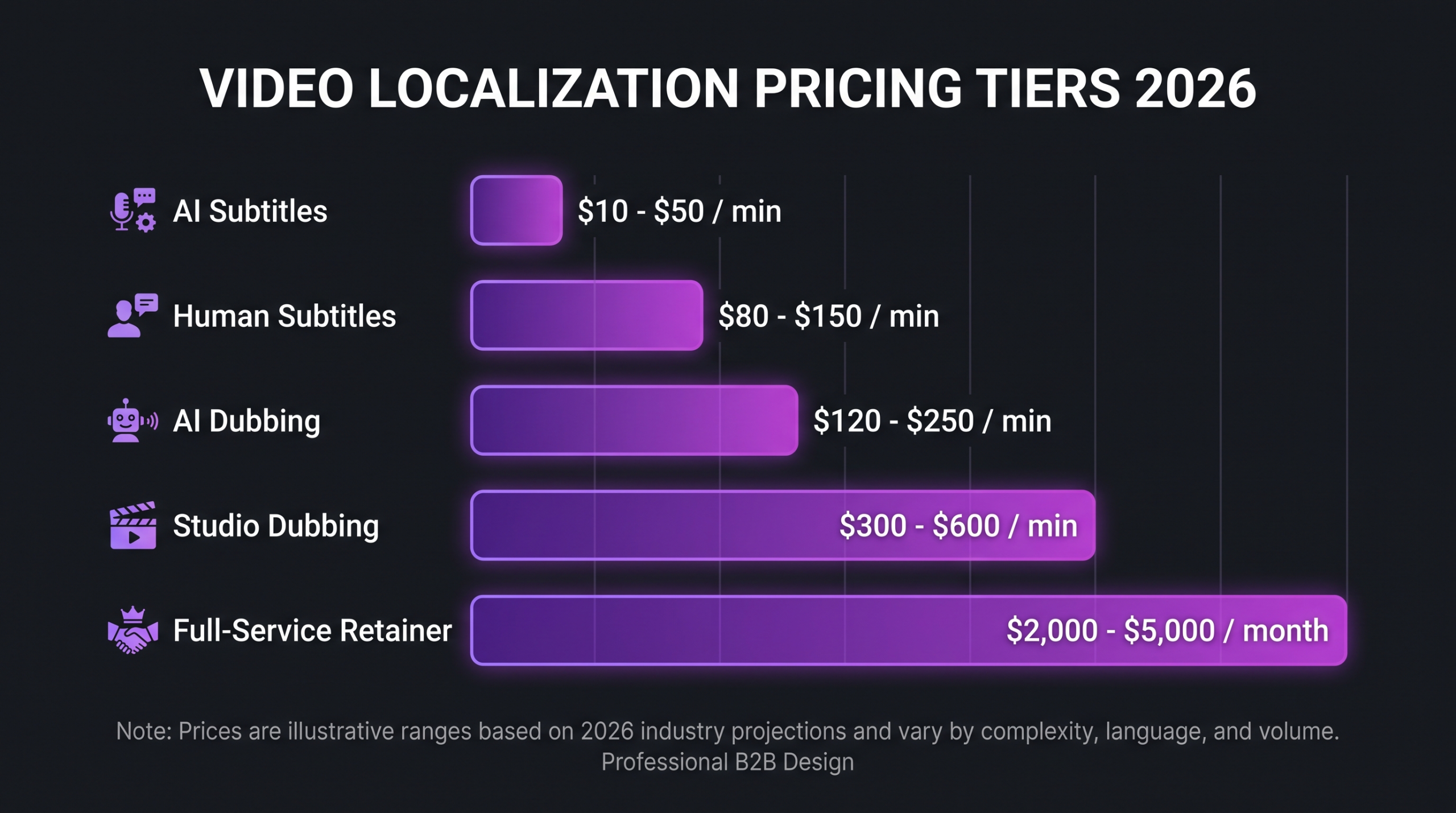
Language pair premium: Common pairs (Spanish, French, German, Japanese) typically attract standard rates. Less common pairs (Thai, Vietnamese, Hungarian, Arabic right-to-left) command meaningful premiums — commonly 30–80% above base rates — due to fewer qualified linguists and more complex layout requirements.
Text expansion factor: Translation into German typically expands text by 20–30%; Spanish by 15–25%; Asian languages can compress significantly. Motion graphics designed with English-length text often need re-layout for European languages — budget for this in advance.
For more context on professional video production investment across different service tiers, the full professional video editing cost guide covers the post-production economics that directly feed into localization budgeting.
Frequently Asked Questions
What is the difference between video localization and video translation?
Video translation refers specifically to converting spoken or written language from one language to another — typically producing a translated subtitle file or script. Video localization is a broader process that includes translation but also covers cultural adaptation, on-screen text re-rendering, dubbing or voiceover replacement, formatting adjustments for right-to-left languages, and platform compliance. A translated subtitle file is one output of localization; localization is not complete until the full viewing experience is culturally and technically adapted for the target market.
How long does video localization typically take?
Turnaround depends heavily on content type and the scope of work. AI-generated subtitles can be ready in minutes for simple content. Human-reviewed subtitles for a 10-minute video typically take 24–48 hours. Full localization including dubbed audio, re-rendered motion graphics, and quality review for a 3-minute explainer commonly takes 3–7 business days from asset handoff. Projects requiring multiple languages in parallel can compress total time if the vendor has sufficient language capacity on staff.
Should I choose AI dubbing or human voice actors for my localized videos?
AI dubbing has made significant advances and is now a credible option for most marketing and explainer content. The decision comes down to brand stakes and content format. For executive communications, high-touch brand campaigns, or content where vocal authenticity is part of the message, human voice artists produce meaningfully better results. For product demos, tutorials, and high-volume content where speed and cost matter more than voice nuance, AI dubbing with human review is often the stronger economic choice. Most professional agencies — including Increditors — offer both and can advise based on your specific brief.
What assets do I need to provide for video localization?
At minimum, a high-quality video file and a transcript or script in the source language. For motion graphics re-rendering, you need the source project files (Premiere Pro, After Effects, DaVinci Resolve). For dubbing, clean audio separation — isolated dialogue track without music or effects mixed in — significantly improves quality and speed. A brand glossary in the target language helps translators maintain consistent terminology for product names, features, and brand-specific language. The more source assets you can provide, the better the localization outcome.
Which languages are most in demand for B2B video localization?
For B2B SaaS and technology companies, the highest-volume localization targets are typically Spanish (Latin America and Spain combined), German, French, Japanese, and Brazilian Portuguese — these five markets collectively represent a substantial share of enterprise software purchasing power outside the English-speaking world. Mandarin Chinese is a high-value target but comes with higher complexity and cost. Mid-market companies commonly find that Spanish and German alone cover the highest ROI language investment before expanding further. According to Nimdzi’s industry research, European languages continue to dominate B2B localization volumes despite Asia-Pacific growth.
Verdict: Which Video Localization Service Is Right for You?
The best video localization service in 2026 is the one that matches your content complexity, workflow, and volume — not the one with the most impressive technology stack or the lowest per-minute rate.
For teams that need localization fully integrated with post-production — especially SaaS companies with motion-graphics-heavy explainers or ongoing campaign series — Increditors is the strongest choice. The ability to touch source files, re-render on-screen text, and deliver platform-ready videos in multiple languages without managing separate vendors is a genuine operational advantage.
VideoEditingCompany is the right call for enterprises prioritising high-volume, long-term retainer partnerships. Rev solves the fast-turnaround subtitle file problem at low cost. Papercup is the best specialist for AI dubbing at scale. Iyuno is the broadcast benchmark. Translated is the strongest pure-translation partner for brands where tone must survive across languages.
Whichever path you choose, the key discipline is to audit your content format before evaluating vendors — a mismatch between content complexity and vendor capability is the most common cause of disappointing localization outcomes. Start with a pilot project, review the deliverable against your quality standards, and scale from there.
Ready for Video That Actually Converts?
Tell us about your localization project and we will put together a custom plan for your target markets.