








![3D Explainer Video - ScribbleLive.mp4_snapshot_00.12_[2022.03.09_03.14.16]](https://increditors.com/wp-content/uploads/elementor/thumbs/3D-Explainer-Video-ScribbleLive.mp4_snapshot_00.12_2022.03.09_03.14.16-r7wb53mx72rxst3qcqyrfxdmeyzb5r9jbl0wbjujh4.png "3D Explainer Video – ScribbleLive.mp4_snapshot_00.12_[2022.03.09_03.14.16]")





























Cybersecurity companies that invest in professional video production consistently outperform peers in pipeline generation, brand trust, and conference impact. This guide covers the exact video types that move the needle for infosec vendors, MSSPs, and security-focused teams — plus what to look for in a video editing partner that understands the compliance-sensitive nature of your messaging.
- Why Cybersecurity Companies Need Specialist Video Production
- The 8 Core Video Types for Infosec Brands
- Trust-Building Through Video: The Compliance-Sensitive Approach
- ROI Cases: What Cybersecurity Video Actually Delivers
- Conference Talks and Thought Leadership Content
- What to Look for in a Video Editing Partner
- The Cybersecurity Video Production Workflow
- Agency vs Freelancer vs In-House: Which Model Fits Infosec
- Frequently Asked Questions
- Verdict
Why Cybersecurity Companies Need Specialist Video Production
Cybersecurity is one of the most trust-dependent markets on the planet. A CISO deciding between two endpoint detection vendors is not choosing a SaaS subscription — they are placing their career, their organization’s data, and in some cases human safety on the line. In that environment, a poorly produced video does not just fail to convert; it actively undermines credibility before a single sales conversation begins.
Video has become a primary channel for infosec buying decisions. Security professionals consume conference talk recordings on YouTube, evaluate vendors through product demo walkthroughs, and form initial impressions of a brand through explainer content shared in security community Slack groups and LinkedIn feeds. The quality of that content signals — loudly and immediately — whether a vendor takes its own professionalism seriously.
Despite this, most cybersecurity companies treat video as an afterthought. Marketing teams ship screen-recorded demos with no post-production. Conference talks sit on YouTube with no chapter markers, no visual polish, and audio that was clearly captured through a laptop microphone. Thought leadership webinars never get repurposed into clips that would reach practitioners who did not attend live.
The companies pulling away from the pack in infosec marketing — particularly in crowded categories like XDR, SIEM, MDR, and cloud security posture — are treating video with the same strategic discipline they apply to threat intelligence: systematic, high-quality, and audience-specific.
The Unique Pressures Infosec Marketing Teams Face
Cybersecurity marketing teams operate under constraints that do not apply to most other B2B verticals. Product roadmaps are often confidential. Screenshots of dashboards may expose infrastructure details. Customer case studies frequently require NDAs and legal sign-off before any external mention. Messaging around specific threats or vulnerabilities must be reviewed to avoid creating unintended panic or becoming a liability if a customer’s environment matches an example shown.
These constraints mean that video production partners who lack infosec context will slow you down rather than accelerate output. They will ask for screen recordings of your live production environment, suggest featuring customer logos without clearance, or apply visual treatments to threat data that inadvertently make your platform look like it has vulnerabilities rather than detects them.
Specialist video post-production for cybersecurity companies is not just about quality — it is about working with editors who understand why certain things cannot appear on screen, and can work efficiently within those constraints to produce content that is both technically accurate and visually compelling.
The 8 Core Video Types for Infosec Brands
Not every video format works equally well in cybersecurity. The buying cycle is long, the buyers are technical and skeptical, and the stakes are high. Here are the eight content formats that consistently perform for security vendors, MSSPs, and consulting firms.
1. Animated Explainer Videos
Animated explainers are the single most effective top-of-funnel video format for cybersecurity companies. They allow you to visualize abstract concepts — zero-trust architecture, lateral movement detection, supply chain attack vectors — in ways that live-action video cannot. A well-crafted 90-second explainer can communicate your core value proposition to a CISO who has three minutes between meetings and zero patience for jargon-heavy slides.
The key distinction in post-production quality here is the gap between template-generated animation and genuinely custom motion graphics. Template animations give infosec content the same visual feel as a SaaS expense tool — which signals to security professionals that you are not a serious technical shop. Custom animation that references your actual detection flow, your real threat model diagrams, and your brand’s visual language communicates that you have invested in your message.
2. Product Demo Walkthroughs
Technical buyers in security evaluate products through their own proof-of-concept labs, but they get to POC selection by watching demos. A polished product demo video does three things simultaneously: it shows your interface, it demonstrates your detection or prevention capabilities in action, and it implicitly communicates that your engineering team ships a coherent product rather than a collection of features bolted together.
Post-production on security product demos is more sensitive than almost any other video type. Editors need to mask real IP addresses, anonymize sample data, use simulated threat environments that look realistic without exposing real infrastructure, and add call-outs and annotations that help non-technical stakeholders follow along without boring the SOC analysts you also need to impress.
3. Threat Intelligence Briefings and Threat Reports
Annual and quarterly threat reports have become a cornerstone of cybersecurity content marketing. Companies like CrowdStrike, Mandiant, and Palo Alto have demonstrated that proprietary threat intelligence, packaged well, functions as both a marketing asset and a genuine public service. Video versions of these reports — executive summaries, animated data visualizations of attack trends, analyst commentary segments — dramatically extend reach compared to PDF-only releases.
The production challenge here is data visualization. Threat data is inherently complex, often statistical, and needs to be presented accurately without being misleading. Editors who lack experience with data-driven content will produce charts that look impressive but are visually inaccurate, or that compress critical caveats into footnotes that viewers will never see.
4. Customer Case Studies and Success Stories
Security case studies are harder to produce than in almost any other industry. Customers frequently cannot be named. Specific metrics — number of incidents blocked, time-to-detect improvement — may be under NDA. The attack scenarios that your product addressed may still be active in the wild, making specific technical detail a liability.
Despite these constraints, video case studies are some of the highest-converting assets in cybersecurity sales cycles. Anonymized customer interviews, filmed with professional production values and edited to highlight specific use cases, convert significantly better than written case studies — particularly when reaching procurement committees where not every member has technical background.
5. Conference Talk Recordings and Event Highlights
RSA, Black Hat, DEF CON, CyberUK, and dozens of regional and vertical-specific conferences represent enormous investments for security vendors. A week of conference activity — speaking slots, booth presence, side events — can cost well into six figures when travel, staff time, and sponsorship fees are included. Yet most companies capture this investment with a single poorly-lit recording of the main stage talk and a handful of candid photos.
Professional post-production of conference content turns a one-time event into a content library that generates pipeline for months afterward. A 40-minute keynote becomes a 3-minute highlight reel, five 60-90 second clips for LinkedIn and X, a full edited recording for YouTube, and a trimmed version embedded in follow-up emails to attendees.
6. Webinar and Virtual Event Production
Webinars remain a primary demand generation channel in cybersecurity. Security practitioners attend webinars at higher rates than many other professional communities — partly because the subject matter is genuinely high-stakes and relevant, and partly because live Q&A with practitioners they respect carries real value. Post-production of webinar recordings — proper audio cleanup, removal of dead air, chapter markers, lower thirds for speakers — determines whether those recordings become a lasting asset or disappear into an unwatched archive.
7. Compliance and Security Awareness Training Videos
For MSSPs and security consulting firms, training video production is often a direct revenue line rather than a marketing cost. Organizations required to demonstrate security awareness training under SOC 2, ISO 27001, HIPAA, PCI-DSS, or sector-specific regulations need video content that is engaging enough to actually change employee behavior — not just tick a compliance box.
The production standards for compliance training video differ meaningfully from marketing video. Pacing is slower, information density is lower, scenarios must be realistic enough to be believable but sanitized enough to avoid creating anxiety, and accessibility requirements (captions, audio descriptions) are typically mandatory rather than optional.
8. Executive Thought Leadership and Analyst Interviews
CISOs, CTOs, and security analysts who can speak credibly about the threat landscape are among the most valuable content assets any security company can develop. Interview-format video — filmed at headquarters, at conferences, or in remote setups — builds personal brand for executives and organizational credibility simultaneously. The difference between a professional and amateur execution of this format is immediately visible and directly affects whether the content gets shared within security communities or ignored.
💡 Pro Tip: Film your executive interviews in batches — one half-day shoot can generate 8-12 separate interview segments covering different topics. With proper post-production, that single shoot becomes months of thought leadership content across LinkedIn, your YouTube channel, and email nurture sequences.
Trust-Building Through Video: The Compliance-Sensitive Approach
Trust is the core currency of cybersecurity. Prospects are not just evaluating whether your technology works — they are evaluating whether they trust your company with access to their most sensitive systems and data. Video is a uniquely powerful trust-building medium because it shows rather than tells: viewers assess credibility through visual cues, production quality, the confidence of speakers, and the consistency of brand presentation across every touchpoint.
Visual Consistency as a Credibility Signal
Security buyers are exceptionally detail-oriented — it is essentially a job requirement. When your video content has inconsistent color grading across episodes, mismatched lower-third styles between your explainer videos and your webinar recordings, or audio quality that varies dramatically from piece to piece, that inconsistency registers as a credibility problem. If your marketing operations look chaotic, the implicit question is: what does your operations center look like?
Professional post-production establishes and enforces visual consistency across all video content — same color grading, same typography, same audio quality standards, same motion graphics treatments. This consistency signals organizational discipline, which is precisely what security buyers need to feel before committing to a vendor relationship.
Compliance-Sensitive Messaging in Video
Cybersecurity video requires careful handling of several categories of sensitive content that most video production partners are not equipped to manage properly:
Threat scenario accuracy: Demonstrating an attack technique in a product demo requires showing realistic but controlled scenarios. Misrepresenting how an attack works — even inadvertently, through imprecise visual metaphors — can create problems with the security research community, which will publicly correct you, and with customers who may feel misled.
Customer data protection: Any real customer data must be fully anonymized before it appears in any video, including during live demos that will be recorded. Editors working on infosec content need to identify and mask personally identifiable information, organizational identifiers, and network-specific details that could appear in screen recordings.
Vulnerability disclosure timing: If your video references specific CVEs or attack techniques, the timing of that content’s publication matters. Content produced around a disclosure event may need to be held until the coordinated disclosure date, requiring your editing partner to handle sensitive unreleased material under embargo.
Regulatory claims: Statements about compliance certifications — FedRAMP, SOC 2 Type II, HIPAA, GDPR — must be accurate at the time of publication and remain accurate for as long as the content is live. Legal review of video scripts is not uncommon in enterprise security marketing, and your editing partner should be able to accommodate revision cycles driven by legal, not just creative, feedback.
💡 Pro Tip: Build a pre-production checklist specific to your organization’s compliance requirements and share it with your video editing partner before every project begins. Items should include: data anonymization requirements, approved customer references, current certification status for regulatory claims, and any topics under embargo. An experienced video editing agency will work from this checklist rather than requiring you to flag issues after the edit is delivered.
The Buyer Journey in Infosec Video Content
Security buying committees typically include technical evaluators (security engineers, SOC analysts), business stakeholders (CISO, VP Engineering), and procurement or finance. Your video content strategy needs to address all three audiences without alienating any of them.
Animated explainers and executive interviews work at the awareness stage for non-technical stakeholders. Technical demo videos work for evaluation-stage engineers. Customer case studies work for CISOs who need to justify the budget decision. ROI-focused summary videos work for finance and procurement. A sophisticated video content strategy maps each format to the specific audience and buying stage it serves — which in turn informs production decisions like pacing, terminology depth, and call-to-action language.
ROI Cases: What Cybersecurity Video Actually Delivers
Measuring video ROI in cybersecurity is more complex than in e-commerce or consumer SaaS, because the sales cycle is long, multi-touch, and involves consensus decision-making across buying committees. That said, security companies that invest seriously in video production consistently report improvements in several measurable areas.
Pipeline Acceleration
Security sales teams commonly report that prospects who have consumed product demo videos enter qualification calls with substantially more informed questions and shorter time-to-technical-validation. When a buyer has already watched a 15-minute product walkthrough before the first call, the discovery conversation can skip product basics and move directly to fit assessment. Teams that track content engagement in their CRM report that video consumption in the 30 days before an opportunity creation event is among their strongest leading indicators of deal velocity.
Conference and Event ROI Multiplication
Security companies that professionally edit and distribute conference content report that the video content generated from a single conference regularly outperforms the event itself in terms of impressions and pipeline contribution — and continues to perform for 6-18 months after the event. The economics are clear: a Black Hat speaking slot represents a massive sunk cost whether or not the talk is professionally recorded and distributed. Adding post-production on top converts that sunk cost into a compounding asset.
Organic Search and Authority
YouTube is the second largest search engine in the world, and security practitioners search it extensively for educational content, tool tutorials, and vendor evaluations. Security companies that publish high-quality educational video content on YouTube build subscriber bases that represent a direct pipeline to the exact technical buyers they are trying to reach — buyers who are actively engaged, not passively scrolled past in a feed.
Understanding how much professional video editing costs in the context of these compounding returns reframes the budget conversation entirely. The relevant comparison is not video editing cost versus zero — it is video editing cost versus the alternative deployment of that budget and the likely pipeline contribution of both options.
Sales Enablement and Shorter Sales Cycles
Video assets in sales sequences — personalized video messages, product demo recordings, customer testimonial clips — measurably increase response rates and reduce time-to-meeting in security sales outbound. Security buyers are bombarded with generic outreach; a well-produced video message from a sales rep that references the buyer’s specific threat environment or technology stack cuts through in ways that text-only emails cannot.
Conference Talks and Thought Leadership Content
The cybersecurity conference calendar — RSA Conference, Black Hat USA and Europe, DEF CON, CyberUK, Gartner Security Summit, regional BSides events, and dozens of vertical-specific gatherings — represents one of the most concentrated opportunities for video content production in any B2B vertical. Security practitioners attend conferences to learn, and a high percentage continue consuming conference content through recordings afterward.
The Conference Content Multiplier
Professional conference content production follows a multiplier model: one live event becomes multiple content formats, each targeting a different distribution channel and audience segment. A typical conference talk post-production package might include: the full edited recording for YouTube; a 3-5 minute highlight reel for LinkedIn and the company website; 8-12 short clips (60-90 seconds each) for social media distribution; speaker headshots and behind-the-scenes content for event follow-up; and an audio-only version for podcast distribution.
The ratio of content output to production input is extremely favorable at the conference multiplier stage, because the core intellectual content — the talk itself — already exists. Post-production at this stage is about packaging and distribution, not creation. This is where specialist video editing delivers some of its highest returns.
Building Thought Leadership Through Consistent Video Output
Thought leadership in cybersecurity is earned through consistent, high-quality output over time. Security practitioners are skeptical of vendor content by default — they know it is marketing, and they are trained to identify bullshit. The companies that break through this skepticism do so by producing genuinely useful content at professional production standards, consistently enough to build a following among practitioners who come to trust them as a reliable source.
This requires a content cadence that most in-house teams struggle to maintain, particularly when video production is being managed alongside everything else a security marketing team is responsible for. Outsourcing video post-production to a specialist agency creates the production capacity to maintain cadence without burning out internal resources on technical editing work that is not their core competency.
Teams that have worked with specialized video post-production partners in adjacent technical markets consistently cite the ability to maintain publishing cadence — rather than individual video quality — as the primary driver of audience growth and brand authority over 12-18 month timeframes.
What to Look for in a Video Editing Partner for Cybersecurity
Choosing a video editing partner for a cybersecurity company involves criteria that go well beyond production quality. The sensitivity of your content, the technical sophistication of your audience, and the compliance requirements around your messaging all narrow the field significantly from a generic “good video editor” to an agency that can actually serve your needs.
Budget Realities for Infosec Video Production
Cybersecurity marketing budgets at established vendors commonly run in the range of $5M-$20M annually at Series B and beyond. Video production as a percentage of that budget varies widely, but marketing teams that treat video as a primary channel typically allocate meaningfully more than those that treat it as a line item for the odd trade show highlight reel.
For earlier-stage infosec companies — seed through Series A — the economics look different. Budget is tighter, but the need for trust-building content is actually higher, because brand recognition cannot do the credibility work that it can for established vendors. At this stage, a dedicated video editing retainer with a specialist agency typically delivers better economics than either in-house production or project-by-project freelancer engagements.
Increditors structures retainer engagements specifically for technical B2B companies — including infosec vendors — with dedicated senior editor teams, motion graphics capability, and account managers who develop institutional knowledge of each client’s product and messaging. This model is particularly well-suited to the cadence requirements of security content marketing, where consistent weekly output matters more than occasional high-budget productions.
The Cybersecurity Video Production Workflow
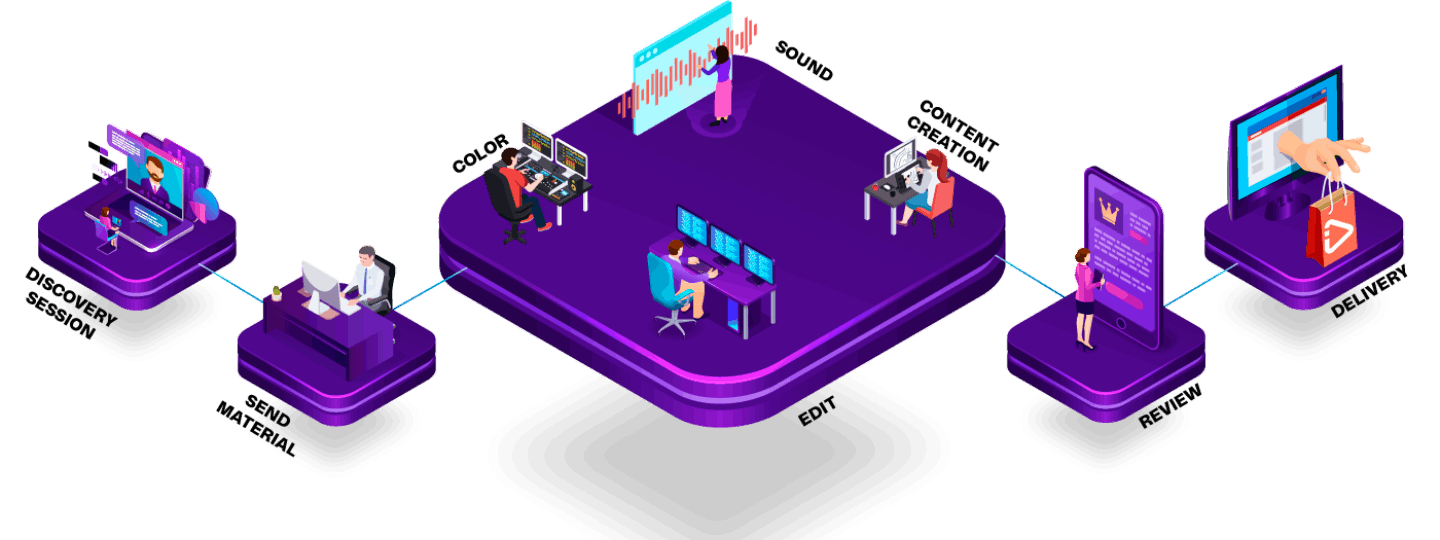
A professional cybersecurity video workflow differs from standard B2B video production in several key areas. Understanding these differences helps you evaluate whether a potential editing partner has genuine experience in this vertical or is adapting a generic process to your needs.
Pre-Production: The Security Content Brief
Every cybersecurity video project should start with a content brief that goes beyond creative direction to address compliance requirements. This brief should specify: which customer data appears in the footage and how it must be handled; which regulatory certifications can be referenced and in what language; what competitive claims are permitted under legal guidance; and which audience personas the content serves. An experienced editing partner will have a template for this brief and will drive the process rather than waiting for you to provide it.
Production: Managing Sensitive Footage
Screen recordings of security products frequently contain sensitive information that must be identified and masked before editing begins. This includes: customer IP addresses and network ranges; system hostnames and internal infrastructure identifiers; usernames and email addresses visible in logs or dashboards; alert details that reference real customer environments; and any vulnerability-specific data that could enable an attacker.
The masking process is not simply blurring — it requires contextual judgment about what constitutes identifying information in a security context. A generic editor will blur what looks like a personal detail. An experienced infosec video editor will recognize that a subnet like 10.145.x.x combined with a geographic reference and a specific CVE number may be enough to identify a customer’s environment even without explicitly identifying data.
Post-Production: The Review and Approval Cycle
Cybersecurity video goes through more review layers than most marketing content. A standard review cycle might include: technical review by a product or engineering team member to verify accuracy; legal review for claims and compliance language; customer approval for any content featuring or referencing specific customers; and communications review for messaging alignment.
An editing partner that prices per revision round rather than accommodating an iterative review process will become expensive quickly in this environment. Look for partners with flat-rate pricing on revisions or clear policies around legal and compliance-driven changes that distinguish them from creative revision requests.
Distribution and Repurposing
Professional cybersecurity video post-production includes delivery in multiple formats optimized for different distribution channels: YouTube (1080p or 4K, optimized for search); LinkedIn (native video with captions for silent autoplay); website embedding (compressed for web performance); email embedding (animated thumbnail GIFs that link to full video); and sales enablement platforms (direct sharing links with tracking).
The multi-format delivery requirement is one of the reasons that working with a dedicated video editing agency rather than a single freelance editor delivers better economics at scale — agencies have standardized workflows for format delivery that freelancers typically have to rebuild project by project.
Agency vs Freelancer vs In-House: Which Model Fits Infosec
Cybersecurity companies of different sizes and maturity stages benefit from different video production models. The decision is not purely about budget — it is about the combination of output volume, content sensitivity, revision cycle requirements, and the institutional knowledge your editing partner needs to develop over time.
The hybrid model — an in-house producer or video marketing manager who briefs and manages an external editing agency — is increasingly the preferred approach for mid-market security vendors. This structure captures the institutional knowledge benefits of in-house talent without the full cost of a complete in-house production operation, while maintaining the output capacity and specialist skills of an agency partner.
Frequently Asked Questions
How do cybersecurity companies handle customer confidentiality in case study videos?
Most security vendors have developed several approaches to customer confidentiality that allow them to produce case study content without violating NDAs. Common approaches include: using industry and company size as identifiers (“a Fortune 500 financial services company”) rather than named customers; producing composite case studies that aggregate common customer experiences without attributing them to a specific organization; featuring anonymized spokesperson interviews with voice and image modification; and working with PR-cleared customers who have approved video content as part of an expanded customer advocacy agreement. A specialist video production partner will have a process for each of these approaches.
What video format gets the best engagement from security practitioners?
Security practitioners — particularly technical roles like threat hunters, SOC analysts, and security engineers — engage most deeply with educational content that teaches them something genuinely useful. Tactical how-to videos, threat intelligence briefings, and honest product demonstrations tend to outperform pure brand or awareness content. On LinkedIn, practitioner audiences tend to respond well to short-form clips (90-120 seconds) from conference talks or expert interviews, particularly when those clips address a specific technical challenge or debate. On YouTube, longer-form educational content performs well when it offers genuine depth rather than marketing polish.
How should a cybersecurity company approach video for a product launch?
Product launch video for a security product typically requires a suite of assets rather than a single video. The standard launch package includes: a 90-second explainer for the product homepage and social media; a 10-15 minute deep-dive demo for prospects in active evaluation; a 2-3 minute executive overview for senior stakeholders and press; and a series of 60-90 second technical clips that each address a specific capability or use case. Planning this suite 8-12 weeks before launch gives an editing partner enough time to produce quality output without rushed delivery.
What should a cybersecurity company budget for conference video coverage?
Conference video coverage budgets vary significantly based on the scope of coverage and the number of deliverables. A focused post-production engagement — editing a single recorded talk into a full YouTube video plus 5-6 social clips — typically runs in a range that makes sense for most vendor marketing budgets. Full conference coverage including on-site filming, multiple speaker sessions, booth highlight content, and a complete post-production package is a more significant investment, but one that most conference teams can justify against the sunk cost of conference attendance. Working with an agency on a retainer that includes conference coverage allowances is often more cost-effective than commissioning conference production as a one-off project.
How do MSSPs approach video marketing differently from product vendors?
MSSPs (Managed Security Service Providers) face a specific video marketing challenge: their core value proposition — continuous monitoring, expertise, and rapid response — is invisible until something goes wrong. This makes trust-building the dominant objective of MSSP video content, rather than product demonstration. Effective MSSP video formats include: team introduction videos that humanize the SOC team; process walkthrough videos that make the invisible work visible; security advisory content that demonstrates analyst expertise; and response narrative case studies (handled carefully for customer sensitivity) that show the team in action. The goal is to make the relationship feel tangible before a contract is signed.
Verdict: Video Is the Highest-Leverage Trust Channel in Cybersecurity
The evidence across the cybersecurity marketing landscape points in one direction: companies that invest in professional, consistent, audience-specific video production build trust faster, accelerate sales cycles, and generate more pipeline from their conference and event investments than those that treat video as a nice-to-have.
The cybersecurity category rewards seriousness. Your video content is a direct signal of how seriously you take your work — and how seriously your prospects should take you. Template animations, shaky conference recordings, and inconsistent visual standards all subtract from the credibility you need to earn a seat at the CISO’s table. Professional post-production adds it back.
The practical starting point is not a complete video strategy overhaul. It is picking the one format where the gap between your current output and what it could be is most visible — typically product demos, conference recordings, or thought leadership interviews — and investing in professional post-production for that category first. The results will justify expanding the program.
For security companies evaluating editing partners, the non-negotiables are B2B technical content experience, a demonstrated ability to handle sensitive material appropriately, motion graphics capability beyond templates, and a production model that accommodates the multi-layer review cycles that compliance-sensitive content requires.
Increditors works with technical B2B companies — including cybersecurity vendors and MSSPs — on exactly this kind of video content program. If you are evaluating whether a retainer model or a project-based engagement makes more sense for your current stage and content volume, the discovery conversation is the right starting point.
Ready for Video That Actually Converts?
Tell us about your project and we will put together a custom plan.