









![3D Explainer Video - ScribbleLive.mp4_snapshot_00.12_[2022.03.09_03.14.16]](https://increditors.com/wp-content/uploads/elementor/thumbs/3D-Explainer-Video-ScribbleLive.mp4_snapshot_00.12_2022.03.09_03.14.16-r7wb53mx72rxst3qcqyrfxdmeyzb5r9jbl0wbjujh4.png "3D Explainer Video – ScribbleLive.mp4_snapshot_00.12_[2022.03.09_03.14.16]")


























Your best testimonial footage may already exist inside discovery calls, onboarding calls, renewal calls, customer interviews, and support conversations. With the right consent, question design, transcript review, editing structure, and approval process, a simple customer call can become a polished sales video that builds trust faster than a written case study or a generic logo wall.
Most companies treat discovery calls as a sales activity and testimonials as a marketing activity. That separation creates waste. Your sales team hears the real problems, objections, emotions, before-and-after stories, and buying triggers directly from customers. Then, weeks or months later, marketing asks those same customers to record a testimonial from scratch. The customer is busier, the story is less fresh, and the best language has already disappeared into a CRM note.
A better approach is to build a repeatable system for turning customer conversations into sales videos. Not every call should become a testimonial. Not every answer is usable. And you should never surprise a customer by taking a private conversation and turning it into public-facing content. But when the process is designed correctly, a normal call can become the raw material for high-trust video assets: website testimonials, landing page proof, sales enablement clips, paid social ads, investor updates, recruiting videos, and vertical-specific case study reels.
This guide breaks down the full workflow: what calls to use, what permissions you need, how to ask better questions, how to review transcripts, how to edit the story, what mistakes kill credibility, and how to build an approval process that keeps customers comfortable while still producing strong sales assets.
- Why Customer Calls Make Better Testimonials
- The Best Call Types to Repurpose
- Consent, Trust, and Customer Comfort
- How to Ask Questions That Create Usable Clips
- The Editing Framework: From Raw Call to Sales Video
- Video Formats You Can Create From One Call
- Approval Workflow and Legal Review
- Where to Use Testimonial Sales Videos
- FAQ
- Verdict
Why Customer Calls Make Better Testimonials
A traditional testimonial often starts with a blank prompt: “Can you record a quick video about your experiencea” That sounds simple, but it puts too much pressure on the customer. They have to remember the story, decide what matters, speak clearly, avoid rambling, and make the company look good without sounding scripted. The result is usually either too vague or too polished. Neither builds much trust.
Customer calls are different because the story appears naturally. A founder explains why they took the call. A head of marketing admits what was broken before the product. A customer success leader describes the internal objections they had to overcome. A buyer says, in plain language, what changed after implementation. These moments are more persuasive because they sound like real conversation, not marketing copy.
Authenticity Is Easier to Preserve
The strongest testimonial videos do not feel like ads. They feel like a buyer speaking to another buyer. Discovery calls and customer interviews capture hesitations, context, pauses, specifics, and emotional texture that are hard to recreate in a staged recording. When edited carefully, those details become credibility signals. The viewer senses that the person is not reading from a script. They are remembering a real problem and explaining a real result.
You Capture the Language Your Market Already Uses
Marketing teams often polish customer language until it becomes generic. A customer says, “Our sales reps were spending half the day chasing updates in three different tools,” and the final copy becomes, “The platform improved operational efficiency.” The first version sells. The second version sounds like a brochure. Repurposing call footage helps you preserve the phrases that buyers actually use when they describe pain, hesitation, risk, relief, and success.
💡 Pro Tip: When reviewing a transcript, highlight phrases a prospect would recognize immediately. Specific buyer language usually beats polished brand language.
Sales Teams Get Proof Assets Faster
Sales enablement often fails because proof assets arrive too late. A prospect asks, “Do you have anyone like us using thisa” and the team sends an old PDF case study that does not match the segment, use case, or objection. If customer calls are reviewed and clipped consistently, the sales team can build a library of proof by industry, company size, persona, objection, outcome, and stage of the buyer journey.
The Best Call Types to Repurpose
Not every recorded call is worth turning into a testimonial. Some calls are too tactical. Some are too sensitive. Some customers are happy privately but uncomfortable publicly. The goal is to identify the moments where a customer is already talking about transformation, value, risk reduction, or confidence.
Discovery Calls Are Useful, But Handle Them Carefully
The title of this guide mentions discovery calls because many companies already record them and ignore the content afterward. However, pure prospect discovery calls are not testimonials unless the person is already a customer or later becomes one and agrees to the use. A prospect describing pain can be useful for internal messaging research, but public testimonial content should come from customers who can truthfully speak about the experience and outcome.
The cleanest workflow is to use discovery calls as the foundation for the story, then follow up after the customer has achieved a result. You can revisit the original language: “On our first call, you said your team was losing visibility after handoff. Is that still accurate What changed after we worked togethera” This creates a strong before-and-after arc without forcing the customer to reconstruct everything from memory.
Customer Interviews Give You the Cleanest Raw Material
If you want predictable testimonial output, schedule dedicated customer interviews. They can still feel conversational, but the environment is cleaner. The customer expects the content may be used publicly, the questions are designed around story, and the recording settings can be improved before the call begins. This is the best option for premium testimonial videos because you can capture stronger audio, better framing, and more complete answers.
Consent, Trust, and Customer Comfort
The biggest mistake companies make with call-based testimonial content is treating recording permission as marketing permission. A customer agreeing to record a Zoom call is not the same as agreeing to appear in an ad, on a landing page, or in a sales deck. If you blur that line, you risk damaging the relationship and making future customers less willing to speak openly.
Use Two Layers of Permission
The first layer is recording consent. This should happen before or at the beginning of the call and should follow the legal requirements in the relevant jurisdictions. The second layer is content usage consent. This should happen before any public use. It should explain where the video may appear, how it may be edited, whether the customer can review the final version, and whether the asset can be used in paid advertising.
For premium B2B testimonials, review rights are usually worth offering. Customers are more likely to participate when they know they can approve the final cut. Approval does not mean they should rewrite the entire piece, but it does mean they can catch sensitive details, inaccurate context, or statements that may conflict with internal policy.
💡 Pro Tip: Ask for usage permission before editing begins. It saves time, protects the relationship, and prevents your team from falling in love with a clip that cannot be used.
Make the Customer Look Good
Customers do not want to feel exploited. They want to look competent, thoughtful, and credible. A good testimonial edit should make the customer the hero of the story. The company should appear as the guide or enabling partner, not the center of every sentence. This matters especially for executive buyers, technical leaders, and enterprise customers whose reputation is tied to the public asset.
That means removing rambling sections, tightening unclear phrasing without changing meaning, avoiding embarrassing facial expressions, balancing enthusiasm with professionalism, and protecting details that could create internal friction. The best sales video is not the most aggressive edit. It is the edit the customer is proud to share.
How to Ask Questions That Create Usable Clips
Great testimonial videos are often won before editing starts. If the questions are vague, the answers will be vague. If the interviewer talks too much, the customer will not produce clean soundbites. If every question invites a yes-or-no answer, the editor will have no story to build. The goal is to ask questions that create complete, self-contained answers.
Ask for Context Before Praise
Do not start with “Why do you love working with usa” That pushes the customer into compliment mode. Start with the situation: “What was happening in the business before you started looking for a solutiona” or “What made this problem urgenta” Context gives the viewer a reason to care. Praise without context sounds like advertising. Praise after context sounds like evidence.
Use Before, Decision, After, Advice
A simple testimonial interview can follow four phases. Before: what was broken or missing Decision: why did they choose you instead of staying with the old way or choosing a competitor After: what changed, and how do they measure that change Advice: what would they tell someone considering the same decision This structure produces clips that work across the entire funnel.
Coach the Answer Without Scripting It
Customers often give answers that depend on the question being included. They might say, “It was definitely better,” which makes sense in conversation but fails as a standalone clip. Before the call, tell them to answer in complete thoughts. Instead of “It was better,” they might say, “After we changed the editing process, our team could publish videos faster without spending hours giving revision notes.” The meaning is the same, but the second version can survive outside the interview.
The Editing Framework: From Raw Call to Sales Video
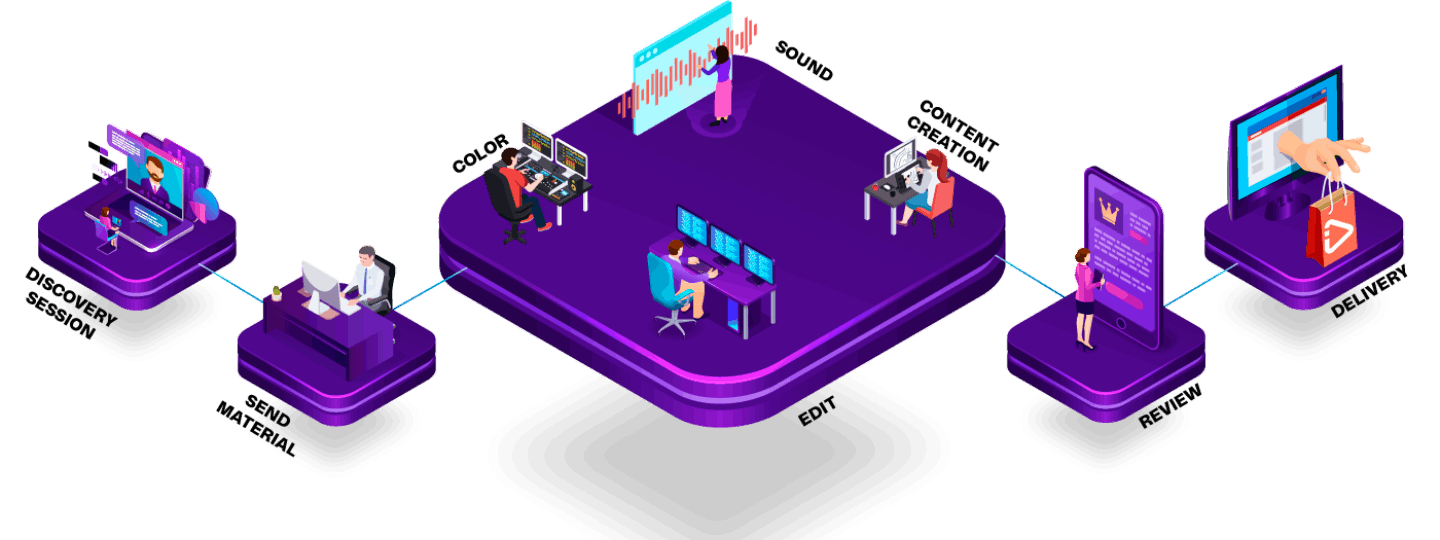
Editing a customer call into a sales video is not just cutting filler words. It is story design. The editor has to find the most persuasive thread, preserve the speaker’s meaning, remove distractions, improve pacing, and package the final piece for a specific channel. A testimonial for a pricing page should not be edited the same way as a paid social ad or an internal sales follow-up clip.
Step 1: Transcribe and Mark the Story Beats
Start with a transcript. Highlight the customer’s strongest statements in four categories: pain, decision, outcome, and recommendation. Pain explains why the problem mattered. Decision explains why they trusted the solution. Outcome explains what changed. Recommendation tells the viewer who should act next. If a clip does not support one of those four beats, it probably belongs in the archive rather than the final video.
Step 2: Build a Paper Edit Before Touching the Timeline
A paper edit is a written version of the final story using selected transcript lines. It helps you test structure before spending hours in the timeline. For example: “We were struggling with inconsistent video output” becomes the opening hook. “We chose them because they understood YouTube and brand polish” becomes the decision beat. “Now we publish weekly without chasing edits” becomes the outcome. The editor can then assemble the timeline with a clear spine.
Step 3: Cut for Meaning, Not Just Speed
Shorter is not always better. If you remove too much context, the clip becomes empty. If you keep every detail, the viewer loses the point. Good testimonial editing protects the causal chain: what was happening, why it mattered, what decision was made, what changed, and why the speaker believes it. Every cut should make that chain clearer.
Step 4: Use B-Roll, Graphics, and Captions to Clarify
A customer talking on a webcam can be powerful, but it should not always carry the whole video alone. Add product footage, process shots, campaign examples, dashboard screenshots, anonymized data visuals, brand footage, or subtle motion graphics when they help the viewer understand the story. Captions should be clear and readable. Lower thirds should identify the speaker and company. Graphics should support trust, not turn the testimonial into a cluttered explainer.
💡 Pro Tip: If the customer mentions a metric, show it visually for two to three seconds. Numbers are easier to remember when the viewer sees them, not only hears them.
Step 5: Create a Master Cut and Derivatives
A single customer call should rarely produce only one asset. Start with a master testimonial, usually 90 seconds to three minutes. Then create shorter clips by theme: one for the main pain point, one for the buying objection, one for the strongest result, one for the recommendation, and one formatted for vertical social. This is how a single interview becomes a proof library instead of a one-time video.
Video Formats You Can Create From One Call
The best format depends on where the buyer is in the journey. A cold visitor may need a short, emotionally clear proof clip. A late-stage prospect may need a longer story with details. A sales rep may need a 30-second answer to a specific objection. Before editing, define the job of the video.
The 30-Second Objection Clip
Objection clips are underrated. If prospects often worry about price, implementation time, quality control, security, or whether your team can understand their industry, a customer answering that concern is more persuasive than a sales rep defending the offer. The structure is simple: name the concern, show that the customer had the same concern, explain what changed their mind, and end with the outcome.
The Case Study Mini-Documentary
For larger deals, a deeper story can work better than a quick clip. A mini-documentary can include customer interview footage, product or service visuals, team context, data points, and a narrative arc that feels more premium. This format is especially useful when the decision is complex and the buyer needs to understand not just the result, but the process behind the result.
Approval Workflow and Legal Review
Approval is where many testimonial projects slow down. The customer likes the idea, the marketing team edits the video, then legal, brand, or leadership gets involved late and changes the scope. Avoid this by setting approval expectations before recording. Explain the intended use, the review process, the timeline, and the kinds of edits that are easy or difficult to make later.
Create an Approval Checklist
A practical checklist should include usage rights, logo permission, speaker title confirmation, company name spelling, metric approval, quote approval, sensitive information review, and distribution channels. If paid ads are included, call that out separately. Some customers will approve website use but not paid media. Others may allow anonymized usage but not logo usage. The earlier you know, the cleaner the edit becomes.
Send Review Cuts With Context
Do not send a rough cut with no explanation and ask, “Thoughtsa” That invites subjective feedback and delays. Send the video with a short note: where it will be used, who it is for, what you want them to review, and what kind of feedback is useful. For example, “Please confirm accuracy of the story, title, company name, metrics, and any sensitive details. We are not looking for line-by-line copy edits unless something is inaccurate.”
Protect Meaning During Edits
Editing can change meaning even without changing words. Removing a caveat, moving a sentence earlier, or combining two separate answers can create a claim the customer did not intend. This is why testimonial editing requires more care than standard social clips. The edit should be persuasive, but it must also be fair. A customer should be able to watch the final video and say, “Yes, that is what I meant.”
Where to Use Testimonial Sales Videos
A testimonial video only creates leverage when it is used. Too many companies publish it once on YouTube, embed it on a hidden case study page, and move on. The better approach is to map each clip to a buyer question. Then place that clip where the question naturally appears.
Website and Landing Pages
Use short proof clips near conversion points: pricing sections, demo request forms, service pages, and comparison pages. If the page targets a specific industry, use a customer from that industry whenever possible. A generic testimonial is better than nothing, but a relevant testimonial is much stronger because the viewer sees themselves in the story.
Sales Follow-Up and Deal Rooms
Sales reps should not have to search through a folder called “Testimonials Final Final.” Build a simple library organized by persona, industry, objection, and outcome. When a prospect says, “We are worried about turnaround time,” the rep should be able to send a 35-second customer clip about turnaround time within minutes. That is where testimonial videos become revenue tools instead of brand decoration.
Paid Social and Retargeting
Customer proof can perform well in retargeting because the audience already has some context. The video does not need to explain the entire offer. It needs to reduce doubt. A strong opening line might be, “We almost hired in-house before we found a better way,” or “The biggest difference was that we stopped chasing revisions.” Those hooks work because they mirror real buyer friction.
FAQ
Can we use a discovery call as a testimonial if the person was not a customer yeta
Not as a testimonial. A prospect can describe their problem, but they cannot truthfully speak to your result until they have experienced it. Use discovery call insights for messaging research, then schedule a follow-up customer interview after the work has created a real outcome.
How long should a testimonial sales video bea
For most B2B uses, a master testimonial should be 90 seconds to three minutes. Shorter derivative clips can run 15 to 60 seconds. The right length depends on the channel, the complexity of the offer, and the buyer’s stage of awareness.
What if the customer gives a great answer but the webcam quality is poora
You can still use the audio or selected footage if the story is strong, but support it with captions, B-roll, product visuals, screenshots, and clean motion graphics. For high-value testimonials, consider recording a second dedicated interview with better lighting, framing, and audio.
Should testimonials include metricsa
Yes, when the metrics are accurate, approved, and meaningful. Metrics make the story more concrete. But do not force numbers if the customer cannot verify them. Qualitative outcomes, such as reduced stress, faster approvals, better consistency, or stronger team confidence, can also be persuasive when explained clearly.
How many videos can one customer call producea
A strong interview can produce one master testimonial and five to ten shorter clips. The exact number depends on the depth of the conversation, the customer’s comfort level, and the distribution plan. Quality matters more than volume. Ten weak clips are less useful than three clips that answer real buyer objections.
Verdict
Customer calls are one of the most underused sources of sales video content. They contain the raw material buyers trust most: real problems, real hesitation, real decision criteria, and real outcomes. But the value only appears when the process is intentional. You need clear consent, better questions, transcript-based story selection, careful editing, customer-friendly approval, and a distribution plan tied to the sales journey.
The companies that win with testimonial videos do not simply ask customers to “say something nice.” They design a system that captures useful proof while the story is fresh, protects the customer relationship, and turns one conversation into multiple assets. That is how a discovery call becomes more than a note in the CRM. It becomes a sales video that helps the next buyer trust you faster.
Ready for Video That Actually Convertsa
Tell us about your project and we will put together a custom plan.