








![3D Explainer Video - ScribbleLive.mp4_snapshot_00.12_[2022.03.09_03.14.16]](https://increditors.com/wp-content/uploads/elementor/thumbs/3D-Explainer-Video-ScribbleLive.mp4_snapshot_00.12_2022.03.09_03.14.16-r7wb53mx72rxst3qcqyrfxdmeyzb5r9jbl0wbjujh4.png "3D Explainer Video – ScribbleLive.mp4_snapshot_00.12_[2022.03.09_03.14.16]")



























Hiring a video editing agency should make your life easier. Better content, faster delivery, less stress. But the wrong agency does the opposite — missed deadlines, inconsistent quality, surprise charges, and the slow realization that you’re paying premium prices for mediocre work.
We’ve seen it from both sides. As a video editing agency, we’ve onboarded dozens of clients who left other agencies because of problems that were obvious in hindsight. The red flags were there from the start — they just didn’t know what to look for.
This guide gives you the 12 most common video editing agency red flags, so you can spot trouble before it costs you months of wasted time and thousands of dollars. Whether you’re vetting a new agency or questioning your current one, these warning signs will help you make a smarter decision.
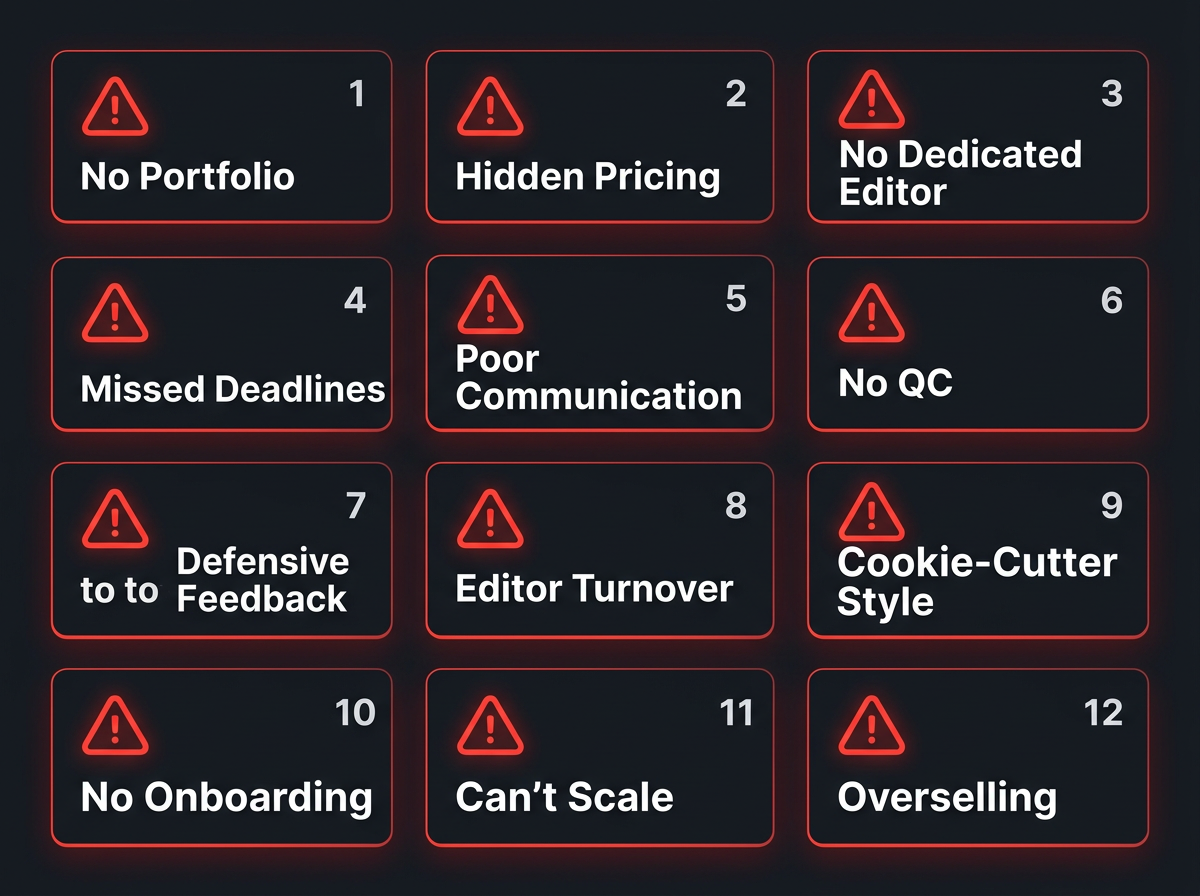
The 12 Red Flags
- No Relevant Portfolio Work
- Vague or Hidden Pricing
- No Dedicated Editor
- Consistently Missed Deadlines
- Slow or Unresponsive Communication
- No Quality Control Process
- Defensive Response to Feedback
- High Editor Turnover
- Cookie-Cutter Editing Style
- No Onboarding Process
- Can’t Scale With You
- Overselling and Underdelivering
- What Good Looks Like: Green Flags
- When to Leave and How to Transition
- FAQ
Red Flag #1: No Relevant Portfolio Work
An agency that can’t show you work similar to what you need is asking you to be their guinea pig. Wedding video editing and YouTube content editing are entirely different skills. Corporate explainer videos and creator vlogs require different sensibilities.
What to do instead: Ask to see 3-5 videos they’ve edited that match your content format. Not their best-ever work — their typical work. Ask which specific team member edited those videos. Ask if that person would be assigned to your account. If they can’t answer these questions directly, that tells you everything.
A quality agency will have a portfolio organized by content type and will happily walk you through specific projects. At Increditors, our portfolio page shows real client work across YouTube, social media, brand content, and more — because we want clients to evaluate us based on actual output, not theoretical capability.
Red Flag #2: Vague or Hidden Pricing
“It depends” is not a pricing model. Yes, video editing costs vary — but any professional agency should be able to give you a clear range based on your specific needs within the first conversation.
Hidden pricing usually means one of two things: the agency knows their real price will scare you off, so they anchor low and upsell later. Or they price based on “what they think you’ll pay” rather than what the work costs, which means different clients pay wildly different rates for the same service.
What transparent pricing looks like: clear packages or retainer tiers on their website, a detailed scope document before you sign anything, explicit lists of what’s included and what’s not, and a pricing page you can reference anytime. Check our pricing page for an example of what clarity looks like.
| Pricing Practice | Red Flag 🚩 | Green Flag ✅ |
|---|---|---|
| Initial quote | “We’ll discuss pricing after the call” | Clear ranges shared upfront |
| Scope definition | Vague deliverables | Specific list: X videos, Y revisions, Z turnaround |
| Add-ons | Everything useful costs extra | Core services bundled, optional add-ons clearly listed |
| Contract terms | Long lock-in, buried cancellation fees | Month-to-month available, clear cancellation policy |
| Price increases | Surprise invoice jumps | 30-60 day notice, justified by scope changes |
Red Flag #3: No Dedicated Editor Assigned to Your Account
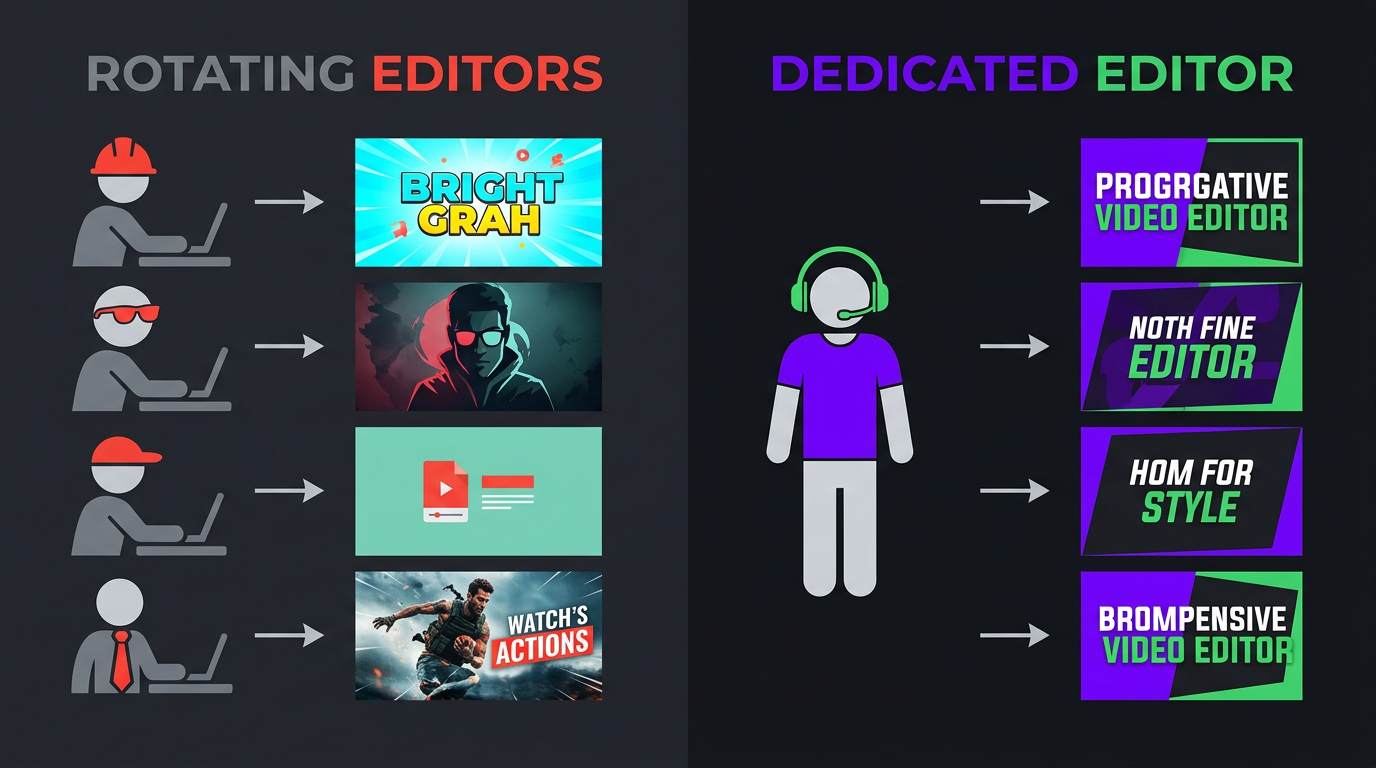
This is one of the most damaging red flags and one of the most common. Many agencies — especially subscription-based services — route your projects to whoever is available. That means a different editor might cut your video every time.
Why this matters: editing style is deeply personal. The way an editor paces cuts, handles transitions, chooses music, and structures visual flow creates a feeling that becomes part of your brand. When a different editor handles every video, your audience subconsciously registers the inconsistency. Your channel feels uneven. Your brand feels less professional.
Beyond style consistency, a dedicated editor gets faster over time. By video 10, they know your preferences instinctively. By video 50, they barely need a brief. A rotating editor pool means every video is essentially a new onboarding — and you’re paying for that ramp-up time in every single deliverable.
Red Flag #4: Consistently Missed Deadlines
This is the red flag people tolerate the longest — and shouldn’t. One missed deadline is a bad day. Two is a concerning pattern. Three or more is a systemic capacity problem that won’t fix itself.
Missed deadlines almost always indicate one underlying problem: the agency has accepted more clients than their team can handle. They sold you speed they can’t deliver because they need your revenue to keep growing. As they add more clients, your turnaround gets worse — and theirs is the only business model that benefits from the arrangement.
For more context on what realistic turnaround should look like, read our breakdown of video editing turnaround times.
Red Flag #5: Slow or Unresponsive Communication
In 2026, there’s no excuse for taking 24+ hours to respond to a simple client message during business hours. Communication speed is a proxy for how much an agency values your business.
Good communication looks like: response within 1-4 hours during business hours, proactive status updates (“Your video is in QC, delivery by 3pm”), clear escalation paths when your primary contact is unavailable, and a project management system where you can check status anytime without asking.
Pay attention to communication patterns during the sales process. If they respond to your inquiry within an hour but take two days to answer a post-sale question, that tells you where their priorities lie.
Red Flag #6: No Quality Control Process
A single editor editing and self-reviewing is not quality control. That’s one person checking their own homework. Real QC requires a second set of eyes — someone whose job is specifically to catch errors, check brand consistency, and verify technical specs before the video reaches you.
Ask directly: “What is your quality control processa” If the answer is anything less than “a separate team member reviews every video before delivery,” you’re the QC department — and you’re paying for the privilege.
At Increditors, every video goes through the editor, then a QC reviewer, before it reaches the client. That extra step catches 90%+ of issues before you ever see the draft. Our clients approve 80%+ of first drafts with zero or minor notes — not because our editors are perfect, but because our QC layer catches imperfections first.
Dealing with Agency Red Flags Right Nowa
You deserve an editing partner that delivers consistent quality, on time, every time. See how we’re different.
Red Flag #7: Defensive Response to Feedback
How an agency handles criticism tells you everything about their culture. Feedback is the mechanism through which your videos get better over time. An agency that resists feedback is an agency that won’t improve.
There’s a difference between an editor explaining their creative rationale (healthy) and an editor refusing to make requested changes (unhealthy). A professional agency will sometimes push back with “here’s why we made this choice” — but will always ultimately defer to the client’s preference if the client insists. Your content, your call.
A great agency goes further: they treat every piece of feedback as training data. Your preferences get documented, shared with the team, and applied to every future video. Over time, you should need to give less feedback because the team is learning. If you’re giving the same notes six months in, the learning loop is broken.
Red Flag #8: High Editor Turnover on Your Account
You started with Editor A, who was great. Then they “moved to another project” and you got Editor B, who needed a month to learn your style. Then Editor B left and here comes Editor C.
High turnover on your account usually means one of three things: the agency underpays editors and they leave for better opportunities, the agency overloads editors until they burn out and quit, or the agency is too small and shuffles people around constantly to plug gaps.
Any of these scenarios means you’re perpetually in the onboarding phase, never reaching the “the editor knows my brand perfectly” stage that makes outsourced editing truly effective.
VYVE Wellness experienced exactly this before working with us. They’d been through multiple editors at a previous agency — each time resetting the learning curve, re-explaining their brand’s wellness-focused aesthetic, and watching the first few videos miss the mark before the new editor caught up. By the time the editor was performing well, they’d rotate again.
When VYVE switched to Increditors, we assigned a dedicated editor who stayed on their account. No rotations, no surprises. That consistency allowed the editor to deeply understand VYVE’s brand voice and visual identity, resulting in content that felt authentically theirs — not generic “wellness video #4,752.”
Red Flag #9: Cookie-Cutter Editing Style
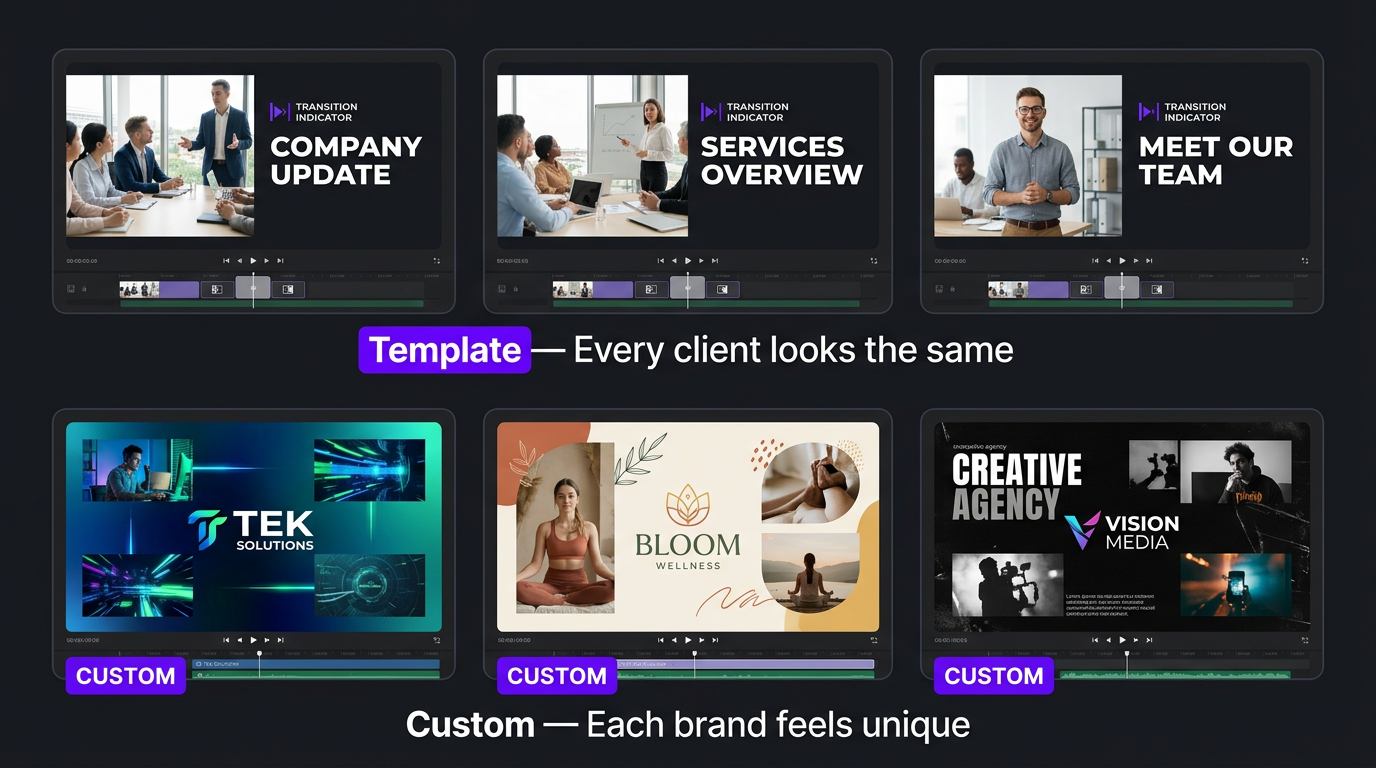
Open five of their client videos side by side. If they all look the same — same transitions, same text animations, same pacing patterns, same music choices — you’re not getting custom editing. You’re getting a template applied to your footage.
Template-based editing isn’t inherently bad — for some content types at lower budgets, it’s perfectly adequate. But if you’re paying premium agency rates and getting template work, you’re overpaying. And more importantly, your content won’t stand out in a sea of identically-edited YouTube videos.
Ask to see work from 3 different clients. Do they look and feel different from each other They should. If every video has the same transitions, the same subtitle style, and the same intro format, the agency is running an editing factory, not a creative service.
Red Flag #10: No Onboarding Process
How an agency starts the relationship predicts how the relationship will go. A professional agency has a defined onboarding process — brand guide creation, style preference documentation, reference video review, test edits, feedback calibration.
Proper onboarding takes time — usually 1-2 weeks — but it saves enormous time downstream. An editor who starts with a thorough understanding of your brand will need fewer revisions, produce better first drafts, and reach “consistent quality” faster than one who learns through trial and error with your real content.
What good onboarding includes:
- Brand discovery call: Understanding your content goals, audience, and visual identity
- Style guide creation: Documenting fonts, colors, graphic styles, intro/outro format, lower third templates
- Reference review: Analyzing 3-5 of your best videos plus aspirational references from other creators
- Test edit: A trial video (or segment) to calibrate before full production begins
- Feedback calibration: Using the test edit to refine understanding of your preferences
- Workflow setup: Establishing file transfer, communication channels, review process, and scheduling
Red Flag #11: They Can’t Scale With You
Your content needs will change. You’ll want to increase from 4 to 8 videos per month. You’ll add a Shorts strategy. You’ll need a special project for a product launch. An agency that can only handle your current volume is a temporary solution.
This red flag is especially painful because it usually surfaces at the worst time — exactly when your channel is growing and you need more content. If your agency can’t scale with you, you’ll be forced to switch providers right when momentum matters most.
When evaluating an agency, explicitly ask: “If I wanted to double my volume in 3 months, how would that worka” A capable agency has a clear answer involving team expansion, additional editors, or tiered packages. An incapable agency gives you a blank stare or a “let’s cross that bridge when we come to it.”
This is where the agency model genuinely outperforms freelancers. A single freelancer physically cannot double their output. An agency with a team can assign additional editors, bring in specialists, and scale your production without you managing the growth. Our unlimited editing plans are specifically designed for clients who need the flexibility to scale up and down based on content cycles.
Riley Coleman’s experience illustrates this perfectly. After his initial engagement with Increditors produced results (doubled views, consistent publishing), he wanted to expand — more long-form content plus a Shorts strategy plus occasional special projects. Because we had team depth behind his dedicated editor, scaling was a conversation about scope, not a crisis about capacity. We added Shorts production to his workflow within a week, with the same brand consistency across formats.
Red Flag #12: Overselling and Underdelivering
This is the meta red flag — the one that encompasses all the others. The sales pitch promised dedicated editors, 24-hour turnaround, cinematic quality, and a revolutionary workflow. The reality is rotating editors, 5-day turnaround, basic cuts, and a Slack channel nobody monitors.
The antidote to overselling is verification. Before signing:
- Ask for references. Not testimonials on their website — actual people you can message or call.
- Start with a trial. Any confident agency will let you do a paid trial month before a longer commitment.
- Check their team size. If they claim to serve 50+ clients but have 3 editors on LinkedIn, the math doesn’t work.
- Read contract details. Everything promised verbally should be reflected in the written agreement.
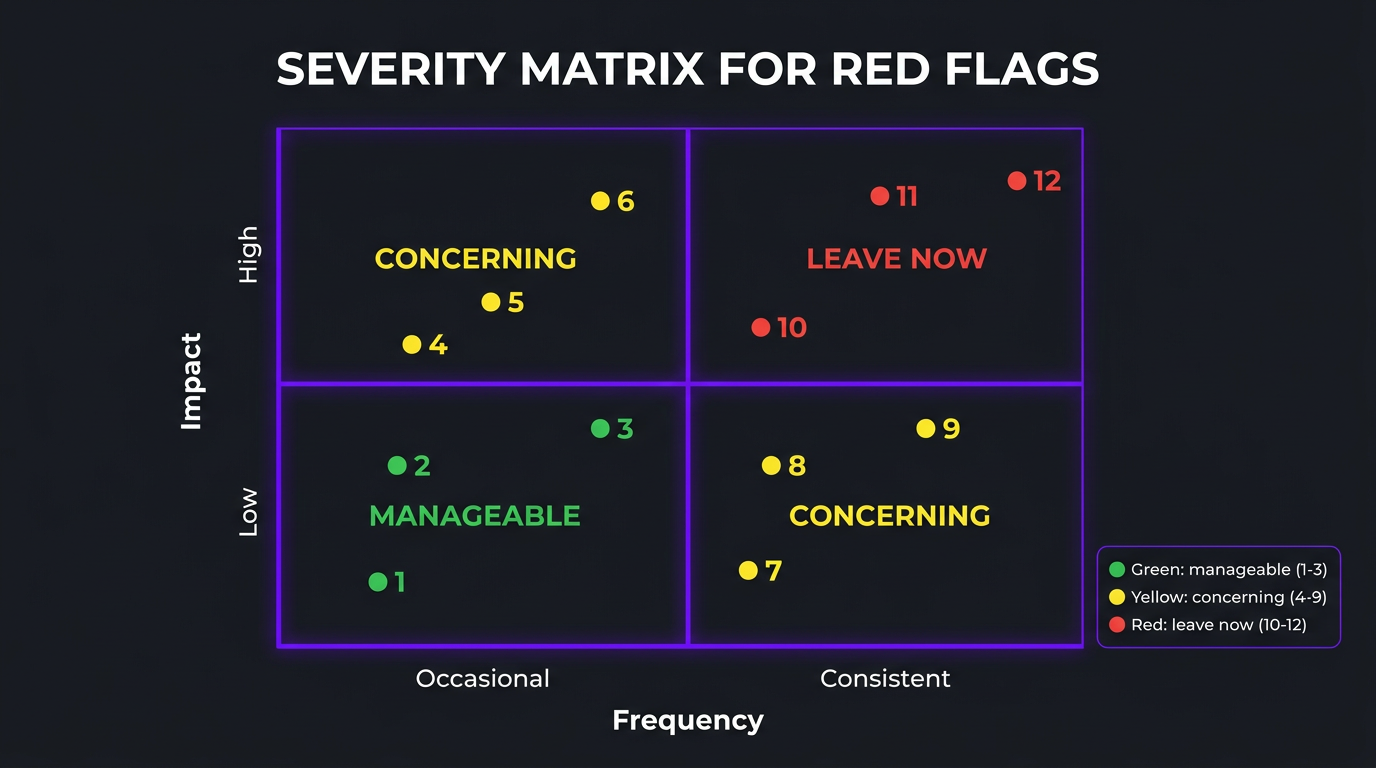
Red Flag Severity Guide: When to Talk vs When to Walk
| Red Flag | Severity | Action |
|---|---|---|
| #1 No relevant portfolio | 🔴 High | Don’t sign — find a better fit |
| #2 Vague/hidden pricing | 🔴 High | Demand clarity before committing |
| #3 No dedicated editor | 🟡 Medium | Negotiate dedicated assignment or move on |
| #4 Missed deadlines | 🔴 High | Direct conversation; if no improvement in 2 weeks, leave |
| #5 Poor communication | 🟡 Medium | Establish SLA; escalate if no change in 1 month |
| #6 No QC process | 🟡 Medium | Ask for QC implementation; accept or leave |
| #7 Defensive to feedback | 🔴 High | One direct conversation; if culture doesn’t change, leave |
| #8 High editor turnover | 🟡 Medium | Request dedicated assignment in writing |
| #9 Cookie-cutter style | 🟡 Medium | Provide strong brand guidelines; evaluate after 4-6 videos |
| #10 No onboarding | 🟡 Medium | Propose your own onboarding docs; flag if ignored |
| #11 Can’t scale | 🟠 Medium-High | Plan transition before you need to scale |
| #12 Overselling | 🔴 High | Document gaps between promises and delivery; leave if pattern holds |
What Good Looks Like: 8 Green Flags to Look For
We’ve spent 12 sections on what to avoid. Let’s flip the script — here’s what a great video editing agency looks like:
When you find an agency that checks all 8 green flags, you’ve found a genuine production partner — not just a vendor. That partnership compounds over time: the longer you work together, the better and faster the output gets. It’s the opposite of the red flag experience, where things deteriorate over time.
When to Leave Your Agency (and How to Do It Smoothly)
The “should I stay or go” framework
Not every red flag means you should immediately leave. Some can be resolved through direct conversation. Here’s a framework:
- 1-2 minor red flags: Have a direct conversation with your account manager. Be specific about the issue and what you need to change. Give them 2-4 weeks to address it.
- 3+ red flags, or any single critical red flag: Start planning your transition. Begin vetting alternative agencies while giving your current agency a final chance to improve.
- Promises made, not kept (after direct conversation): Leave. If they acknowledged the problem, committed to fixing it, and didn’t follow through, they won’t fix it on the second attempt either.
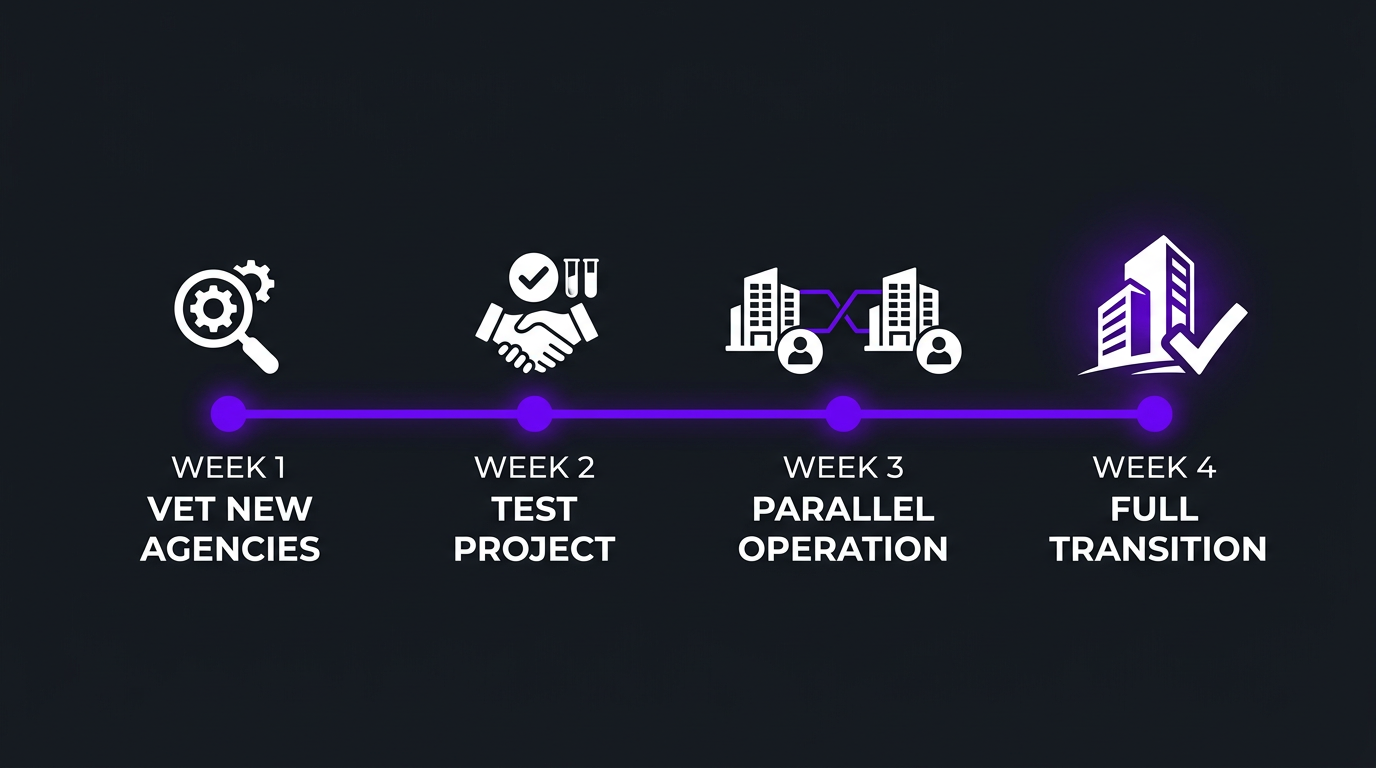
How to transition agencies without disrupting your content
- Start the new agency before ending the old one. Run parallel for 2-4 weeks. Overlap costs money, but content gaps cost more.
- Give the new agency your brand guide, references, and feedback history. Everything your old agency learned about your brand — make sure the new agency gets it on day one.
- Start with a test project. Don’t hand over your full content calendar immediately. Give the new agency 2-3 videos to prove they can match your quality standards.
- Export your assets. Intros, outros, templates, graphics, fonts — make sure you own these and can transfer them. If your old agency created them, confirm ownership in your contract.
- Build a content buffer. Before transitioning, stockpile 2-3 weeks of edited, ready-to-publish content. This buffer protects your publishing schedule during the transition.
Looking for an Agency Without Red Flagsa
Transparent pricing, dedicated editors, written turnaround commitments, and a quality control process that actually works. That’s what we do.
Frequently Asked Questions
The most critical red flags are: no portfolio of work similar to yours, vague pricing with hidden fees, no dedicated editor assigned to your account, consistently missed deadlines, poor communication response times, and no quality control process beyond the editor themselves. Any of these alone is concerning; multiple together is a clear signal to look elsewhere.
Track these patterns over 2-3 months: turnaround times getting slower, quality inconsistency between videos, high editor turnover on your account, defensive responses to feedback, inability to scale with your needs, and excuses instead of solutions when problems arise. One bad week happens to everyone. A bad trend is a red flag.
Consider leaving if you experience 3 or more red flags consistently, especially after you’ve raised concerns directly. One or two issues can be resolved through conversation. A pattern of multiple red flags after you’ve given explicit feedback suggests systemic problems the agency isn’t structured to solve.
The top green flags: a portfolio with work matching your content type, transparent published pricing, a dedicated editor assigned from day one, written turnaround commitments, multi-layer QC, proactive communication, eagerness to receive and act on feedback, and a clear path to scale when you need more content.
Quality agencies charge $2,500-$8,000 per month for dedicated editing teams handling 8-40+ videos. See our full video editing pricing breakdown for detailed benchmarks. If pricing seems too good to be true — say, $500/month for “unlimited” editing — it probably is.
Occasional delays from extraordinary circumstances are understandable — once or twice a year. Repeated missed deadlines are not normal and signal the agency has overcommitted beyond their team’s capacity. A well-staffed agency with proper project management should hit 95%+ of deadlines consistently.
Ready for an Agency That Delivers What It Promisesa
We built Increditors to be the agency we wished existed. Dedicated editors, transparent pricing, and the consistency to back it up. Check our client portfolio.
Based on our experience onboarding clients from other agencies and common patterns reported across the video editing industry. Individual agency experiences may vary. For information about Increditors’ approach and guarantees, visit our pricing page or schedule a call.