










![3D Explainer Video - ScribbleLive.mp4_snapshot_00.12_[2022.03.09_03.14.16]](https://increditors.com/wp-content/uploads/elementor/thumbs/3D-Explainer-Video-ScribbleLive.mp4_snapshot_00.12_2022.03.09_03.14.16-r7wb53mx72rxst3qcqyrfxdmeyzb5r9jbl0wbjujh4.png "3D Explainer Video – ScribbleLive.mp4_snapshot_00.12_[2022.03.09_03.14.16]")






























White label video editing lets agencies offer professional video editing under their own brand, with a specialist partner handling all production work invisibly. Your agency quotes the client, delivers polished videos, and keeps the margin — your editing partner stays completely behind the scenes. It’s the fastest way to add a high-demand service line without hiring, without equipment investment, and without years of building a post-production team. In 2026, with video demand outpacing agency capacity across every vertical, the model has moved from niche to mainstream.
White label video editing lets agencies resell professional post-production under their own brand. In 2026, the best setups combine a dedicated editing partner with clear pricing mark-ups (typically 40–80%), branded delivery, and tight feedback loops. Agencies that crack the model consistently add $5,000–$30,000/month in recurring revenue without a single in-house hire. Increditors works as a fully invisible white-label editing partner for agencies worldwide.
- What Is White Label Video Editing?
- White Label Video Editing for Agencies: How the Model Works
- White Label Video Production: Full Scope Breakdown
- How to Evaluate White Label Video Editing Services in 2026
- Reseller Video Editing: The Business Case
- Pricing Models: How to Structure Your Mark-Up
- Agency vs In-House vs White Label: Side-by-Side Comparison
- Onboarding Your First White Label Partner
- Quality Control and Scaling
- Common Pitfalls to Avoid
- FAQ
What Is White Label Video Editing?
White label video editing is a business arrangement in which an agency contracts a specialist post-production company to edit videos, then resells that work under its own brand. The end client never sees the editing partner’s name, communication, or branding — every deliverable arrives as if your agency produced it internally.
The term “white label” comes from manufacturing: products shipped without branding so retailers could apply their own labels. In services, the logic is identical. A white label video editing partner is your production department — with no payroll, no overhead, and no management burden.
White Label vs Subcontracting vs Outsourcing
These three terms overlap but they’re not interchangeable. Subcontracting typically involves the client knowing — or at least suspecting — a third party is doing the work. Outsourcing is a broader operational term that doesn’t imply brand invisibility. White label means the partner is fully invisible: they use your templates, your file naming conventions, your delivery formats, and sometimes your communication tools. The client experience is seamless.
That distinction matters for pricing. When clients know a subcontractor is involved, they often negotiate down because they feel the agency is just passing margin. White label keeps that conversation out of scope entirely — you’re the service provider, full stop.
Who Uses White Label Video Editing?
The model is most common among:
Marketing and creative agencies that already handle brand, copy, and strategy for clients who are now asking for video. Adding a white label partner is a revenue unlock with almost no overhead.
Social media management agencies that produce content calendars and manage posting — but currently hand off video to a freelancer or tell clients to handle it themselves. White label closes that gap.
PR and communications firms adding video to executive communications, event recaps, and press packages.
Production houses that handle filming but not editing, or that have overflow volume they can’t handle in-house during busy periods.
According to Social Media Examiner’s industry research, video content consistently ranks as the highest-performing format across social platforms. The demand is there — agencies that can fulfill it without building an in-house team win the accounts.
White Label Video Editing for Agencies: How the Model Works
Understanding how white label video editing for agencies works in practice is what separates agencies that run it profitably from those that lose time and clients to coordination chaos. The mechanics are straightforward, but the details make all the difference.
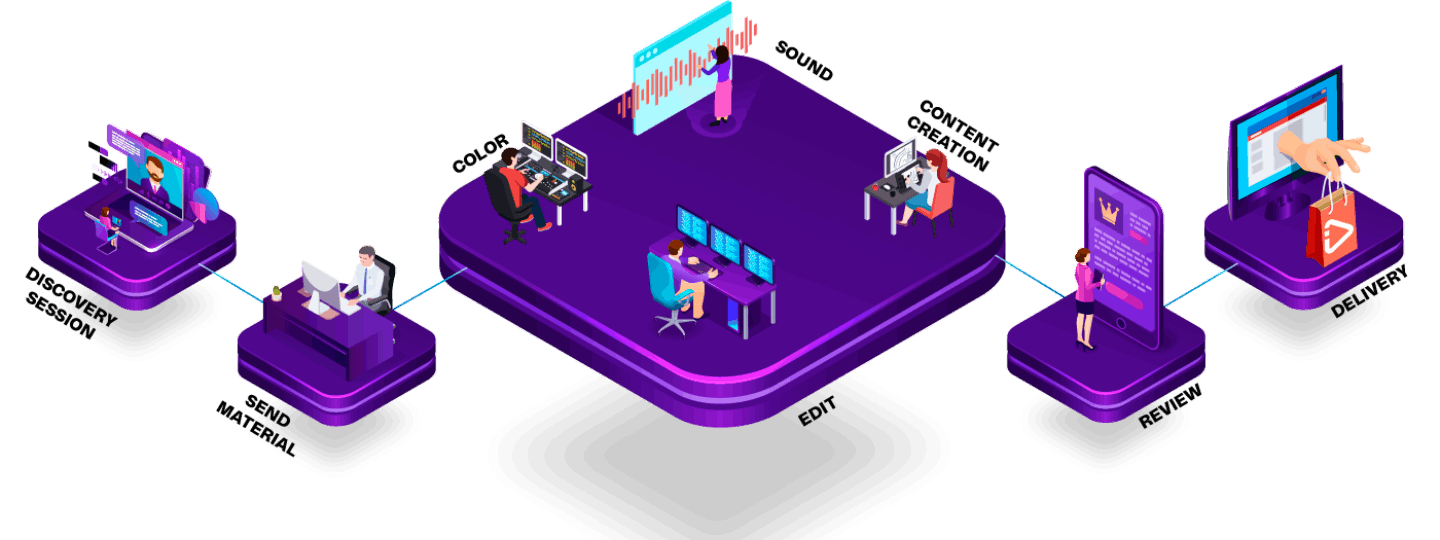
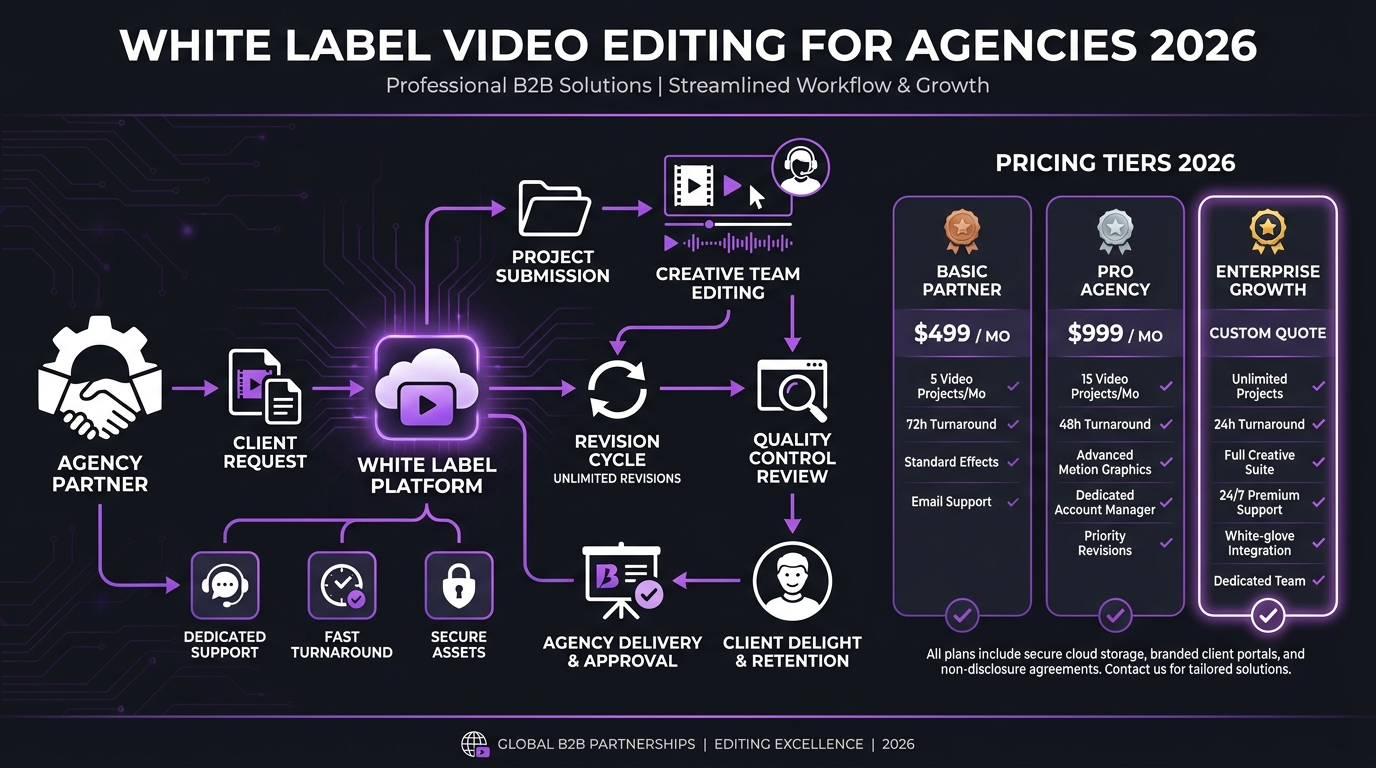
Step 1: Agency Signs a Client on a Video Retainer
The agency closes a client on a monthly video content package — say, eight social videos and two long-form edits per month. The client pays the agency directly. The agency’s quote already includes the editing partner’s rate plus your margin. The client sees a single invoice.
Step 2: Footage Handoff
The agency receives raw footage from the client (or from their production partner) and passes it to the editing partner via an agreed platform: Frame.io, Google Drive, Dropbox, or a custom pipeline. The editing partner sees the project brief, the brand kit, and the deadline — not the client’s contact information or billing details.
Step 3: Editing and Delivery
The editing partner delivers polished videos to the agency, usually in a shared folder or project review platform. The agency reviews, requests revisions if needed, and delivers to the client using the agency’s own communication channels. The editing partner’s name never appears in client-facing communication.
Step 4: Billing and Margin
The agency pays the editing partner’s wholesale rate and bills the client the retail rate. The spread is the agency’s margin — typically 40% to 80% depending on volume, service level, and how the package is positioned. At scale, this becomes a significant recurring revenue line.
💡 Pro Tip: Build the editing partner cost into your client pricing from day one — don’t try to absorb it if volume grows. Structure contracts so your margin holds whether you’re handling two clients or twenty.
A remote video editing agency like Increditors is built specifically for this model: invisible branding, dedicated editors per agency partner, and systems that integrate with how agencies already work. The operational fit matters as much as the editing quality.
White Label Video Production: Full Scope Breakdown
White label video production is a broader term than white label editing — it can include pre-production planning, scripting, shoot direction, and post-production in addition to editing. Understanding what you’re actually buying (or selling) matters when building your service package.
Post-Production Only vs Full Production
Most agency white label arrangements are post-production only: the agency or client handles filming, and the white label partner handles everything after. This is the most common setup because:
1. It maps cleanly to how agencies already work — many have production partners or clients who film themselves
2. Post-production is where the specialist expertise gap is most acute
3. It’s easier to define scope, turnaround, and pricing for editing than for full production
Full white label video production — covering shoot direction, location, talent, and editing — is less common in pure white-label form because it requires deeper coordination and the agency’s brand exposure is higher when more deliverables are in play.
What Post-Production Includes
A quality white label video production and editing service typically covers:
Assembly and rough cut — selecting the best takes, building the story or content arc, establishing timing.
Color grading — matching color consistency across shots, applying a brand-specific look if required, correcting exposure.
Audio mixing and cleanup — removing background noise, balancing music and voice, syncing audio to picture.
Motion graphics and titles — lower thirds, logo placement, branded transitions, subtitle overlays.
Format delivery — exporting to the correct specs for each platform: 16:9 for YouTube, 9:16 for Reels and TikTok, 1:1 for feed posts, 4K masters for archiving.
Agencies that work with the best white label video editing partners get all of this as a repeatable, branded workflow — not a freelancer-by-freelancer negotiation each time.
Format Delivery Matrix
A professional white label partner should handle any format a client might need without additional negotiation:
YouTube long-form (16:9 HD/4K) · Instagram Reels (9:16) · LinkedIn native video (16:9, under 10 min) · TikTok (9:16, max 10 min) · Facebook/Meta (16:9 or 1:1) · Website hero video (16:9, compressed) · Podcast/talking head video (16:9 with lower thirds) · Trade show/event loops (often 16:9 or 4:3) · Broadcast commercials (specific broadcast specs per market).
According to HubSpot’s video marketing research, short-form video generates the highest ROI of any content format — meaning your clients will be asking for multi-format repurposing, not just a single long-form edit.
How to Evaluate White Label Video Editing Services in 2026
The market for white label video editing services has grown significantly, and so has the quality variance. Picking the wrong partner costs you client relationships, not just money. Here’s how to evaluate objectively.
The Six Evaluation Criteria That Actually Matter
1. Editor consistency — Does your account have a dedicated editor, or do projects get distributed across a pool? Consistency is what builds style familiarity with your client’s brand. Rotating editors mean re-briefing on every project.
2. Turnaround reliability — What’s the quoted turnaround, and what does it look like in real conditions? Missed deadlines are your problem with the client, not the partner’s. Require SLAs with written turnaround commitments.
3. Revision process — How many revision rounds are included? How are feedback delivered and tracked? Partners with a structured revision workflow (timestamped notes, clear round numbering) are dramatically easier to work with than those handling revisions via email or informal message threads.
4. White label compliance — Does the partner sign an NDA? Do their watermarks, email footers, and file metadata show their name, or yours? Test this before signing a contract by requesting a sample deliverable and checking every visible and metadata layer.
5. Communication tools — Can they work in your preferred tools (Slack, Frame.io, Notion, Asana)? Or do you have to learn their system? Friction in communication amplifies over volume. The best white label video editing services adapt to your workflow, not the other way around.
6. Scalability — Can the partner handle volume spikes? If you land a new client mid-month, can capacity scale without blowing timelines for existing accounts? Ask specifically: “If I doubled my current volume tomorrow, what would happen?”
💡 Pro Tip: Run a paid test project before committing to a retainer agreement. Give the candidate partner one real project with real footage, a real deadline, and a real brief. Their handling of that test tells you more than any sales conversation.
Red Flags in White Label Video Services
Watch out for partners who: can’t provide references from agency clients specifically (individual brand clients have different needs); quote turnaround without specifying what “business days” means in their timezone; charge “rush fees” that make the basic service unworkable; have no formal NDA or white label agreement; or can’t tell you specifically who will edit your projects.
Checking video editing packages side by side helps you identify what’s included vs. what’s an add-on charge in disguise. Some partners look cheap until you add revision rounds, multi-format exports, and rush fees.
Reseller Video Editing: The Business Case
Reseller video editing is the commercial structure behind the white label model: you buy editing services at wholesale and resell them at retail. Understanding this framing helps you think about it as a proper business unit rather than an ad-hoc arrangement.
The Reseller Math: A Realistic Example
Suppose you charge a client $3,000/month for a video content package: eight short-form social edits and two long-form videos. Your white label editing partner charges you $1,500/month for the same volume. Your gross margin on that package is 50%. Your account management time: roughly 3–5 hours per month for client communication, feedback relay, and quality review.
Five clients at that structure: $7,500/month gross margin from the video line alone, with 15–25 hours of your team’s time. That’s a meaningful revenue line without a single in-house hire.
The math improves at scale because fixed costs (NDA, onboarding, workflow setup) amortize over more volume, and well-run reseller relationships often come with volume discounts from the editing partner.
Positioning Reseller Video Editing to Clients
You’re not “reselling” in the way clients might understand it. You’re providing a managed video production service. Your value is: project management, quality control, brand consistency, creative direction, and account relationship. The editing execution is a production function — like a design studio using print partners or a PR firm using distribution services.
Never call it reselling to a client. You manage a production workflow on their behalf. That framing is accurate and positions the service at a higher value point.
Reseller vs Affiliate vs Partner
Some editing services have formal reseller programs with volume pricing and co-marketing. Others have affiliate programs where you refer clients and earn commission — this is not white label. Still others offer informal agency partnerships with custom pricing but no formal structure. Know which category you’re negotiating before you agree to terms.
For deeper cost analysis across editing service structures, see this breakdown of how much professional video editing costs — it covers freelancer, service, and agency rates in market-realistic ranges.
Industry publications like Sprout Social’s video marketing research consistently show that social video consumption increases year over year, making this reseller market more durable, not less.
Pricing Models: How to Structure Your Mark-Up
One of the most common agency mistakes is choosing a pricing model that creates margin pressure under volume or makes it hard to quote clients. Here are the main white label pricing structures and how to mark them up sustainably.
How to Price to Clients
A common mistake is applying a flat percentage mark-up. Instead, price based on the client’s perceived value of the service. A client doing $500,000/year in revenue from their video content views a $3,000/month retainer very differently than a client doing $50,000/year. Price to value, not just to cost-plus.
The practical floor for a properly resourced monthly retainer with a dedicated editor, multi-format delivery, and revision rounds tends to start around $800–1,200/month on the wholesale side. Agencies commonly retail this at $2,000–4,000/month depending on market and positioning.
Agency vs In-House vs White Label: Side-by-Side Comparison
Before committing to the white label model, it’s worth stress-testing it against the alternatives: hiring in-house editors, or outsourcing to a full-service agency on a project basis. Here’s the full comparison.
For most agencies processing under 30 video projects per month, white label outperforms in-house on the economics until volume reaches a threshold where an in-house editor is fully utilized (typically 25–35 hours of editing per week, continuously). Below that threshold, in-house editing is expensive slack capacity.
Onboarding Your First White Label Partner
The onboarding process sets the foundation for whether the partnership delivers at scale or creates ongoing friction. Invest in a thorough onboarding and you’ll compound time savings for months. Rush it and you’ll pay the cost in endless correction cycles.
Onboarding Checklist
Legal foundation: NDA signed, white label agreement covering IP ownership, confidentiality of client data, and prohibited uses of your client materials. Confirm the editing partner holds no rights to the final deliverables.
Brand kit transfer: Share your clients’ brand guidelines — logo variations, font files, color codes, motion style examples, any existing video templates or intro/outro files.
File transfer system: Agree on the platform and folder structure. Define how raw files are named, how projects are organized, and how final deliverables are labeled. Set this in writing — verbal agreements drift.
Feedback protocol: Define how revisions are submitted. Timestamped video comments (Frame.io), numbered revision lists in a shared doc, or a project management system like Notion or Asana. Never freeform email — it creates confusion about which version is being referenced.
Turnaround and SLAs: Establish the exact definition of “one business day” in context of timezones, what constitutes a rush, and what the process is if a deadline is missed.
Test project: Run a live project through the workflow before launching to a client. Catch issues in the process before they become client issues.
Quality Control and Scaling Across Multiple Clients
Quality control is the function most agencies underinvest in when scaling white label video. At one client, it’s manageable informally. At five clients, it needs a system.
The QC Review Layer
Your agency should maintain a QC step between the editing partner’s delivery and the client’s delivery. This doesn’t need to be a full re-edit — it’s a structured check against a review list:
✅ Correct aspect ratio and resolution for stated platform
✅ Logo placement matches brand guide
✅ Color grading is consistent with previous deliverables
✅ No audio issues — no clipping, no noticeable background noise
✅ Captions/subtitles accurate and correctly timed
✅ Correct file format and codec for delivery channel
✅ No editing partner branding in metadata or watermarks
✅ All requested changes from previous revision round incorporated
A 10-minute QC pass catches 90% of issues before they reach the client. Skipping it means clients find problems first — that erodes confidence in your service, not your partner’s.
Scaling to 10+ Clients
At 10+ concurrent white label clients, informal coordination breaks. What works at this scale:
Dedicated account managers per client cluster — one person owns the relationship with a group of clients and handles all briefing and delivery for their accounts.
Standardized brief templates — a filled-in brief takes 10 minutes. An underbriefed project costs 2–3 revision rounds. Brief templates save time globally.
Weekly pipeline reviews — a 30-minute check on what’s in-flight, what’s due this week, and what’s queued. Catches capacity issues before they become missed deadlines.
Increditors specifically structures white label partnerships for agency scale — with dedicated editor assignments, project tracking that integrates with common agency tools, and volume capacity that doesn’t degrade quality as you grow. That’s what makes the model a real growth engine rather than a patch on a capacity problem.
Common Pitfalls and How to Avoid Them
Every agency that runs white label video editing at scale has made some version of these mistakes. The ones who scale successfully learn them fast.
Pitfall 1: Thin Margin That Can’t Absorb Overruns
Agencies trying to win on price often mark up only 20–30%, which leaves no buffer for revision overruns, rush requests, or onboarding a new client. If one client’s project goes over-budget (on the partner side) and you’ve only marked up 20%, you’re working at near-zero or below. Price with at least 40% margin as your floor.
Pitfall 2: Single Partner Dependency
Relying on one editing partner for all your accounts creates catastrophic risk if that partner has a capacity crisis, staff turnover, or goes out of business. Once you’re handling 3+ clients’ video production through one partner, build a backup — a second qualified vendor you’ve test-onboarded, even if you’re not using them regularly.
Pitfall 3: Scope Creep Absorption
Clients often ask for “just one more thing” — an extra cut for a story, a quick resize for another platform, a version with the logo repositioned. Your editing partner charges for these. If you absorb them to keep the client happy, your margin bleeds. Define scope clearly in client contracts and communicate change orders promptly.
Pitfall 4: Briefing Failures
The most common source of revision rounds and client dissatisfaction is an incomplete brief. An underbriefed project forces the editor to make assumptions — and the editor will make different assumptions than the client had in mind. Every project brief should specify: tone, pacing, music direction, text overlays, call-to-action, target platform, length, and any specific shots to include or exclude.
Pitfall 5: Ignoring White Label Compliance
Even well-intentioned editing partners can slip. A file exported with their company name in the metadata. An email with their logo in the footer that accidentally goes to your client. Establish clear white-label compliance requirements in your contract and audit deliverables periodically.
You can reference industry benchmarks and case studies on agency content structures at the Content Marketing Institute‘s annual benchmarks — they publish data on agency video adoption and client budget trends that’s useful for positioning your offering.
The Revenue Math: What Agencies Actually Earn
The business case for white label video editing isn’t theoretical — it’s a math problem. Here’s how to model it accurately, including the friction costs most agencies underestimate.
Base Case: Five Retainer Clients
Five clients, each paying $3,000/month for a monthly video content package (eight short-form videos + two long-form edits). Your white label partner charges you $1,400/month per client for that volume.
Gross revenue from video line: 5 × $3,000 = $15,000/month
Wholesale editing cost: 5 × $1,400 = $7,000/month
Gross margin: $8,000/month (53%)
Account management time: ~4 hours/client/month = 20 hours total
Internal labor cost at $75/hour: $1,500/month
Net margin: ~$6,500/month from the video line alone
At 10 clients on the same structure, net margin reaches $13,000+/month with marginal additional management overhead — account management time per client decreases as workflows become systematic.
Growth Case: Adding the Premium Tier
Agencies that segment by client sophistication typically run two tiers. A standard tier (retainer-based, social content focus, $2,000–3,500/month) and a premium tier (dedicated editor with same-week turnaround, multi-format delivery, brand kit management, $5,000–10,000/month). Premium tier clients are typically in-house marketing teams at growth-stage companies who want the output quality of an in-house team without the hiring overhead.
Two premium clients at $7,000/month = $14,000 gross. If your partner charges you $2,800/month per client for premium-tier service, that’s $5,600 wholesale, $8,400 gross margin. One dedicated staff member managing those two accounts (20 hours/month at $80/hour = $1,600) leaves ~$6,800 net from just two clients.
What to Model as Hidden Costs
Most agency business plans overestimate net margin on white label by underestimating friction:
Revision overruns — clients request more revision rounds than the package allows, and you absorb them instead of billing. Budget 10–15% of the wholesale cost as margin protection for this.
Onboarding new clients — the first 4–6 weeks with a new client are higher-overhead. Brief alignment, brand kit setup, and style calibration all take more time before the workflow becomes systematic. This is a one-time cost, but it shouldn’t be ignored.
Churn gap — when a client leaves mid-month, you may have already committed to a partner billing cycle. Keep partner commitments on rolling 30-day terms where possible to minimize this exposure.
Tools for Managing Your White Label Video Workflow
The right tooling keeps your white label video operation running smoothly as you scale. These are the categories where agencies most commonly under-tool.
File Transfer and Review
Frame.io — the industry standard for video review and approval. Supports timestamped comments directly on the video, version stacking, and branded review links that don’t expose the editing partner’s identity. Most professional white label partners support Frame.io natively.
Google Drive or Dropbox — for raw footage transfer and archive. Simple, universally compatible, easy to share with both clients (for raw upload) and partners (for receipt). Organize with a strict folder structure: /ClientName/ProjectName/Raw, /Review, /Finals.
WeTransfer Pro — for one-off large file transfers when a permanent folder structure isn’t needed. The agency-branded links work well for client final delivery.
Project Management
Notion or Asana — brief management, deadline tracking, and revision round logging. Pick one and standardize it — mixing tools across clients creates audit confusion.
Slack — for async communication with your editing partner. Create a dedicated channel per client account (not per project). This keeps brand context in one place and makes it easy to search historical decisions about a client’s style.
Billing and Client Management
Separate your billing cadence from your partner payment cadence. Invoice clients on the 1st of the month; pay the partner on receipt of approved deliverables (or on the 15th). The timing gap gives you a cash float buffer and reduces the risk of being out of pocket during client onboarding months when project volumes are highest. This is standard practice in agency retainer management and eliminates the cash flow squeeze that catches new operators off-guard.
As you build this workflow, resources from Social Media Examiner regularly cover how agencies are structuring video services for social clients — useful for staying current on what client expectations look like in 2026.
FAQ: White Label Video Editing for Agencies
What is white label video editing, and how is it different from outsourcing?
White label video editing means your agency resells a specialist partner’s editing work under your own brand — the client never knows who did the editing. Outsourcing is a broader term that simply means having an external party do work for you; it doesn’t imply brand invisibility. The white label model means the partner adapts to your branding, communication style, and delivery format, not the other way around.
How much should I charge clients for white label video editing services?
Price based on the value delivered to the client, not just a fixed mark-up on your partner cost. Monthly retainers for social video content commonly range from $1,500–5,000/month at retail, depending on volume and deliverable complexity. Apply a minimum 40% margin to ensure the business unit is viable even with overruns and revision absorption.
Will my clients find out I’m using a white label video editing partner?
Not if you set up the partnership correctly. A proper white label arrangement means the partner signs an NDA, delivers files under your branding, never contacts your client directly, and produces deliverables with no visible trace of their identity. Audit your first few deliverables for metadata and branding to confirm compliance before scaling to multiple clients.
What’s the difference between white label video production and white label video editing?
White label video editing refers specifically to post-production: taking recorded footage and editing, grading, mixing, and delivering finished videos. White label video production can include the broader production pipeline — scripting, shoot logistics, direction, and post-production. Most agency white label arrangements focus on post-production only, since that’s where specialist expertise is most needed and raw footage is often already produced by the client or a separate production partner.
How do I find a reliable white label video editing reseller partner?
Look for partners that specifically mention white label or agency partnerships — general editing services don’t always understand the invisibility requirements. Ask for references from other agencies (not just brands). Run a paid test project before committing. Check their NDA, review their communication process, and confirm they have dedicated editor assignments rather than a freelancer pool. Increditors is built specifically for agency white label partnerships — with dedicated editorial teams, a fully invisible delivery model, and scalable capacity for growing agency accounts.
Ready to Add White Label Video Editing to Your Agency?
Increditors works as a fully invisible editing partner for agencies — dedicated editors, branded delivery, and the capacity to scale with your client list. Tell us about your current volume and we’ll put together a custom agency partner plan.