








![3D Explainer Video - ScribbleLive.mp4_snapshot_00.12_[2022.03.09_03.14.16]](https://increditors.com/wp-content/uploads/elementor/thumbs/3D-Explainer-Video-ScribbleLive.mp4_snapshot_00.12_2022.03.09_03.14.16-r7wb53mx72rxst3qcqyrfxdmeyzb5r9jbl0wbjujh4.png "3D Explainer Video – ScribbleLive.mp4_snapshot_00.12_[2022.03.09_03.14.16]")





























When your company produces 30 videos a month across three departments and two continents, the freelancer you found on Upwork isn’t going to cut it anymore.
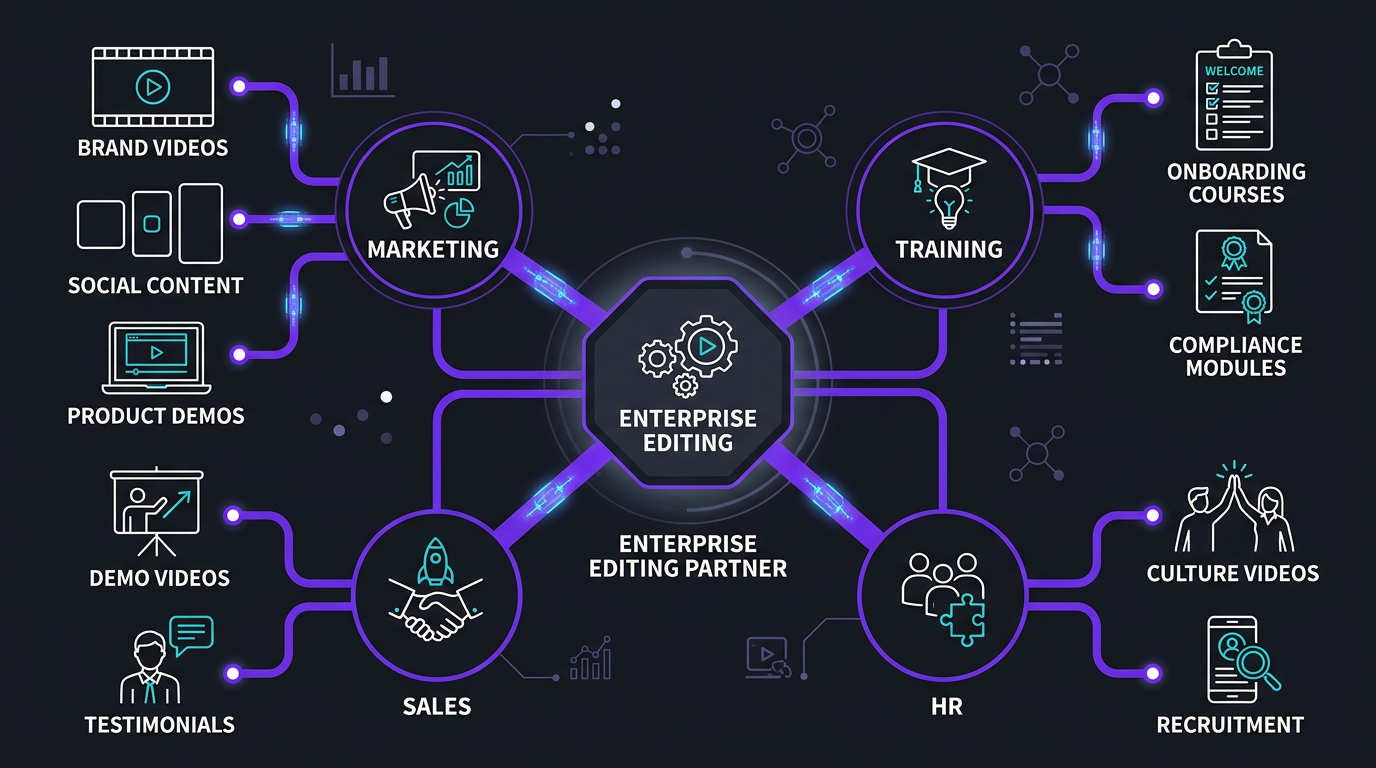
Enterprise video editing services exist because scale breaks everything that works at small volumes. The editor who does amazing work on 4 videos a month becomes a bottleneck at 40. The informal brand guidelines that lived in your head need to become a system. The casual Slack messages about deadlines need to become SLAs with teeth.
We work with organizations producing anywhere from 20 to 100+ videos per month — from Fortune 500 marketing teams to government-funded training platforms to global wellness brands. The problems they face before finding an enterprise-grade editing partner are remarkably consistent: inconsistent quality, missed deadlines, security concerns, and zero scalability.
Here’s what actually matters when evaluating enterprise video editing services — and what most companies get wrong.
What’s in This Guide
- Enterprise vs. Regular Video Editing: The Real Differences
- Brand Consistency at Scale
- SLAs and Turnaround Guarantees
- Security and Compliance Requirements
- Scalability: From 10 Videos to 100
- Managing Global Teams and Time Zones
- Enterprise Pricing Models
- How to Evaluate Enterprise Editing Partners
- Case Studies: Enterprise Editing in Practice
- Build In-House vs. Outsource: The Enterprise Decision
- FAQ
Enterprise vs. Regular Video Editing: The Real Differences
Let’s be blunt: most video editing services are built for creators and small businesses. They work fine at that scale. But when you throw enterprise requirements at them — compliance documentation, multi-brand management, capacity planning, audit trails — they fall apart.
The difference isn’t just about doing more of the same thing. It’s a fundamentally different operating model.
| Capability | Standard Editing Service | Enterprise Video Editing Service |
|---|---|---|
| Team structure | 1 editor, maybe a PM | Dedicated pod: editor(s), colorist, motion designer, PM, QC lead |
| Brand management | Basic style notes | Full brand guideline library, template systems, multi-brand support |
| Security | Google Drive links | Encrypted transfer, NDAs, access controls, audit trails |
| Scalability | Capacity of one editor | Team scales up/down based on demand, capacity guaranteed via SLA |
| SLAs | “We’ll try to hit deadlines” | Contractual turnaround times, escalation procedures, penalty clauses |
| Reporting | None | Monthly delivery reports, quality metrics, capacity utilization |
| Onboarding | Send a few example videos | Structured onboarding: brand audit, workflow mapping, template creation |
| Backup coverage | ❌ Editor is sick = you wait | ✅ Cross-trained backup editors, zero disruption |
That table isn’t theoretical. Every line in it reflects a real pain point we’ve seen companies hit when they try to force-fit a creator-tier editing service into an enterprise workflow. The breaking point usually comes around 15-20 videos per month — that’s when the ad-hoc systems collapse and the need for real infrastructure becomes obvious.
Brand Consistency at Scale: The #1 Enterprise Challenge
Here’s a scenario every enterprise marketing leader recognizes: your North America team produces beautiful, on-brand videos. Your APAC team uses slightly different fonts. Your training department uses a completely different intro animation. Your sales team is just… doing their own thing.
Brand consistency is easy with one editor and five videos a month. It’s nearly impossible with multiple editors, departments, and regions — unless your editing partner has systems specifically designed for it.
What Brand Governance Actually Looks Like in Video
A proper enterprise editing partner maintains:
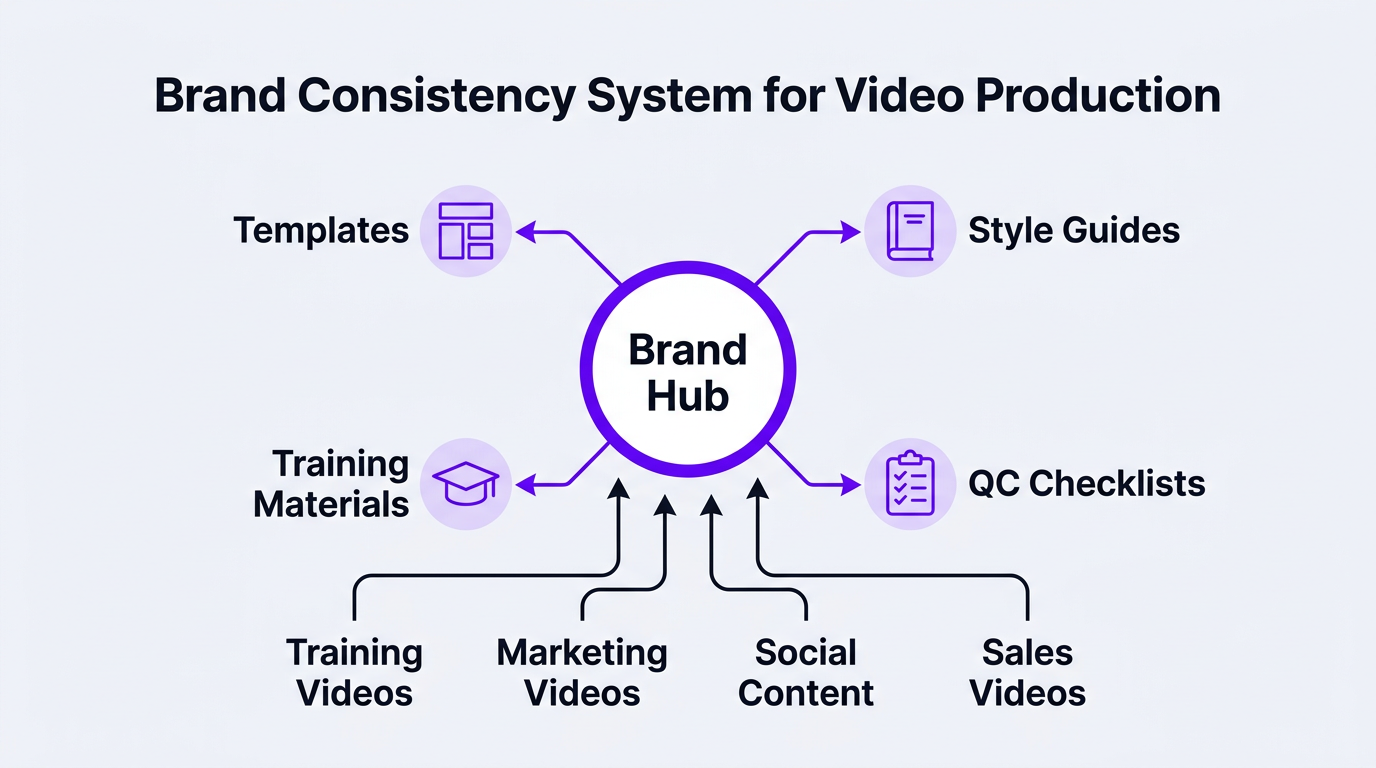
- Brand guideline documentation — not just logos and colors, but editing rhythm, transition styles, text animation preferences, music guidelines, and tone-of-voice rules for every content type
- Template libraries — pre-built Premiere/After Effects templates for intros, outros, lower thirds, title cards, and recurring segments that any editor on the team can use
- Style reference libraries — a curated collection of “this is the standard” examples for each content type so new team members can calibrate immediately
- Multi-brand separation — if you run multiple brands or sub-brands, each gets its own guideline set and template library with no cross-contamination
- QC checklists — every video is reviewed against brand compliance criteria before delivery
When we onboarded eSafety, a government-backed digital safety education platform, they needed 30+ training courses produced with absolute consistency. Every course had to look, sound, and feel like part of the same family — despite covering wildly different topics and being produced over several months. We built a comprehensive template system and style guide that ensured course 30 was indistinguishable in quality and brand alignment from course 1. No drift, no inconsistency, no “oh, a different editor must have done this one” moments.
That kind of consistency doesn’t happen by accident. It happens because the system is designed for it.
The Cost of Brand Inconsistency
Brand inconsistency in video is more damaging than in other media because video is immersive. Viewers notice — consciously or subconsciously — when the production quality shifts, when the font changes, when the energy of the edit doesn’t match what they’ve come to expect.
For enterprises, this inconsistency directly undermines the professional image you’re paying millions to build. According to Lucidpress research, consistent brand presentation across all platforms increases revenue by up to 23%. Video is increasingly the primary brand touchpoint — if your videos are inconsistent, your brand is inconsistent.
SLAs and Turnaround Guarantees: Why They Matter More Than Price
When a YouTube creator’s video is a day late, it’s annoying. When an enterprise product launch video misses its deadline, it cascades through the entire go-to-market plan. Campaign dates shift. Media buys are wasted. Internal stakeholders lose confidence in the marketing team.
This is why SLAs — Service Level Agreements — are non-negotiable for enterprise video editing.
What Enterprise SLAs Should Include
| SLA Component | Standard Service | Enterprise Standard |
|---|---|---|
| First draft turnaround | “Usually 3-5 days” | Guaranteed 24-72 hours (by complexity tier) |
| Revision turnaround | “We’ll get to it” | Guaranteed within 12-24 hours |
| Communication response | No guarantee | Response within 2-4 business hours |
| Capacity guarantee | None | Minimum X videos/month guaranteed, surge capacity defined |
| Escalation path | Email the editor | Tiered: PM → Account Director → VP of Operations |
| Quality standard | Subjective | Defined quality criteria, measurable pass/fail |
| Uptime/availability | Not discussed | Coverage hours defined, holiday/PTO backup planned |
When evaluating partners, ask to see their actual SLA document — not a marketing page that says “fast turnaround.” If they don’t have one, they’re not an enterprise service. They’re a freelancer with a nice website.
Turnaround Tiers: How Smart SLAs Work
Not every video needs the same turnaround. A well-structured enterprise SLA uses complexity tiers:
- Tier 1 (Simple): Talking head, basic cuts, standard graphics — 24-hour first draft
- Tier 2 (Standard): Multi-cam, B-roll integration, custom graphics — 48-hour first draft
- Tier 3 (Complex): Motion graphics, animation, VFX, multi-language — 72-hour+ first draft
- Rush: Any tier accelerated to 12-24 hours at a defined premium (typically 25-50%)
This tiered approach prevents the common problem where every single video gets labeled “urgent” by internal stakeholders. When there’s a clear framework, teams can plan production schedules rationally and reserve rush capacity for genuine emergencies.
Need Enterprise-Grade Video Editing with Real SLAsa
We build dedicated teams with contractual turnaround guarantees, brand governance, and the infrastructure enterprises actually need.
Security and Compliance: The Requirements Most Editing Services Can’t Meet
Ask most video editing services about security and you’ll get a blank stare. Or worse, you’ll get “we use Google Drive” — which, for regulated industries, is an instant disqualifier.
Enterprise video content often contains pre-release product footage, confidential training materials, executive communications, and proprietary data. Treating this like any other freelancer project is a compliance risk waiting to materialize.
Security Baseline for Enterprise Video Editing
- NDAs: Individual NDAs signed by every team member who touches your footage — not just a company-level NDA that’s unenforceable against individual contractors
- Encrypted file transfer: SFTP, encrypted cloud storage, or dedicated transfer solutions (Signiant, MASV, Aspera). No WeTransfer. No public Google Drive links.
- Access controls: Role-based access ensuring editors only see projects they’re assigned to. No shared logins. No “everyone can see everything” folder structures.
- Audit trails: Logs of who accessed what files, when, and what they did. Essential for compliance reporting.
- Data retention policies: Clear agreements on how long raw footage and project files are stored, where they’re stored, and when they’re deleted.
- Geographic restrictions: Some industries require data to remain within specific jurisdictions. Your editing partner needs to accommodate this.
Industry-Specific Compliance
Depending on your industry, additional requirements may apply:
| Industry | Regulation | Video Editing Implication |
|---|---|---|
| Healthcare | HIPAA | Patient footage must be stored/transferred with PHI protections. BAA required. |
| Finance | SOX, FINRA | Marketing videos may need compliance review workflows built into editing process. |
| Education | FERPA | Student footage requires specific handling and consent documentation. |
| Government | FedRAMP, ITAR | Data sovereignty requirements, security clearance may apply to editors. |
| Technology | SOC 2 | Vendor security assessments, annual audits, documented security policies. |
Our work with eSafety — a government-funded platform — required strict adherence to data handling protocols for educational content involving minors. Every team member underwent background checks, all content was transferred through encrypted channels, and we maintained complete audit trails throughout the 30+ course production process. This isn’t overhead — it’s the baseline for enterprise work.
Scalability: The Difference Between 10 Videos and 100
Every enterprise starts with a manageable video volume. Then a product launch hits. Or the CEO decides to do a weekly video series. Or the training department needs 50 compliance modules by Q3. Suddenly, you need 3x the capacity and you need it yesterday.
Scalability isn’t just about being able to handle more videos. It’s about handling more videos without quality degradation, timeline slippage, or communication breakdown.
How Enterprise Editing Partners Scale
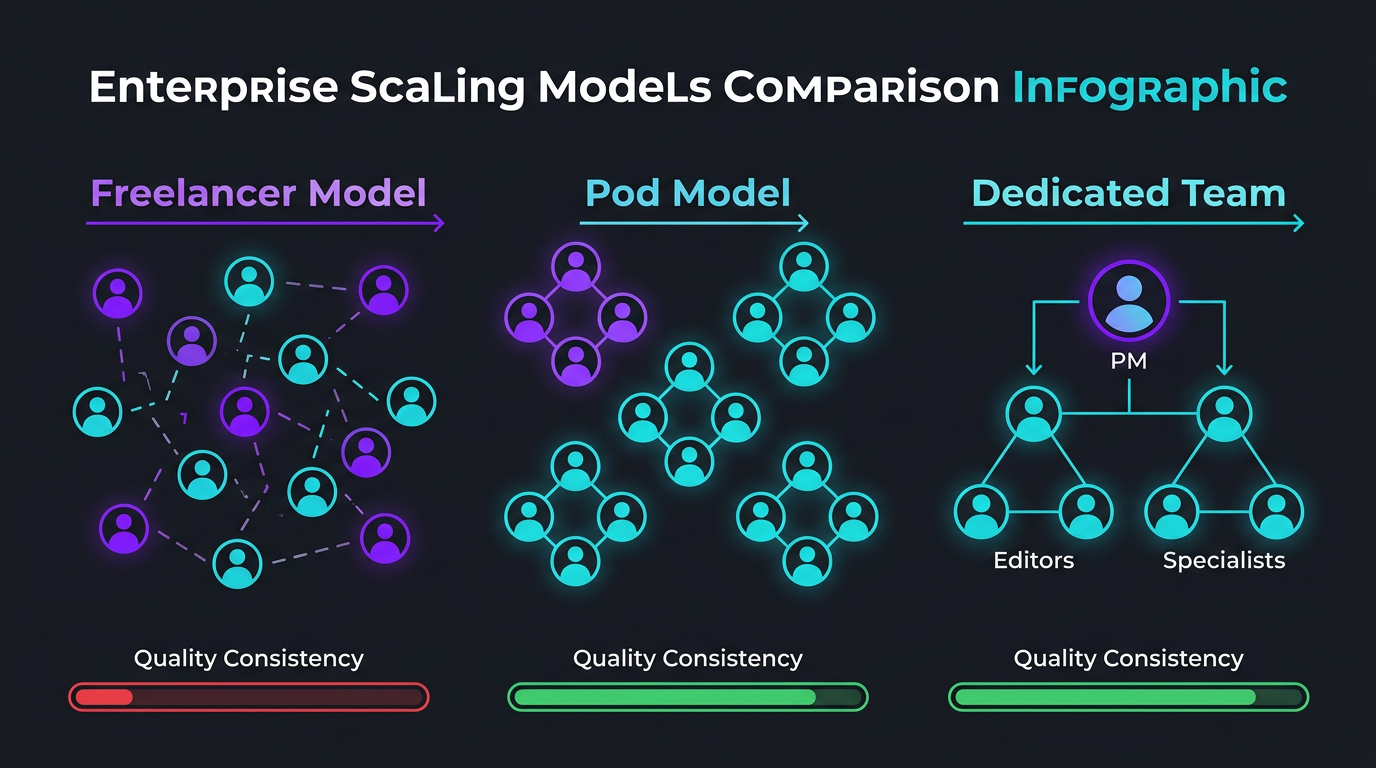
There are three models for scaling editing capacity, and they have very different implications:
Model 1: Add More Freelancers
This is how most agencies scale — and it’s the worst option for enterprises. Each new freelancer needs onboarding, brand training, and quality calibration. At 10 freelancers, you have 10 slightly different interpretations of your brand. Management overhead skyrockets.
Model 2: Pod-Based Scaling
This is the model that actually works. A “pod” is a self-contained editing team — typically an editor, a motion designer, and a QC reviewer — that operates as a unit. When you need more capacity, you add another pod. Each pod goes through structured onboarding and has cross-trained backups.
At Increditors, our enterprise clients are assigned dedicated pods. When eSafety needed to scale from their initial course production to 30+ courses, we didn’t just throw more editors at the project. We scaled the pod, maintained the same QC pipeline, and ensured every new team member was calibrated against the existing style reference library.
Model 3: Full-Time Dedicated Teams
For the highest-volume enterprises (50-100+ videos/month), a full-time dedicated team model makes the most sense. You’re essentially getting an outsourced post-production department — editors, colorists, motion designers, and a PM working exclusively on your content, 40 hours a week.
Capacity Planning: The Overlooked Requirement
Enterprise editing partners should be doing capacity planning proactively — not reactively. This means:
- Quarterly reviews of projected video volume
- Pre-approved surge capacity for campaigns and launches
- Documented ramp-up timelines (how quickly can they add capacitya)
- Cross-training so team members can cover multiple content types
If your editing partner is surprised when you ask for 50% more videos next quarter, they’re not thinking at the enterprise level. The best partners anticipate your needs and have plans ready before you ask.
Managing Global Teams and Time Zones
Multinational enterprises don’t operate on a single clock. Your London marketing team needs edits reviewed during GMT hours. Your Singapore office submits raw footage at the end of their business day and expects a first draft when they arrive the next morning. Your New York HQ wants real-time communication during EST.
Global video editing isn’t just about language and localization (though those matter). It’s about operational coverage.
What Global Coverage Actually Requires
- Overlapping shifts: Your editing partner should have editors working across time zones that overlap with your key regions. Not just “we have editors in the Philippines” — structured shift coverage that guarantees responsiveness during your business hours.
- Localization capabilities: Subtitle creation, voiceover integration, region-specific graphics (different currencies, date formats, cultural references), and understanding of local compliance requirements.
- Centralized project management: Even with distributed teams, there should be a single source of truth for project status. Not three Slack channels, two email threads, and a WhatsApp group.
- Follow-the-sun workflows: For time-sensitive projects, work should be able to pass from one timezone team to the next, so progress happens around the clock.
Localization Beyond Subtitles
True localization for enterprise video goes far beyond adding subtitles. It includes:
- Re-editing for cultural context (humor, references, examples that don’t translate)
- Replacing on-screen text and graphics in the target language
- Syncing dubbed voiceovers to mouth movements (for training content where lip sync matters)
- Adjusting pacing for languages that naturally speak faster or slower
- Compliance with local regulations on disclaimers, disclosures, and content restrictions
This is especially relevant for training content. When an enterprise like eSafety produces educational courses that need to reach diverse populations, every piece of content must resonate locally while maintaining the brand’s universal standards.
Enterprise Video Editing Pricing Models
Enterprise pricing doesn’t work like creator pricing. You’re not paying per video or per hour — you’re paying for capacity, reliability, and infrastructure.
| Pricing Model | Monthly Range | Best For | Watch Out For |
|---|---|---|---|
| Per-video pricing | $150–$800/video (volume discounted) |
Variable volume, predictable per-unit costs | Costs spike during high-volume periods; less commitment from vendor |
| Monthly retainer | $5,000–$15,000/mo | Consistent monthly volume, dedicated team | Underutilization in slow months; need clear scope definitions |
| Dedicated team (FTE model) | $8,000–$20,000+/mo | High-volume, full-time needs, maximum control | Higher commitment; best ROI at 40+ videos/month |
| Hybrid (retainer + per-video) | $3,000 base + $200-400/video | Variable volume with guaranteed minimum capacity | Complexity in billing; need clear overflow definitions |
The True Cost of Enterprise Editing: Beyond the Invoice
When comparing enterprise video editing services, the sticker price tells you maybe 60% of the story. The other 40% is:
- Internal management time: How many hours does your team spend managing the editing partner A premium partner with good project management saves 20-40 hours/month in internal coordination.
- Rework costs: How many revision rounds does it actually take An enterprise partner that gets it right on the first draft saves 30-50% in hidden rework costs.
- Opportunity cost of delays: What does it cost your business when a video misses its launch date For product launches and campaign timelines, this can dwarf the editing fee.
- Switching costs: Every time you change editing partners, you lose 4-8 weeks of productivity during re-onboarding. At enterprise scale, that’s $20,000-$50,000+ in lost output.
The cheapest enterprise video editing service is almost never the most cost-effective one. The most cost-effective one is the one that delivers consistent quality on time with minimal management overhead from your team.
Get Enterprise Pricing for Your Volume
We’ll design a team structure and pricing model based on your actual content volume, complexity mix, and turnaround requirements.
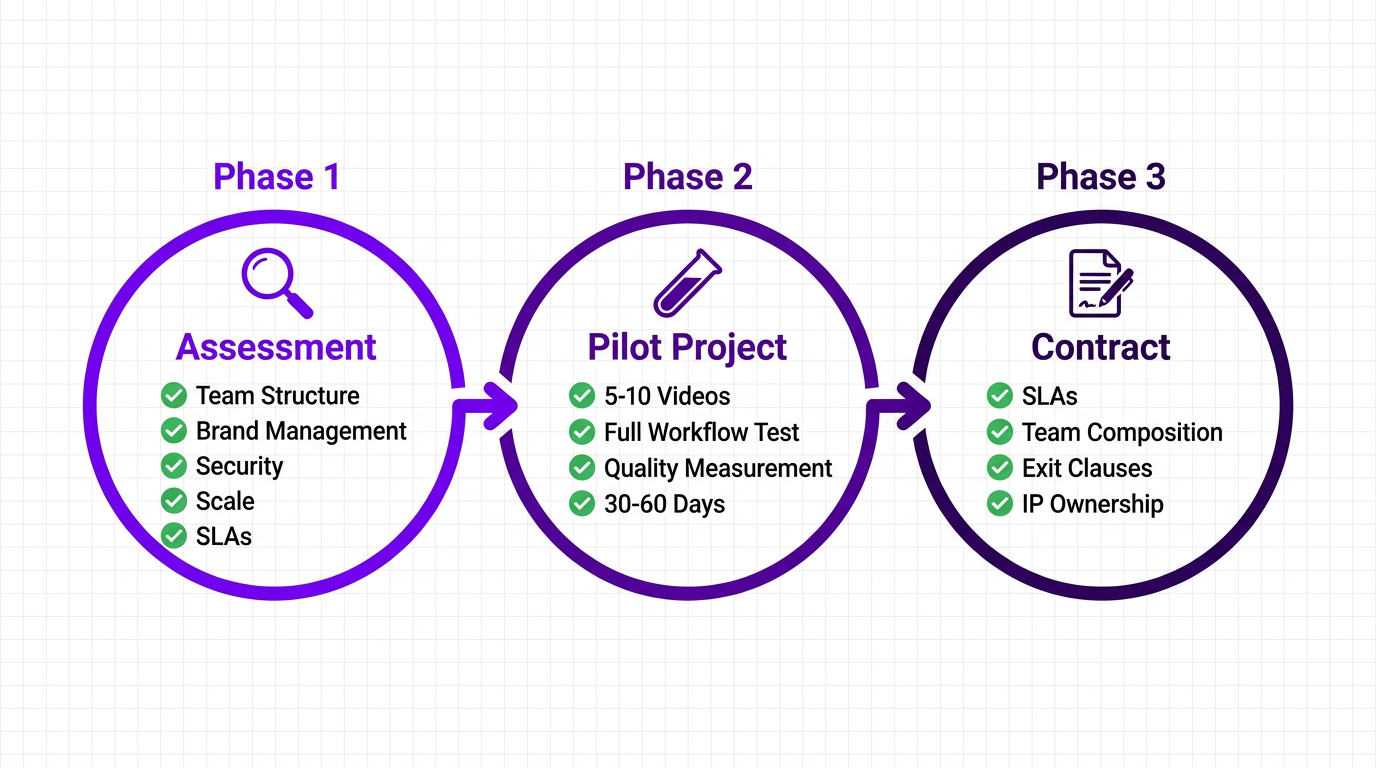
How to Evaluate Enterprise Video Editing Partners: The Checklist
We’ve worked with enterprises that went through 3-4 editing partners before finding the right fit. To save you that pain, here’s the evaluation framework we’d recommend:
Phase 1: Capability Assessment
| Criteria | Questions to Ask | Red Flags |
|---|---|---|
| Team structure | How many editors What’s your team-to-client ratio Who’s my primary contacta | Single editor handling 10+ clients. No dedicated PM. |
| Brand management | How do you maintain consistency across editors Show me your template system. | “We watch your previous videos.” No documented system. |
| Security | Walk me through your data handling. Who has access to our footage Where is it storeda | Can’t answer specifically. Uses consumer-grade tools. |
| Scale | What’s your maximum monthly capacity How quickly can you add team membersa | “We can handle anything.” No specific capacity numbers. |
| SLAs | Show me your standard SLA. What are the penalties for missed deadlinesa | No written SLA. Vague turnaround promises. |
| References | Can I speak with a current enterprise client How long have they been with youa | No enterprise references. All references are small creators. |
Phase 2: Pilot Project
Never commit to a long-term enterprise contract without a pilot. A well-designed pilot should:
- Include 5-10 videos across your most common content types
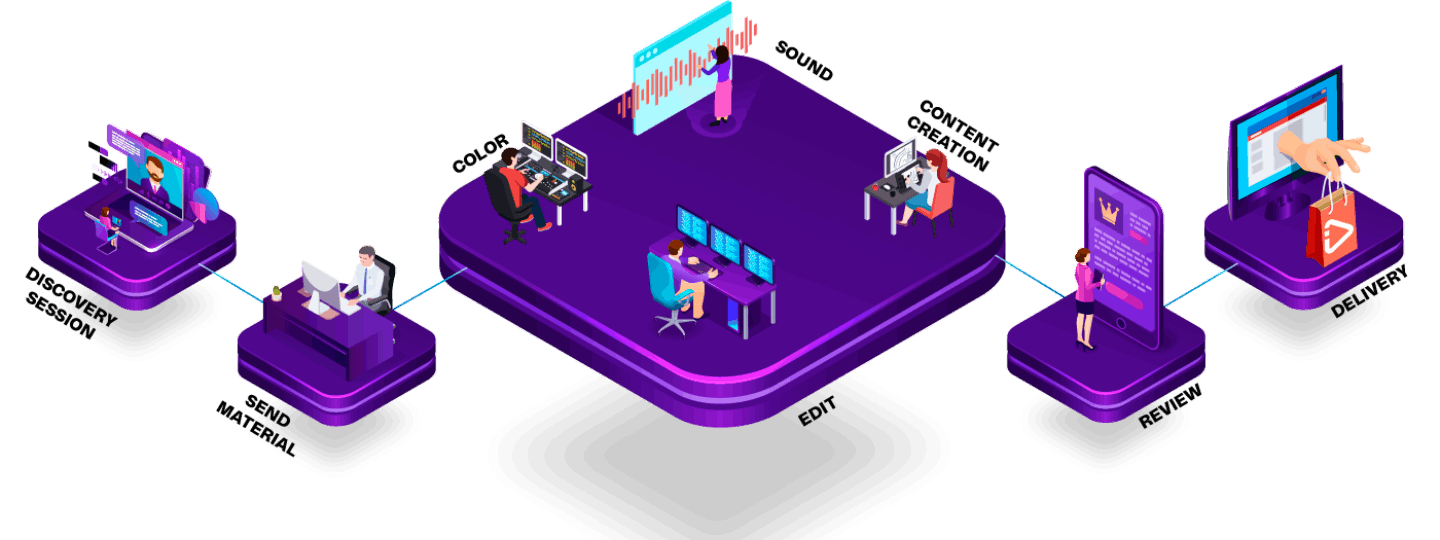
- Test the full workflow: brief submission → first draft → revisions → final delivery
- Evaluate communication responsiveness and clarity
- Measure actual turnaround against promised SLAs
- Assess quality consistency across different editors/projects
- Run for 30-60 days to capture enough data points
Phase 3: Contract Negotiation
Enterprise editing contracts should include:
- Clear SLAs with measurable criteria and consequences
- Defined team composition and guaranteed staffing levels
- Exit clauses with reasonable notice periods (30-60 days)
- IP ownership terms (you own everything, including project files)
- Data deletion policies post-contract
- Annual rate review terms (no surprise price increases)
Case Studies: Enterprise Video Editing in Practice
eSafety: 30+ Training Courses with Zero Brand Drift
The challenge: eSafety, a government-backed digital safety education platform, needed to produce 30+ comprehensive training courses. Each course contained multiple video modules, quizzes, and supplementary materials — all requiring consistent production quality, accessibility compliance, and brand alignment across the entire library.
The enterprise requirements:
- Strict brand consistency across 30+ courses produced over several months
- Accessibility compliance (captions, visual clarity, pacing for learning)
- Government data handling protocols
- Scalable production without quality variance
- Documented QC processes for audit purposes
How we solved it: We built a dedicated template system covering every visual element — from title cards to transition styles to diagram aesthetics. Every editor was trained against a master style guide with specific examples. A two-tier QC process ensured every module passed brand compliance before delivery. The result: course 30 was visually and tonally indistinguishable from course 1.
The outcome: All 30+ courses delivered on schedule and on brand. eSafety’s internal review team reported zero major revision requests due to brand inconsistency — a first for their experience with external production partners.
VYVE Wellness: Scaling a Global Wellness Brand’s Video Presence
The challenge: VYVE Wellness, a health and wellness brand, had been producing video content but couldn’t scale beyond a handful of videos per month without quality dropping. Their existing editing approach — a rotating cast of freelancers — meant every video felt slightly different. For a wellness brand where trust and consistency are paramount, this inconsistency was undermining their content strategy.
The enterprise requirements:
- Consistent visual identity across all content types (educational, promotional, social)
- Scalable production from ~5 videos/month to 20+
- Fast turnaround for trend-responsive wellness content
- Color grading that matched their warm, premium brand aesthetic
How we solved it: A dedicated editing pod was assigned exclusively to VYVE. We created a comprehensive brand editing guide covering color grading presets, transition styles, text animations, music guidelines, and pacing templates. The pod system meant VYVE always had the same editors who deeply understood their brand.
The outcome: VYVE scaled from sporadic content production to a consistent pipeline. Engagement metrics improved measurably within the first month of consistent, professional editing, and the brand was able to build a recognizable visual identity across platforms.
Build In-House vs. Outsource: The Enterprise Decision Framework
Many enterprises ask: should we just hire our own editing team It’s a legitimate question. Here’s how to think about it:
| Factor | In-House Team | Enterprise Editing Partner |
|---|---|---|
| Year 1 cost (5-person team) | $350,000–$550,000 (salary, benefits, software, hardware) |
$96,000–$240,000 ($8K-$20K/month) |
| Ramp-up time | 3-6 months (hiring + onboarding) | 2-4 weeks |
| Scale flexibility | Slow — hiring takes months | Fast — add pods in 1-2 weeks |
| Backup coverage | You manage PTO and sick leave | Partner handles all backup |
| Skill diversity | Limited to who you hire | Access to editors, colorists, motion designers, VFX artists |
| Management overhead | Significant — you’re running a team | Minimal — partner handles operations |
| Control | Maximum | High (with the right partner) |
| Technology/software | You purchase and maintain | Partner provides |
When In-House Makes Sense
- Video is your core product (media companies, production studios)
- You need editors physically present for live events or studio work
- Your content requires deep proprietary knowledge that can’t be shared externally
- You produce 100+ videos/month and have a VP of Post-Production to manage the team
When Outsourcing Makes Sense
- Video supports your business but isn’t your core product
- You need to scale up/down with business cycles
- You want access to multiple specialties (editing + motion + color + VFX) without hiring 8 people
- You need to be producing in 2 weeks, not 6 months
- Your internal team should be focused on strategy and creation, not post-production
For most enterprises, the answer is outsource — at least initially. You can always bring it in-house later once you fully understand your video production needs. Starting with a dedicated external team gives you the speed, flexibility, and expertise to figure out what works before making $500K+ in permanent hiring commitments.
And for organizations that want the control of in-house without the overhead, our dedicated team model provides full-time editors who work exclusively on your content. It’s functionally identical to an in-house team — minus the HR headaches, software costs, and management burden.
Frequently Asked Questions
Enterprise video editing services are professional post-production solutions designed for large organizations that need consistent, scalable, and secure video output across departments, regions, and content types. Unlike freelancer or small-agency editing, enterprise services include SLAs, dedicated teams, brand governance, and infrastructure for handling high volumes — typically 20-100+ videos per month.
Enterprise video editing retainers typically range from $5,000 to $20,000+ per month depending on volume, complexity, and team size. Per-video costs drop significantly at scale — enterprises editing 40-100+ videos per month often pay $150-$400 per video compared to $500+ for one-off projects. See our pricing page for current rates.
At minimum: individual NDAs for all team members, encrypted file transfer (not Google Drive or WeTransfer), role-based access controls, audit trails, and clear data retention policies. For regulated industries, additional compliance with HIPAA, SOC 2, FedRAMP, or other standards may be required.
Yes — this is a core enterprise capability. Top partners maintain separate brand guideline libraries for each sub-brand, assign dedicated teams per brand to prevent cross-contamination, and handle localization (subtitles, voiceover, region-specific graphics) across dozens of markets simultaneously.
Standard enterprise SLAs include guaranteed turnaround times (24-72 hours by complexity tier), maximum revision response times (12-24 hours), communication response guarantees (2-4 business hours), capacity commitments, escalation procedures, and quality standards with measurable criteria.
Through documented brand guidelines, template libraries (intros, outros, lower thirds, title cards), style reference collections, multi-layer QC processes, and long-term team assignments. The best services assign the same editors to your account so institutional knowledge compounds over time, reducing the need for revisions.
Let’s Build Your Enterprise Editing Team
From dedicated pods to full-time teams, we’ll design a solution that fits your volume, brand requirements, and security needs. No templates — a custom proposal for your organization.
This guide reflects Increditors’ experience working with enterprise clients across technology, education, healthcare, and consumer brands. For current enterprise capabilities and pricing, contact our team directly.