










![3D Explainer Video - ScribbleLive.mp4_snapshot_00.12_[2022.03.09_03.14.16]](https://increditors.com/wp-content/uploads/elementor/thumbs/3D-Explainer-Video-ScribbleLive.mp4_snapshot_00.12_2022.03.09_03.14.16-r7wb53mx72rxst3qcqyrfxdmeyzb5r9jbl0wbjujh4.png "3D Explainer Video – ScribbleLive.mp4_snapshot_00.12_[2022.03.09_03.14.16]")





























Here’s a stat that should make every ecommerce brand pay attention: product pages with video convert at rates 20-80% higher than pages without. Yet most ecommerce brands still treat video as an afterthought — a nice-to-have rather than a core revenue driver.
The brands winning in ecommerce in 2026 aren’t just shooting more video. They’re investing in professional video editing that transforms raw footage into content that sells. From product demos that eliminate purchase hesitation to social media content that stops the scroll, the editing is what separates content that converts from content that just exists.
We work with ecommerce brands at Increditors — from DTC startups to established retail brands — and we’ve seen firsthand how upgrading post-production transforms sales metrics. This guide breaks down exactly how video editing for ecommerce works, what types of content you need, and how to build a video production system that scales with your business.
What’s in This Guide
- Why Video Editing Matters for Ecommerce
- The 8 Video Types Every Ecommerce Brand Needs
- Video Editing for Product Pages That Convert
- Social Media Video Content for Ecommerce
- Video Ads: Editing for Conversion
- UGC vs Polished: When to Use Each
- Case Studies: Ecommerce Brands We’ve Worked With
- The ROI of Professional Ecommerce Video Editing
- Building Your Ecommerce Video Workflow
- What Ecommerce Video Editing Costs
- FAQ
Why Video Editing Matters More Than Video Production for Ecommerce
Most ecommerce brands focus on production — better cameras, better lighting, better sets. And that matters. But the reality is that editing determines whether your footage becomes a sales tool or just sits on your Shopify page looking pretty without converting.
Here’s why editing is the multiplier:
Editing Controls Attention
Your customer has the attention span of a goldfish on caffeine. The average ecommerce product page visit lasts 52 seconds. Your video needs to communicate value, overcome objections, and create desire in that window. That’s not a production challenge — it’s an editing challenge. Pacing, cuts, text overlays, and visual hierarchy are what keep viewers watching long enough to hit “Add to Cart.”
Editing Scales Your Content
A single product shoot can generate 5-10 pieces of content when properly edited: a full product demo, a 30-second product page video, 3-4 social clips, and 2-3 ad variations. The shoot happens once. The editing multiplies it. Without professional editing, most of that footage goes to waste.
Editing Adapts Content to Platforms
A product video that works on your Shopify page needs to be completely re-edited for Instagram Reels, TikTok, YouTube Shorts, and Facebook Ads. Each platform has different dimensions, pacing expectations, hook requirements, and caption styles. Professional editing isn’t one-and-done — it’s a system for platform-optimized content production.
Editing Creates Consistency
Brand consistency across dozens of product videos, social posts, and ad creatives is what builds trust. When your color grading, graphics style, text treatment, and pacing feel cohesive across every piece of content, customers perceive your brand as premium. Inconsistent editing — different looks, different styles, different quality levels — does the opposite.
The 8 Video Types Every Ecommerce Brand Needs
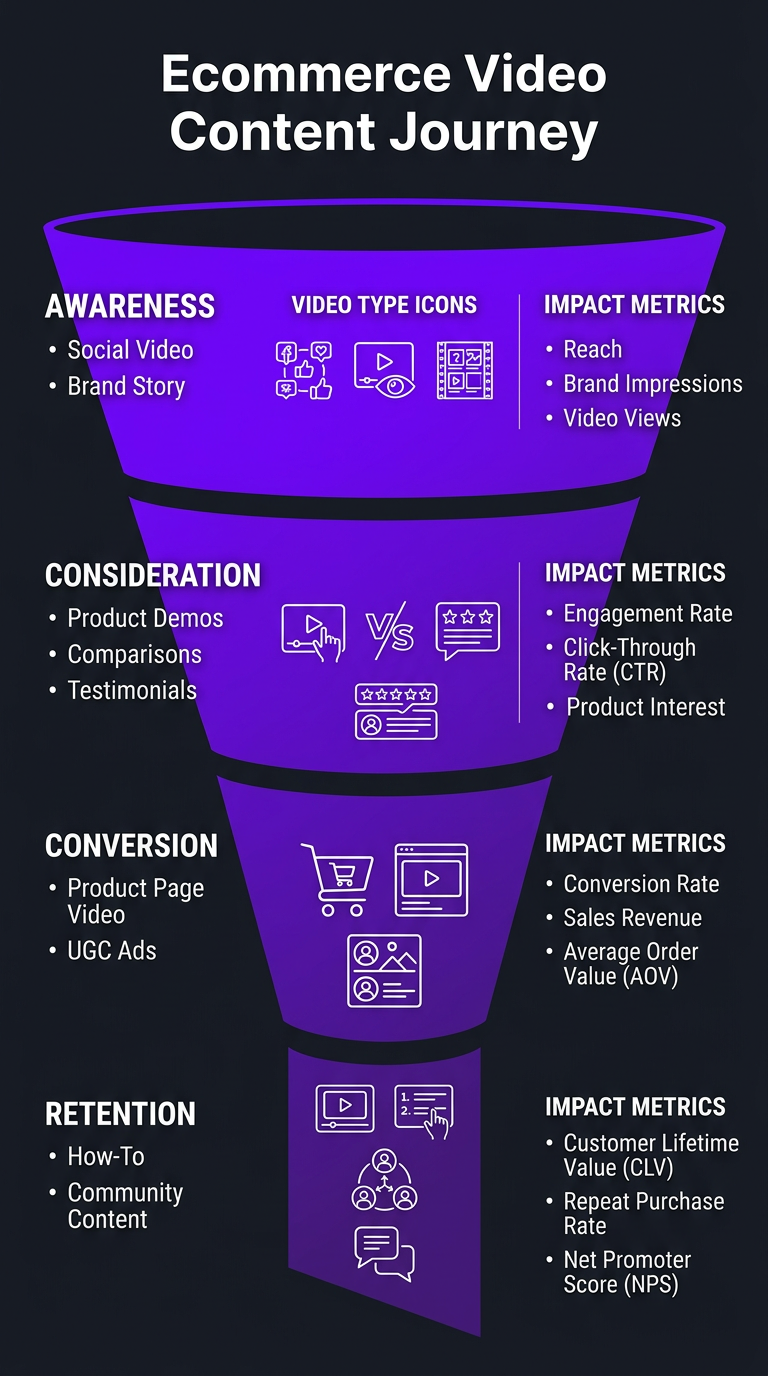
Not all ecommerce video is created equal. Different stages of the customer journey require different video formats. Here’s the complete toolkit:
1. Product Demonstration Videos
The foundation of ecommerce video. Show your product in use, highlight key features, demonstrate size and scale. These live on product pages and directly impact conversion rates. Professional editing adds smooth transitions between features, text callouts for key specs, and pacing that maintains interest through the full demo.
2. Lifestyle/Brand Story Videos
These answer the question “why should I care about this branda” Lifestyle content shows your products in real-world contexts, connects emotionally with your target audience, and builds the aspirational brand identity that justifies premium pricing. Editing here focuses on mood — color grading, music sync, cinematic pacing.
3. Customer Testimonial Compilations
Nothing sells like social proof. But raw testimonial footage is almost always too long, poorly lit, and lacking structure. Professional editing transforms 15 minutes of rambling customer interviews into punchy 60-90 second highlights that hit the key trust triggers: specific results, emotional reactions, and genuine enthusiasm.
4. UGC-Style Ad Creative
User-generated content style ads dominate paid social. They look authentic, feel native to the platform, and outperform polished ads for cold audiences. But “UGC-style” doesn’t mean “unedited.” The best UGC ads are carefully edited to feel raw while actually being strategically paced, properly captioned, and optimized for hook-retain-convert structure.
5. Unboxing and Review Content
The unboxing experience translates powerfully to video. Professional editing adds anticipation through pacing, highlights packaging details, and emphasizes first impressions. This content type is gold for both organic social and retargeting campaigns.
6. Social Media Short-Form Content
Instagram Reels, TikTok, YouTube Shorts — each platform has specific requirements and audience expectations. Ecommerce brands need 5-15+ short-form clips per week to maintain visibility. This volume is only sustainable with professional editing systems that can batch-produce platform-optimized content efficiently.
7. How-To and Tutorial Videos
Post-purchase content that reduces returns and increases customer lifetime value. Show customers how to use, care for, and get the most from your products. These also serve as top-of-funnel content — someone searching “how to style [product type]” discovers your brand through helpful content.
8. Comparison and “Best Of” Videos
Capture customers in the research phase. “Our product vs. competitor” or “5 ways to use [product]” videos intercept high-intent searches and position your brand as the obvious choice. Editing here requires clean split-screen comparisons, data visualization, and objective-feeling presentation.
| Video Type | Primary Platform | Funnel Stage | Volume Needed | Editing Complexity |
|---|---|---|---|---|
| Product demos | Product pages, YouTube | Conversion | 1 per product | Medium-High |
| Lifestyle/brand | Website, social, ads | Awareness | 2-4/month | High |
| Testimonials | Product pages, ads | Consideration | 2-3/month | Medium |
| UGC-style ads | Meta, TikTok, YouTube | Awareness/Conversion | 5-10/month | Medium |
| Unboxing | Social, YouTube | Consideration | 2-4/month | Low-Medium |
| Short-form social | Reels, TikTok, Shorts | Awareness | 10-20+/month | Low-Medium |
| How-to/tutorial | YouTube, website | Retention | 2-4/month | Medium |
| Comparison | YouTube, website | Consideration | 1-2/month | Medium-High |
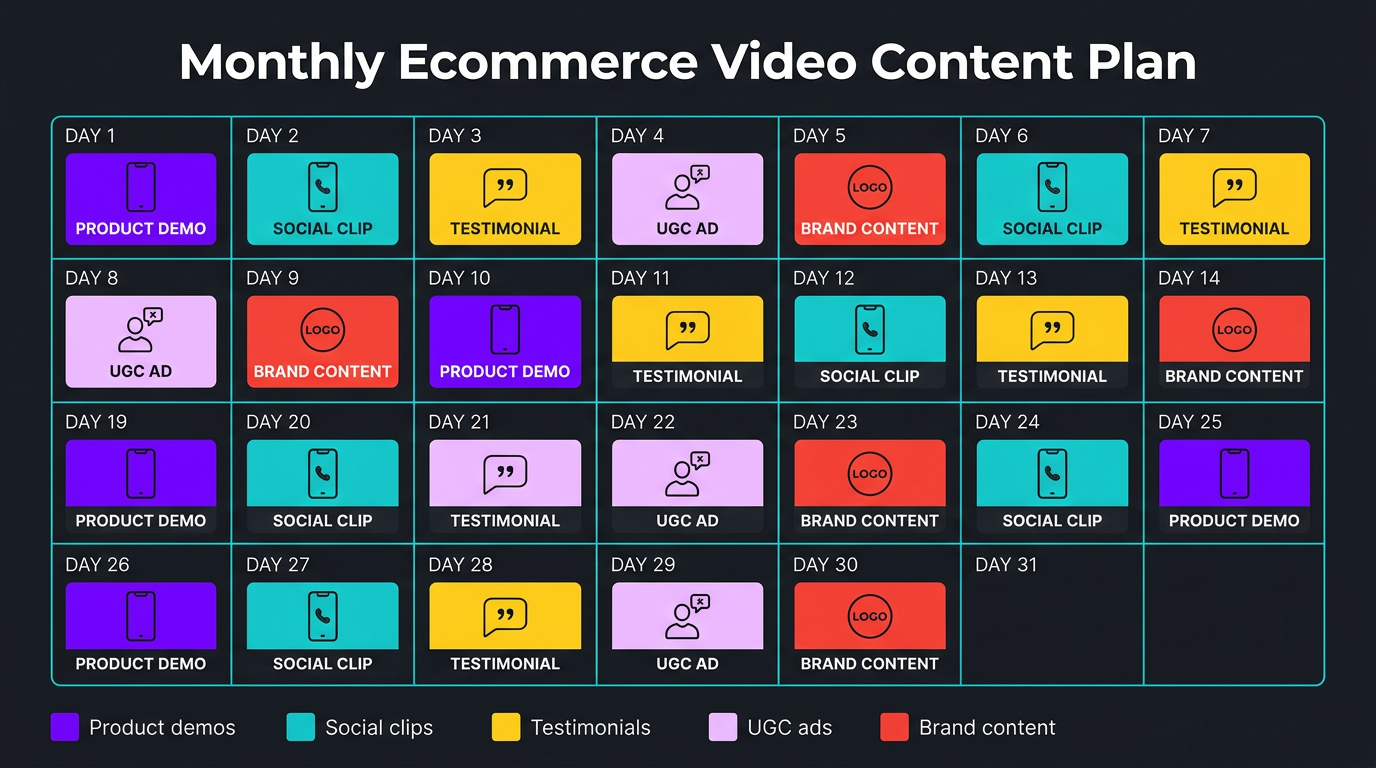
Add it up: a properly equipped ecommerce brand needs 25-45+ pieces of video content per month. That’s not manageable with an in-house generalist or occasional freelancer. It requires a systematic approach to video editing — which is exactly what a dedicated editing team provides.
Video Editing for Product Pages That Actually Convert
Product page video is the highest-ROI video content an ecommerce brand can produce. Here’s what separates product videos that convert from product videos that just play in the background while customers scroll past.
The First 3 Seconds Rule
Auto-play video on product pages needs to hook immediately. Start with the product’s most visually compelling moment — not a logo animation, not a slow fade-in from black. Editors who understand ecommerce know that the first frame should show the product doing its thing. A skincare product being applied. A jacket in motion. A gadget solving a problem. First-frame impact is an editing decision.
Silent-First Design
Most product page videos auto-play without sound. Your editing must account for this: text overlays communicating key features, visual demonstrations that don’t require narration, and captions for any spoken content. Music and sound design are bonuses for viewers who tap to unmute — not requirements for understanding the product.
Feature-Benefit Structure
Don’t just show features — show benefits. A product video that says “waterproof zippers” is fine. A video that shows the jacket in rain while text reads “Your gear stays dry in any storm” is better. Professional editing structures each scene as a feature→benefit pair, creating a persuasive argument that builds through the video.
Optimal Length: 30-90 Seconds
Product page videos between 30 and 90 seconds have the highest completion rates and conversion impact. Under 30 seconds feels insufficient for purchase consideration. Over 90 seconds loses attention. Editing for this length means ruthless prioritization — every second must earn its place.
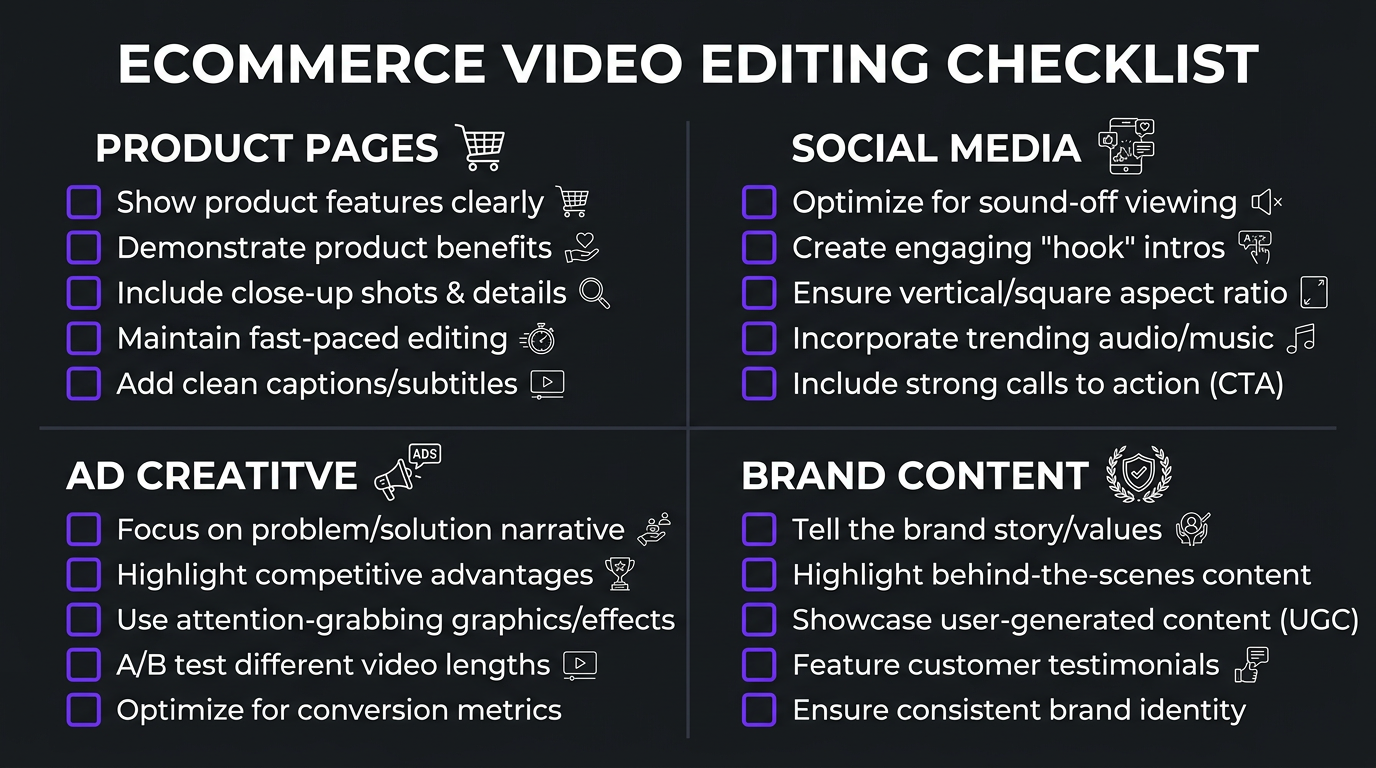
The Product Page Video Editing Checklist
- Opens with the product in action (first frame matters)
- Works fully without sound (text overlays, visual storytelling)
- Shows the product from multiple angles and contexts
- Includes size/scale reference (human hand, common objects)
- Highlights 3-5 key features with benefit-focused text
- Professional color grading that matches brand aesthetic
- Clean transitions (no cheesy effects)
- Ends with a subtle brand moment (not a hard CTA)
- 30-90 seconds total runtime
- Loopable (end connects visually to beginning)
Social Media Video Content for Ecommerce Brands
Social media is where ecommerce brands build demand. But the editing requirements for social video are completely different from product page content — and most brands get this wrong.
Platform-Specific Editing Matters
A video that works on Instagram Reels will underperform on TikTok if you don’t re-edit it. Here’s why:
- Instagram Reels: Polished aesthetic, smooth transitions, branded feel. Instagram users expect slightly more production value.
- TikTok: Raw, authentic, trend-aware. Over-produced content feels out of place. Text overlays and trending sounds are essential.
- YouTube Shorts: Middle ground — higher production value than TikTok, less polished than Instagram. Hook-heavy first 2 seconds.
- Facebook/Meta Ads: Hook in first 1-3 seconds, silent-first design, clear value proposition. Different dimensions and pacing than organic social.
This is why social media video editing requires platform expertise — not just general editing skills. The same product footage needs to be edited 3-4 different ways for different platforms.
The Hook-Value-CTA Framework
Every social video for ecommerce should follow this structure:
- Hook (0-3 seconds): Stop the scroll. Use movement, bold text, curiosity gap, or visual surprise.
- Value (3-25 seconds): Deliver on the hook’s promise. Show the product, demonstrate the benefit, tell the story.
- CTA (final 3-5 seconds): Direct viewers to the next step — website link, “link in bio,” or product tag.
Professional editing makes this structure feel seamless rather than formulaic. The hook grabs naturally, the value section maintains engagement through pacing and visual variety, and the CTA feels like a logical conclusion — not a hard sell.
Volume Is the Strategy
The ecommerce brands winning on social aren’t producing one perfect video per week. They’re producing 3-5 per day — testing hooks, formats, products, and angles. This volume is only possible with a dedicated editing team that can batch-produce content efficiently.
When we work with ecommerce brands at Increditors, we typically set up content systems: one product shoot generates 15-25 edited clips across platforms. That’s not assembly-line editing — each clip is optimized for its specific platform and audience. But the efficiency of having a dedicated team that understands your brand means we can produce at this volume without sacrificing quality.
Video Ads: Editing for Conversion, Not Just Views
Paid social advertising is where ecommerce video editing has the most direct, measurable impact on revenue. Every element of an ad — the hook, the pacing, the CTA, the thumbnail — is an editing decision that affects ROAS.
The Creative Testing Machine
Successful ecommerce advertisers don’t run one ad creative. They test 10-20+ variations simultaneously, measuring which hooks, value propositions, and CTAs drive the best cost-per-acquisition. This means your editing team needs to produce multiple variations of each ad quickly:
- Hook variations: Same ad, 3 different opening hooks — test which one captures attention best
- Length variations: 15-second, 30-second, and 60-second cuts of the same content
- Format variations: UGC-style, polished brand, testimonial-led — same product, different creative approaches
- CTA variations: “Shop now” vs. “Learn more” vs. “Limited time” — test end frames
Each variation is a separate editing job. A brand testing 5 products × 4 variations = 20 ad creatives per cycle. Without dedicated editing capacity, creative testing becomes a bottleneck that limits your ad performance.
Ad Creative Editing Best Practices
- First frame must hook: Facebook and Instagram measure thumb-stop rate — the percentage of users who stop scrolling. Your first frame determines this metric. Use motion, contrast, or text to force attention.
- Captions are mandatory: 85% of social media video is watched without sound. Burned-in captions aren’t optional — they’re structural.
- Pacing beats production value: A well-paced UGC ad outperforms a slow cinematic ad every time. Keep cuts tight, maintain visual variety every 2-3 seconds, and never let the viewer’s attention wander.
- Social proof in first 5 seconds: “100,000+ sold” or “4.8★ rating” as text overlay in the opening hook massively improves conversion rates.
- End with urgency: Limited time offers, scarcity messaging, or direct CTAs in the final frame. Editing should make the CTA feel natural, not bolted on.
Need a Video Editing Team That Understands Ecommercea
We build dedicated editing teams for ecommerce brands producing high-volume content for product pages, social media, and paid ads.
UGC vs Polished: The Ecommerce Content Spectrum
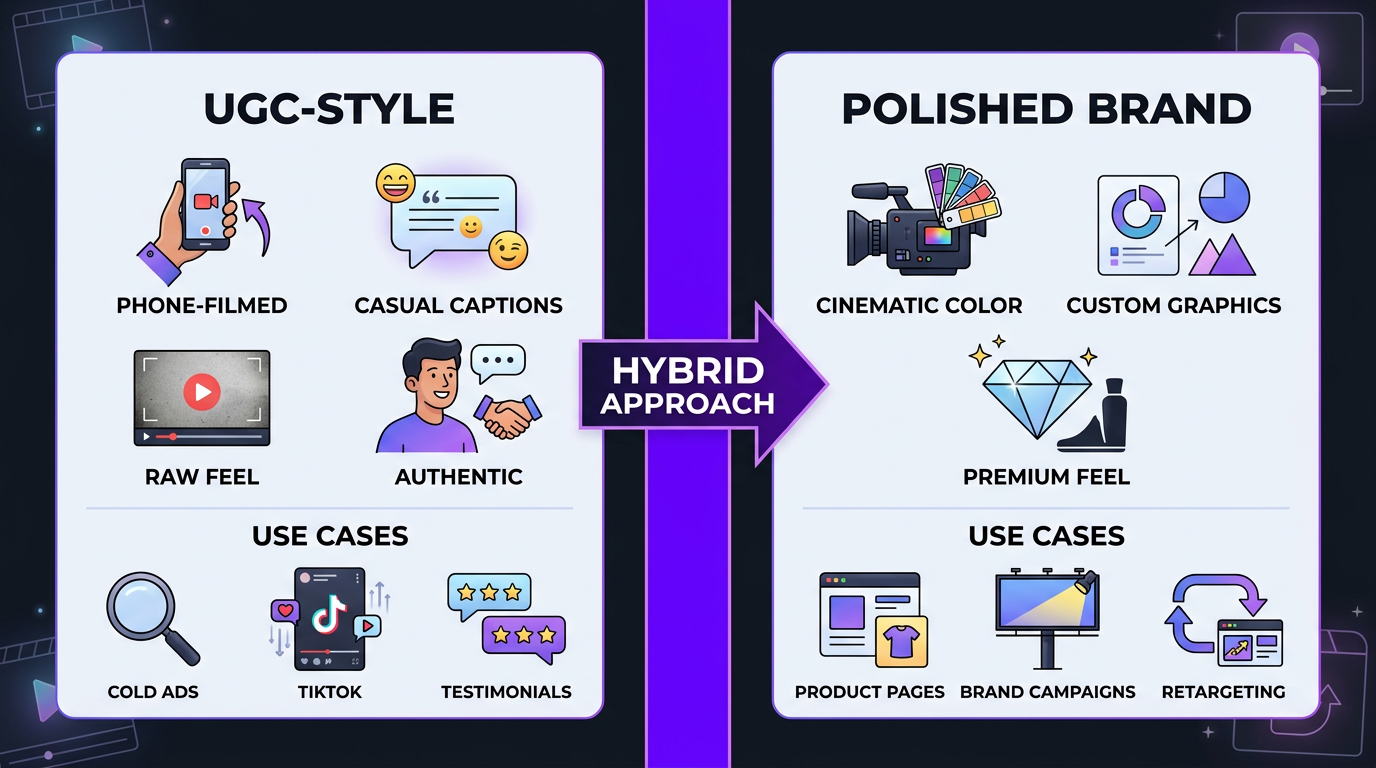
One of the biggest debates in ecommerce video is whether to invest in polished, high-production content or lean into raw, UGC-style authenticity. The answer is both — but knowing when to use each is critical.
When to Use UGC-Style Editing
- Cold audience social ads: People who’ve never heard of your brand respond better to authentic-feeling content that blends into their feed
- TikTok organic content: Over-produced content gets scrolled past on TikTok
- Influencer and creator partnerships: Edit their footage to feel native while adding your brand elements subtly
- Testimonial content: Real customers on real phones feels more trustworthy than studio testimonials
When to Use Polished Editing
- Product pages: Premium product page video signals quality and justifies pricing
- Brand campaigns: Seasonal launches, brand stories, and hero content need cinematic treatment
- Retargeting ads: Warm audiences who already know your brand respond well to polished content that reinforces premium positioning
- Website hero videos: Your homepage and landing page videos set the tone for the entire brand experience
- YouTube content: Long-form YouTube videos need professional post-production to compete
The “Edited to Feel Unedited” Approach
The most effective UGC-style ecommerce content is actually carefully edited. It looks raw and authentic, but every second is intentional. Professional editors doing UGC-style work will:
- Cut dead air and ums without making jumps feel jarring
- Add subtle text overlays that feel native to the platform
- Adjust color and exposure to look like “good phone footage” (not color-graded, but not muddy)
- Time music or sound effects to platform trends
- Structure the narrative arc (hook→story→proof→CTA) while maintaining casual feel
This is a specific editing skill that requires understanding both professional technique and platform culture. It’s harder than it looks — which is why brands that try to produce “authentic” content without editing expertise end up with content that’s genuinely bad rather than authentically raw.
Case Studies: Ecommerce Brands We’ve Worked With
Theory is useful. Real results are better. Here are two ecommerce brands that transformed their video content strategy with professional editing.
Blue Zones Health: Wellness Ecommerce at Scale
Blue Zones Health is a wellness and supplements ecommerce brand inspired by the Blue Zones longevity research. They came to us with a specific challenge: they had plenty of raw content — product footage, expert interviews, customer testimonials, educational health content — but their post-production couldn’t keep up with the volume they needed for both their ecommerce product pages and their social media presence.
The challenge:
- Needed 20+ video assets per month across product pages, social media, and ads
- Content ranged from product demos to expert health interviews to customer stories
- Brand positioning required a premium, trust-building aesthetic — health products can’t look cheap
- Multiple product lines meant maintaining consistency across dozens of SKU-specific videos
What we did:
- Assigned a dedicated editing team that learned the Blue Zones brand voice, color palette, and content standards
- Created templated but customizable graphics systems for product feature callouts, expert credentials, and health data visualizations
- Built a content multiplication workflow: each product shoot generated 8-12 edited pieces across platforms
- Implemented consistent color grading across all content — warm, natural tones that conveyed health and vitality
- Edited expert interviews into both long-form educational content (YouTube) and punchy social clips (Reels, TikTok)
Results:
- Product page conversion rates improved measurably after adding professionally edited video
- Social media engagement increased as consistent, high-quality content replaced sporadic posting
- Content production volume increased 3x without proportional cost increase — editing efficiency at scale
- Brand perception elevated: customer feedback consistently referenced the “professional” and “trustworthy” feel of their content
Ink Magnet: Print-on-Demand Ecommerce Growth
Ink Magnet operates in the print-on-demand space — a segment where product differentiation through video is critical because the base products (t-shirts, mugs, accessories) are commoditized. The brand’s value is in the designs and the story behind them.
The challenge:
- High SKU count meant needing product videos at scale — not one video, but dozens
- Needed to differentiate in a crowded market where every competitor sells similar base products
- Social media ad creative needed constant refreshing to avoid audience fatigue
- Budget constraints meant needing high volume at reasonable per-unit costs
What we did:
- Developed scalable editing templates that maintained brand consistency while allowing rapid per-product customization
- Focused on storytelling editing: each product video highlighted the design inspiration, not just the product specs
- Created a UGC-style ad creative pipeline: 10-15 ad variations per product launch for A/B testing
- Built a short-form content system generating 15-20 social clips per week from batched footage
Results:
- Ad creative testing velocity increased dramatically — more variations tested, faster winners identified
- Cost-per-acquisition on paid social decreased as creative quality and testing volume improved
- Social media presence grew through consistent, high-volume posting of engaging content
- Product launch timelines shortened — video assets ready within days of new design drops
The ROI of Professional Ecommerce Video Editing
Let’s quantify what professional video editing actually means for ecommerce bottom lines.
Product Page Conversion Impact
| Metric | Without Video | With Basic Video | With Professional Video |
|---|---|---|---|
| Product page conversion rate | 2.5% | 3.2% | 4.0-4.5% |
| Time on page | 45 seconds | 65 seconds | 90+ seconds |
| Return rate | 25% | 20% | 15-18% |
| Add-to-cart rate | 8% | 11% | 14-16% |
Revenue Impact Model
Let’s model a mid-size ecommerce brand doing $500K/month in revenue:
| Factor | Before Professional Video | After Professional Video |
|---|---|---|
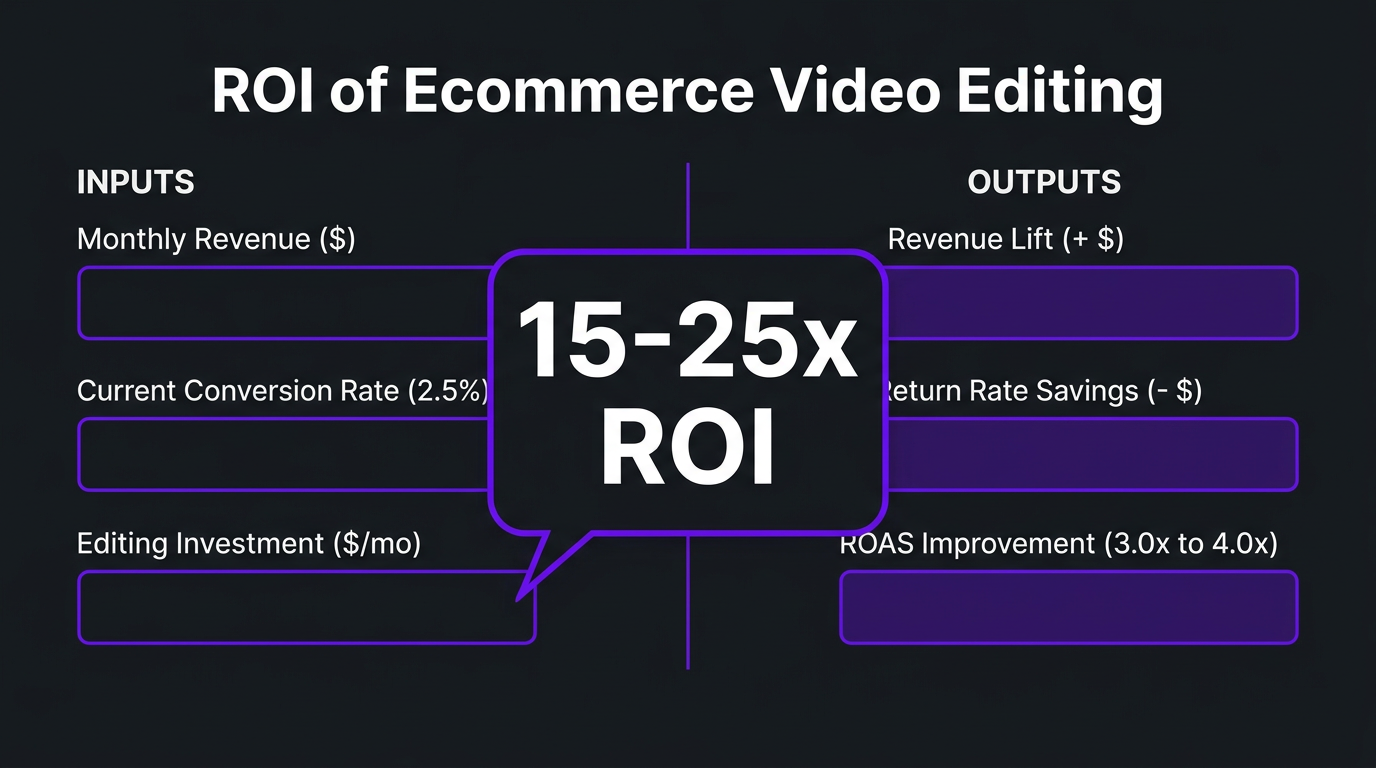
| Monthly revenue | $500,000 | $575,000-$625,000 |
| Conversion rate lift | — | +15-25% |
| Return rate reduction | — | $15,000-$25,000 saved/month |
| Ad ROAS improvement | 3.0x | 3.5-4.5x |
| Monthly editing investment | $0-$1,000 | $3,000-$5,000 |
| Net monthly gain | — | $70,000-$120,000+ |
The math is overwhelming. Even conservative estimates show 15-25x return on video editing investment for established ecommerce brands. The investment isn’t in “making videos” — it’s in converting more of the traffic you’re already paying for.
The Compound Effect
What tables don’t capture is the compound effect. Better video → better conversion → more revenue → more budget for traffic → more conversions. Meanwhile, your video assets continue working indefinitely — a product video created this month keeps converting visitors for months or years. Unlike ad spend, editing investment creates durable assets.
Building Your Ecommerce Video Editing Workflow
Knowing you need video is step one. Building a sustainable system for producing it at scale is the real challenge. Here’s the workflow we recommend for ecommerce brands:
Phase 1: Content Audit and Gap Analysis
Before producing anything new, audit what you have:
- Which products have video Which don’ta
- What raw footage exists that hasn’t been editeda
- Which existing videos need updating (old branding, poor quality)a
- What content types are you missing entirelya
Phase 2: Batch Production System
The most efficient approach: batch shoot → batch edit → scheduled distribution.
- Monthly shoot days: 1-2 dedicated shoot days producing footage for the entire month
- Batch editing: Your editing team processes all footage within a week, producing all content for the month
- Content calendar: Schedule distribution across platforms with platform-specific optimization
This batch approach works because your dedicated editing team can process footage efficiently when they receive it in bulk — consistent brand context, similar lighting/settings, related products.
Phase 3: Content Multiplication
Every piece of footage should generate multiple assets:
| Source Footage | Edited Assets | Platforms |
|---|---|---|
| Product demo (5 min raw) | 1 full demo + 1 product page clip + 3 social clips + 2 ad variations | Website, YouTube, IG, TikTok, Meta Ads |
| Customer testimonial (15 min raw) | 1 full testimonial + 3 highlight clips + 2 quote cards | Website, YouTube, social, ads |
| Lifestyle shoot (20 min raw) | 1 brand video + 5-8 social clips + 3 ad creatives | Website, all social, all ad platforms |
Phase 4: Ongoing Optimization
Use performance data to inform editing decisions:
- Which hooks have the highest thumb-stop rate Edit more like those.
- Which product videos have the best conversion impact Replicate that structure.
- Which ad creatives have the lowest CPA Create more variations of winners.
- Where are viewers dropping off Adjust pacing and content structure.
This feedback loop is where having a dedicated editing team — one that stays with you month after month — becomes invaluable. They learn what works for your specific audience, not just what works generically.
What Ecommerce Video Editing Costs
Here’s the pricing reality for ecommerce video editing in 2026:
| Content Type | Per-Unit Cost | Monthly Volume | Monthly Cost |
|---|---|---|---|
| Product page videos | $150-$400 | 4-8 | $600-$3,200 |
| Social media clips | $50-$150 | 15-30 | $750-$4,500 |
| Ad creative variations | $75-$200 | 10-20 | $750-$4,000 |
| Testimonial edits | $200-$500 | 2-4 | $400-$2,000 |
| Brand/lifestyle videos | $400-$1,000 | 2-4 | $800-$4,000 |
| Total (full program) | — | 33-66 assets | $3,300-$17,700 |
At Increditors, we bundle ecommerce editing into monthly retainers that are significantly more cost-effective than per-unit pricing. A dedicated team retainer producing 30-50 assets per month typically runs $4,000-$6,000/month — well below the per-unit total above because dedicated teams work more efficiently than ad-hoc production.
For comparison, hiring an in-house video editor costs $50,000-$80,000/year in salary alone, plus benefits, software ($500+/month), equipment, and management overhead. An agency retainer at $5,000/month ($60,000/year) gives you a team — editor, PM, colorist, motion designer — for comparable cost to a single generalist hire.
Ready to Scale Your Ecommerce Video Contenta
We build dedicated editing teams for ecommerce brands. Tell us your content needs and we’ll design a system that scales.
Frequently Asked Questions
Professional video editing improves ecommerce sales by increasing product page conversion rates (20-80% lift with video), building consumer trust through polished brand content, reducing return rates by setting accurate expectations, and enabling effective ad creative for paid campaigns. The editing determines whether raw footage becomes a sales tool or just background decoration on your site.
The essential types: product demonstrations, lifestyle/brand story videos, customer testimonials, UGC-style ad creative, unboxing content, social media short-form clips, how-to tutorials, and comparison videos. Most successful ecommerce brands produce 25-45+ video assets per month across these formats.
Per-unit costs range from $50-$150 per short clip to $400-$1,000 for polished brand videos. Monthly retainers for full ecommerce content programs run $3,000-$6,000+ with agencies like Increditors. The ROI typically delivers 15-25x return through conversion rate improvements, reduced returns, and better ad performance.
Both. UGC-style works best for cold social ads, TikTok, and authenticity-driven platforms. Polished content is essential for product pages, brand campaigns, retargeting, and YouTube. The most effective strategy layers both — raw content for top-of-funnel, professional content for conversion-focused placements.
Active ecommerce brands should target 25-45+ video assets per month including: 4-8 product demos, 15-30 social clips, 2-4 testimonials, and 10-20 ad creative variations. Brands running heavy paid social need even more volume for creative testing and avoiding ad fatigue.
The best product page formats: 30-90 second product demo videos showing the item in use, 360-degree product views, size/scale comparison clips, and customer testimonial snippets. Videos should auto-play silently with captions, open with the product in action (not a logo), and be professionally color graded to match brand aesthetic.
Build a Video Engine for Your Ecommerce Brand
See how our client work drives real ecommerce results. Let’s design a content system built for your products and platforms.
Conversion and ROI data in this article reflects industry benchmarks from multiple studies and our direct client experience. Individual results vary based on product category, traffic quality, and overall marketing strategy. For current Increditors ecommerce packages, visit our pricing page or schedule a call.